[STUDY GUIDE] • HIGH-YIELD PRACTICE & REVIEW EDITION
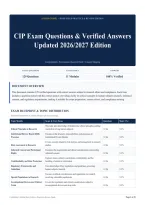
CIP Exam Questions & Verified Answers
Updated 2026/2027 Edition
Comprehensive Examination Question Bank • Concept Mapping
TOTAL QUESTIONS EXAM TOPICS ANSWERS
129 Questions 11 Modules 100% Verified
DOCUMENT OVERVIEW
This document contains 129 verified questions with correct answers related to research ethics and compliance. Each item
includes a question paired with the correct answer, providing clarity on critical concepts in human subjects research, informed
consent, and regulatory requirements, making it suitable for exam preparation, course review, and compliance training.
EXAM BLUEPRINT & TOPIC DISTRIBUTION
Systematic breakdown of subject domains and exam coverage.
Topic Module Scope & Core Focus Questions Share (%)
This topic tests knowledge of fundamental ethical principles guiding
Ethical Principles in Research research involving human subjects. 12 Qs 9.3%
Institutional Review Board (IRB) Focuses on the structure, responsibilities, and processes of
Processes Institutional Review Boards. 12 Qs 9.3%
Covers concepts related to risk analysis and management in research
Risk Assessment in Research studies. 12 Qs 9.3%
Informed Consent and Participant Examines the requirements and ethical considerations surrounding
Rights informed consent. 12 Qs 9.3%
Explores issues related to participant confidentiality and the
Confidentiality and Data Protection handling of sensitive information. 12 Qs 9.3%
Regulatory Frameworks and Tests knowledge of key regulations and guidelines governing
Guidelines human subjects research. 12 Qs 9.3%
Focuses on ethical considerations and regulations for research
Special Populations in Research involving vulnerable populations. 12 Qs 9.3%
Investigational Devices and Clinical Covers the regulations and ethical considerations related to
Trials investigational devices and drug trials. 12 Qs 9.3%
Confidential • Student Study Edition • Practice & Review Guide Page 1 of 35
,STUDENT STUDY & MASTERY EDITION PRACTICE & REVIEW GUIDE
Research Audits and Compliance Examines the processes and requirements for auditing research
Monitoring compliance. 11 Qs 8.5%
Tests knowledge of significant historical cases that shaped ethical
Historical Research Ethics Cases research practices. 11 Qs 8.5%
Statistical and Methodological Focuses on understanding statistical methods and their application
Concepts in research design. 11 Qs 8.5%
Total Exam Coverage 11 Integrated Topic Modules 129 Qs 100.0%
TOPIC 1: ETHICAL PRINCIPLES IN RESEARCH
12 Questions • 9.3% of Exam • This topic tests knowledge of fundamental ethical principles guiding research involving human subjects.
QUESTION 1
Minimal Risk
Answer: The probability of harm or discomfort...not greater...than those ordinarily encountered in daily life or during
the performance of routine physical or psychological examinations.
QUESTION 2
The Belmont Principles
Answer: Respect for persons, beneficence, and justice.
QUESTION 3
Criteria for waiver or alteration of consent
Answer: 45 CFR 46.116(d) An IRB may approve a waiver or alteration of consent requirements if:
*the research involves no more than minimal risk;
*the waiver or alteration will not adversely affect the rights and welfare of the subjects;
*the research could not practicably be carried out without the waiver or alteration; and
*whenever appropriate, the subjects will be provided with additional pertinent information after participation.
Confidential • Student Study Edition • Practice & Review Guide Page 2 of 35
,STUDENT STUDY & MASTERY EDITION PRACTICE & REVIEW GUIDE
QUESTION 4
Beneficence
Answer: The doing of good, obligates the researcher to secure the individual's well-being by maximizing benefits and
minimizing harms to the individual research subject. Requires that the researcher perform a risk/benefit analysis.
Requires that competent investigators design ethical research, protect human subjects from risk, and make continuing
assessments of the risk/benefit ratio.
QUESTION 5
Federalwide Assurance (FWA)
Answer: A type of contract established by OHRP that specifies when and how an institution will comply with DHHS
research regulations. Written documentation of an institution's commitment to comply with federal regulations governing
human subjects research--covers all federally supported or conducted research involving human subjects.
QUESTION 6
The 3 Statutory Responsibilities of OHRP
Answer: Administration of assurances, education, and compliance oversight.
QUESTION 7
Five Basic Categories of Harm as noted in The Belmont Report
Answer: Social harm, economic harm, legal harm, psychological harm, and physical harm.
QUESTION 8
Peer contagion
Answer: May be caused by grouping high-risk adolescents for behavioral interventions in which negative behaviors are
enforced. This is of particular risk in school-based research.
Confidential • Student Study Edition • Practice & Review Guide Page 3 of 35
, STUDENT STUDY & MASTERY EDITION PRACTICE & REVIEW GUIDE
QUESTION 9
Anonymous Samples
Answer: Samples collected without direct identifiers and involve the lowest level of risk.
QUESTION 10
Milgram Study
Answer: 1963 A series of social psychology experiments conducted by Yale University psychologist Stanley Milgram.
They measured the willingness of study participants, men from a diverse range of occupations with varying levels of
education, to obey an authority figure who instructed them to perform acts conflicting with their personal conscience
(administering electric shocks to a subject who was allied with the research and who pretended to feel pain) ; the
experiment found, unexpectedly, that a very high proportion of people were prepared to obey, albeit unwillingly, even if
apparently causing serious injury and distress. Ethical problems:
deception, unanticipated psychological harms.
QUESTION 11
Device Classifications
Answer: Class I Devices
Considered to be at the lowest level of risk of all medical devices and are therefore required to comply with the lowest level
of regulatory control. Examples of Class I devices include: elastic bandages, dental floss and enemas.
Class II Devices
Simple devices, though they are considered to be at slightly higher risk than Class I devices and therefore require more
stringent regulatory controls to provide assurance of their effectiveness and safety. Examples of Class II devices include:
condoms, pregnancy testing kits and powered wheelchairs.
Class III Devices
Class III devices are generally considered to be the most complex devices. They are also considered to be at the highest
risk and therefore require more stringent regulatory controls to provide assurance of their effectiveness and safety.
Examples of Class III devices include:
implantable pacemakers and breast implants.
Confidential • Student Study Edition • Practice & Review Guide Page 4 of 35
CIP Exam Questions & Verified Answers
Updated 2026/2027 Edition
Comprehensive Examination Question Bank • Concept Mapping
TOTAL QUESTIONS EXAM TOPICS ANSWERS
129 Questions 11 Modules 100% Verified
DOCUMENT OVERVIEW
This document contains 129 verified questions with correct answers related to research ethics and compliance. Each item
includes a question paired with the correct answer, providing clarity on critical concepts in human subjects research, informed
consent, and regulatory requirements, making it suitable for exam preparation, course review, and compliance training.
EXAM BLUEPRINT & TOPIC DISTRIBUTION
Systematic breakdown of subject domains and exam coverage.
Topic Module Scope & Core Focus Questions Share (%)
This topic tests knowledge of fundamental ethical principles guiding
Ethical Principles in Research research involving human subjects. 12 Qs 9.3%
Institutional Review Board (IRB) Focuses on the structure, responsibilities, and processes of
Processes Institutional Review Boards. 12 Qs 9.3%
Covers concepts related to risk analysis and management in research
Risk Assessment in Research studies. 12 Qs 9.3%
Informed Consent and Participant Examines the requirements and ethical considerations surrounding
Rights informed consent. 12 Qs 9.3%
Explores issues related to participant confidentiality and the
Confidentiality and Data Protection handling of sensitive information. 12 Qs 9.3%
Regulatory Frameworks and Tests knowledge of key regulations and guidelines governing
Guidelines human subjects research. 12 Qs 9.3%
Focuses on ethical considerations and regulations for research
Special Populations in Research involving vulnerable populations. 12 Qs 9.3%
Investigational Devices and Clinical Covers the regulations and ethical considerations related to
Trials investigational devices and drug trials. 12 Qs 9.3%
Confidential • Student Study Edition • Practice & Review Guide Page 1 of 35
,STUDENT STUDY & MASTERY EDITION PRACTICE & REVIEW GUIDE
Research Audits and Compliance Examines the processes and requirements for auditing research
Monitoring compliance. 11 Qs 8.5%
Tests knowledge of significant historical cases that shaped ethical
Historical Research Ethics Cases research practices. 11 Qs 8.5%
Statistical and Methodological Focuses on understanding statistical methods and their application
Concepts in research design. 11 Qs 8.5%
Total Exam Coverage 11 Integrated Topic Modules 129 Qs 100.0%
TOPIC 1: ETHICAL PRINCIPLES IN RESEARCH
12 Questions • 9.3% of Exam • This topic tests knowledge of fundamental ethical principles guiding research involving human subjects.
QUESTION 1
Minimal Risk
Answer: The probability of harm or discomfort...not greater...than those ordinarily encountered in daily life or during
the performance of routine physical or psychological examinations.
QUESTION 2
The Belmont Principles
Answer: Respect for persons, beneficence, and justice.
QUESTION 3
Criteria for waiver or alteration of consent
Answer: 45 CFR 46.116(d) An IRB may approve a waiver or alteration of consent requirements if:
*the research involves no more than minimal risk;
*the waiver or alteration will not adversely affect the rights and welfare of the subjects;
*the research could not practicably be carried out without the waiver or alteration; and
*whenever appropriate, the subjects will be provided with additional pertinent information after participation.
Confidential • Student Study Edition • Practice & Review Guide Page 2 of 35
,STUDENT STUDY & MASTERY EDITION PRACTICE & REVIEW GUIDE
QUESTION 4
Beneficence
Answer: The doing of good, obligates the researcher to secure the individual's well-being by maximizing benefits and
minimizing harms to the individual research subject. Requires that the researcher perform a risk/benefit analysis.
Requires that competent investigators design ethical research, protect human subjects from risk, and make continuing
assessments of the risk/benefit ratio.
QUESTION 5
Federalwide Assurance (FWA)
Answer: A type of contract established by OHRP that specifies when and how an institution will comply with DHHS
research regulations. Written documentation of an institution's commitment to comply with federal regulations governing
human subjects research--covers all federally supported or conducted research involving human subjects.
QUESTION 6
The 3 Statutory Responsibilities of OHRP
Answer: Administration of assurances, education, and compliance oversight.
QUESTION 7
Five Basic Categories of Harm as noted in The Belmont Report
Answer: Social harm, economic harm, legal harm, psychological harm, and physical harm.
QUESTION 8
Peer contagion
Answer: May be caused by grouping high-risk adolescents for behavioral interventions in which negative behaviors are
enforced. This is of particular risk in school-based research.
Confidential • Student Study Edition • Practice & Review Guide Page 3 of 35
, STUDENT STUDY & MASTERY EDITION PRACTICE & REVIEW GUIDE
QUESTION 9
Anonymous Samples
Answer: Samples collected without direct identifiers and involve the lowest level of risk.
QUESTION 10
Milgram Study
Answer: 1963 A series of social psychology experiments conducted by Yale University psychologist Stanley Milgram.
They measured the willingness of study participants, men from a diverse range of occupations with varying levels of
education, to obey an authority figure who instructed them to perform acts conflicting with their personal conscience
(administering electric shocks to a subject who was allied with the research and who pretended to feel pain) ; the
experiment found, unexpectedly, that a very high proportion of people were prepared to obey, albeit unwillingly, even if
apparently causing serious injury and distress. Ethical problems:
deception, unanticipated psychological harms.
QUESTION 11
Device Classifications
Answer: Class I Devices
Considered to be at the lowest level of risk of all medical devices and are therefore required to comply with the lowest level
of regulatory control. Examples of Class I devices include: elastic bandages, dental floss and enemas.
Class II Devices
Simple devices, though they are considered to be at slightly higher risk than Class I devices and therefore require more
stringent regulatory controls to provide assurance of their effectiveness and safety. Examples of Class II devices include:
condoms, pregnancy testing kits and powered wheelchairs.
Class III Devices
Class III devices are generally considered to be the most complex devices. They are also considered to be at the highest
risk and therefore require more stringent regulatory controls to provide assurance of their effectiveness and safety.
Examples of Class III devices include:
implantable pacemakers and breast implants.
Confidential • Student Study Edition • Practice & Review Guide Page 4 of 35