
[STUDY GUIDE] • HIGH-YIELD PRACTICE & REVIEW EDITION
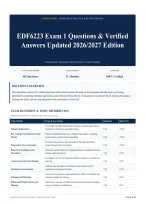
EDF6223 Exam 1 Questions & Verified
Answers Updated 2026/2027 Edition
Comprehensive Examination Question Bank • Concept Mapping
TOTAL QUESTIONS EXAM TOPICS ANSWERS
80 Questions 11 Modules 100% Verified
DOCUMENT OVERVIEW
This document contains 80 verified questions with correct answers focused on the principles of behavioral psychology,
particularly examining stimulus equivalence and relational frame theory. Each question is paired with an answer, providing a
resource for study, review, and preparation for certification in the field.
EXAM BLUEPRINT & TOPIC DISTRIBUTION
Systematic breakdown of subject domains and exam coverage.
Topic Module Scope & Core Focus Questions Share (%)
Covers the concepts and principles related to stimulus equivalence,
Stimulus Equivalence including its definitions and implications. 8 Qs 10.0%
Key Concepts in Relational Frame Explores foundational ideas in relational frame theory, including
Theory naming theory and relational responding. 8 Qs 10.0%
Examines the processes and outcomes of forming equivalence
Equivalence Class Formation classes through behavior analysis. 8 Qs 10.0%
Behavioral Techniques and Discusses methodologies for shaping behaviors, including imitation
Procedures training and task analysis. 7 Qs 8.8%
Investigates the role of contextual stimuli in behavioral control and
Contextual Control and Stimuli learning. 7 Qs 8.8%
Addresses the principles of functional contextualism and its
Functional Contextualism application to language learning. 7 Qs 8.8%
Focuses on the processes and guidelines for effective modeling and
Imitation and Modeling imitation in behavior training. 7 Qs 8.8%
Differential Reinforcement and Explores the concepts of differential reinforcement and the shaping
Shaping process in behavior modification. 7 Qs 8.8%
Confidential • Student Study Edition • Practice & Review Guide Page 1 of 20
,STUDENT STUDY & MASTERY EDITION PRACTICE & REVIEW GUIDE
Covers the construction and analysis of behavior chains, including
Behavior Chains task analysis techniques. 7 Qs 8.8%
Equivalence and Nonequivalence Examines the distinctions between equivalence and nonequivalence
Relations relations in behavior analysis. 7 Qs 8.8%
Practical Applications of Behavioral Discusses real-world applications stemming from behavioral
Principles theories and approaches. 7 Qs 8.8%
Total Exam Coverage 11 Integrated Topic Modules 80 Qs 100.0%
TOPIC 1: STIMULUS EQUIVALENCE
8 Questions • 10.0% of Exam • Covers the concepts and principles related to stimulus equivalence, including its definitions and implications.
QUESTION 1
Stimulus equivalence
Answer: Equivalence describes the emergence of accurate responding to untrained and nonreinforced stimulusstimulus
relations following the reinforcement of responses to some stimulus-stimulus relations.
QUESTION 2
Equivalence class
Answer: Is the collection of stimuli that evoke the same bx. Once an equivalence class has been established, it remains
functional long after training Crying when you see a dog, but also crying when you see a cat.
QUESTION 3
Why does stimulus equivalence matter
Answer: New forms of stimulus control were created that had never been targeted directly by the teaching procedures
Potential for utilizing an equivalence approach to promote teaching efficiency The equivalence outcome captured the
essence of what is meant when we speak of "symbol" With equivalence procedures, novel behavior is illustrated reliably
and in predictable patterns by the emergent performances on probe trials.
Confidential • Student Study Edition • Practice & Review Guide Page 2 of 20
, STUDENT STUDY & MASTERY EDITION PRACTICE & REVIEW GUIDE
QUESTION 4
Key Outcomes Obtained with Equivalence Approaches
Answer: Class Formation
• Delayed Emergence
• Class Expansion
• Class Merger
• Transfer of
Function
• Contextual Control.
QUESTION 5
Class merger
Answer: A combining of independent equivalence class such that a larger class is established. This is typically
accomplished by teaching a new relation between one member of each of the classes to be combined.
_________ is verified by emergent relations between the other stimuli and from the formerly independent classes.
QUESTION 6
Training structure
Answer: The dimensions of the teaching arrangement One stimulus set (nodal stimulus or node) must beheld in common
across a minimum of two conditional discriminations to provide a basis for all equivalence properties.
QUESTION 7
Response differentiation
Answer: When differential reinforcement is applied consistently within a response class, its triple effect results in a new
response class composed primarily of responses sharing the characteristics of the previously reinforced subclass.
Confidential • Student Study Edition • Practice & Review Guide Page 3 of 20
EDF6223 Exam 1 Questions & Verified
Answers Updated 2026/2027 Edition
Comprehensive Examination Question Bank • Concept Mapping
TOTAL QUESTIONS EXAM TOPICS ANSWERS
80 Questions 11 Modules 100% Verified
DOCUMENT OVERVIEW
This document contains 80 verified questions with correct answers focused on the principles of behavioral psychology,
particularly examining stimulus equivalence and relational frame theory. Each question is paired with an answer, providing a
resource for study, review, and preparation for certification in the field.
EXAM BLUEPRINT & TOPIC DISTRIBUTION
Systematic breakdown of subject domains and exam coverage.
Topic Module Scope & Core Focus Questions Share (%)
Covers the concepts and principles related to stimulus equivalence,
Stimulus Equivalence including its definitions and implications. 8 Qs 10.0%
Key Concepts in Relational Frame Explores foundational ideas in relational frame theory, including
Theory naming theory and relational responding. 8 Qs 10.0%
Examines the processes and outcomes of forming equivalence
Equivalence Class Formation classes through behavior analysis. 8 Qs 10.0%
Behavioral Techniques and Discusses methodologies for shaping behaviors, including imitation
Procedures training and task analysis. 7 Qs 8.8%
Investigates the role of contextual stimuli in behavioral control and
Contextual Control and Stimuli learning. 7 Qs 8.8%
Addresses the principles of functional contextualism and its
Functional Contextualism application to language learning. 7 Qs 8.8%
Focuses on the processes and guidelines for effective modeling and
Imitation and Modeling imitation in behavior training. 7 Qs 8.8%
Differential Reinforcement and Explores the concepts of differential reinforcement and the shaping
Shaping process in behavior modification. 7 Qs 8.8%
Confidential • Student Study Edition • Practice & Review Guide Page 1 of 20
,STUDENT STUDY & MASTERY EDITION PRACTICE & REVIEW GUIDE
Covers the construction and analysis of behavior chains, including
Behavior Chains task analysis techniques. 7 Qs 8.8%
Equivalence and Nonequivalence Examines the distinctions between equivalence and nonequivalence
Relations relations in behavior analysis. 7 Qs 8.8%
Practical Applications of Behavioral Discusses real-world applications stemming from behavioral
Principles theories and approaches. 7 Qs 8.8%
Total Exam Coverage 11 Integrated Topic Modules 80 Qs 100.0%
TOPIC 1: STIMULUS EQUIVALENCE
8 Questions • 10.0% of Exam • Covers the concepts and principles related to stimulus equivalence, including its definitions and implications.
QUESTION 1
Stimulus equivalence
Answer: Equivalence describes the emergence of accurate responding to untrained and nonreinforced stimulusstimulus
relations following the reinforcement of responses to some stimulus-stimulus relations.
QUESTION 2
Equivalence class
Answer: Is the collection of stimuli that evoke the same bx. Once an equivalence class has been established, it remains
functional long after training Crying when you see a dog, but also crying when you see a cat.
QUESTION 3
Why does stimulus equivalence matter
Answer: New forms of stimulus control were created that had never been targeted directly by the teaching procedures
Potential for utilizing an equivalence approach to promote teaching efficiency The equivalence outcome captured the
essence of what is meant when we speak of "symbol" With equivalence procedures, novel behavior is illustrated reliably
and in predictable patterns by the emergent performances on probe trials.
Confidential • Student Study Edition • Practice & Review Guide Page 2 of 20
, STUDENT STUDY & MASTERY EDITION PRACTICE & REVIEW GUIDE
QUESTION 4
Key Outcomes Obtained with Equivalence Approaches
Answer: Class Formation
• Delayed Emergence
• Class Expansion
• Class Merger
• Transfer of
Function
• Contextual Control.
QUESTION 5
Class merger
Answer: A combining of independent equivalence class such that a larger class is established. This is typically
accomplished by teaching a new relation between one member of each of the classes to be combined.
_________ is verified by emergent relations between the other stimuli and from the formerly independent classes.
QUESTION 6
Training structure
Answer: The dimensions of the teaching arrangement One stimulus set (nodal stimulus or node) must beheld in common
across a minimum of two conditional discriminations to provide a basis for all equivalence properties.
QUESTION 7
Response differentiation
Answer: When differential reinforcement is applied consistently within a response class, its triple effect results in a new
response class composed primarily of responses sharing the characteristics of the previously reinforced subclass.
Confidential • Student Study Edition • Practice & Review Guide Page 3 of 20


