
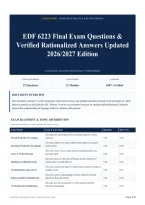
[STUDY GUIDE] • HIGH-YIELD PRACTICE & REVIEW EDITION
EDF 6223 Final Exam Questions &
Verified Rationalized Answers Updated
2026/2027 Edition
Comprehensive Examination Question Bank • Concept Mapping
TOTAL QUESTIONS EXAM TOPICS ANSWERS
57 Questions 12 Modules 100% Verified
DOCUMENT OVERVIEW
This document contains 57 verified questions with correct answers and detailed rationales focused on the principles of verbal
behavior analysis as articulated by B.F. Skinner. It serves as an essential resource for students and professionals looking to
deepen their understanding of language behavior, function, and operants.
EXAM BLUEPRINT & TOPIC DISTRIBUTION
Systematic breakdown of subject domains and exam coverage.
Topic Module Scope & Core Focus Questions Share (%)
This topic tests knowledge about the structural aspects of verbal
Formal Properties of Language responses. 5 Qs 8.8%
This topic explores the reasons behind verbal responses and their
Functional Properties of Language reinforcement. 5 Qs 8.8%
This topic covers various verbal operants including mands, tacts,
Types of Verbal Operants and intraverbals. 5 Qs 8.8%
This topic focuses on the roles of listeners and the mediation of
Mediation and Reinforcement reinforcement in verbal behavior. 5 Qs 8.8%
This topic examines the types of verbal relations and the concepts of
Verbal Relations and Control multiple control. 5 Qs 8.8%
This topic assesses understanding of echoic responses and their
Echoic and Intraverbal Behavior differences from intraverbals. 5 Qs 8.8%
This topic tests the classification of verbal operants and their
Verbal Operant Classifications functional relationships. 5 Qs 8.8%
Confidential • Student Study Edition • Practice & Review Guide Page 1 of 20
,STUDENT STUDY & MASTERY EDITION PRACTICE & REVIEW GUIDE
Acquisition and Emergence of This topic covers the processes through which verbal behavior is
Verbal Behavior acquired and emerges. 5 Qs 8.8%
Skinner's Analysis of Verbal This topic discusses Skinner's theories and their implications for
Behavior understanding verbal behavior. 5 Qs 8.8%
This topic examines the differences between specific and
Reinforcement Types generalized reinforcement in verbal behavior. 4 Qs 7.0%
Public Accompaniment and This topic focuses on the definitions and examples of public
Autoclitics accompaniment and autoclitic behaviors. 4 Qs 7.0%
General Knowledge and True/False This topic contains true/false and general knowledge questions
Questions regarding verbal behavior. 4 Qs 7.0%
Total Exam Coverage 12 Integrated Topic Modules 57 Qs 100.0%
TOPIC 1: FORMAL PROPERTIES OF LANGUAGE
5 Questions • 8.8% of Exam • This topic tests knowledge about the structural aspects of verbal responses.
QUESTION 1
The formal properties of language involve the ________ and ___________ of a verbal response,
whereas the functional properties of language involve the functions of the response.
Answer: Topography, structure.
Rationale: The formal properties of language refer to the underlying characteristics of a verbal response, such as its sound, rhythm, and
grammatical structure, which are concerned with the topography and structure of the response. In contrast, the functional properties of
language involve the purpose or function of the response, such as its ability to convey meaning, express emotions, or achieve a specific
goal, which is unrelated to the topography and structure.
QUESTION 2
Textual and taking dictation are both types of ____________ relations.
Answer: Codic.
Rationale: Codic relations refer to the relationship between a written text and its original or authoritative source, which is often a
spoken text or a dictation. The word "codic" is derived from the Latin "codex," meaning "book," and in this context, it describes the
connection between an original spoken text and its written transcription.
Confidential • Student Study Edition • Practice & Review Guide Page 2 of 20
, STUDENT STUDY & MASTERY EDITION PRACTICE & REVIEW GUIDE
QUESTION 3
TRUE OR FALSE. Formal properties of language involve topograpghy of the verbal reponse
whereas the functional properties involve the causes of the response
Answer: True.
Rationale: Formal properties of language refer to the structural and organizational aspects of language, such as phonology, syntax, and
semantics, which are inherent to the verbal response itself. Therefore, it is logical to conclude that the topography of the verbal
response, or the physical properties of the language, is an aspect of formal properties, making "TRUE" the correct answer.
QUESTION 4
How are verbal operants classified?
Answer: Verbal operants are classified into six different types of elementary verbal operants. They are: mand, tact,
echoic, intraverbal, textual, transcription.
Rationale: The classification of verbal operants into six types - mand, tact, echoic, intraverbal, textual, and transcription - is based on
the functional relationship between the verbal behavior and the environment, with each type representing a distinct way in which the
verbal behavior is related to the environment. This classification system is correct because it provides a clear and consistent framework
for understanding and analyzing the complex and varied ways in which verbal behavior can be learned and maintained.
QUESTION 5
The formal properties of language involve
Answer: Topography of the verbal response.
Rationale: The formal properties of language involve the topography of the verbal response because it refers to the study of the
surfacelevel features of language, such as syntax, phonology, and morphology, which shape the way language is structured and used in
verbal responses. By examining the topography of verbal responses, one can analyze the formal properties of language that govern how
language is used in communication, revealing patterns and structures that underlie human language.
TOPIC 2: FUNCTIONAL PROPERTIES OF LANGUAGE
5 Questions • 8.8% of Exam • This topic explores the reasons behind verbal responses and their reinforcement.
Confidential • Student Study Edition • Practice & Review Guide Page 3 of 20
EDF 6223 Final Exam Questions &
Verified Rationalized Answers Updated
2026/2027 Edition
Comprehensive Examination Question Bank • Concept Mapping
TOTAL QUESTIONS EXAM TOPICS ANSWERS
57 Questions 12 Modules 100% Verified
DOCUMENT OVERVIEW
This document contains 57 verified questions with correct answers and detailed rationales focused on the principles of verbal
behavior analysis as articulated by B.F. Skinner. It serves as an essential resource for students and professionals looking to
deepen their understanding of language behavior, function, and operants.
EXAM BLUEPRINT & TOPIC DISTRIBUTION
Systematic breakdown of subject domains and exam coverage.
Topic Module Scope & Core Focus Questions Share (%)
This topic tests knowledge about the structural aspects of verbal
Formal Properties of Language responses. 5 Qs 8.8%
This topic explores the reasons behind verbal responses and their
Functional Properties of Language reinforcement. 5 Qs 8.8%
This topic covers various verbal operants including mands, tacts,
Types of Verbal Operants and intraverbals. 5 Qs 8.8%
This topic focuses on the roles of listeners and the mediation of
Mediation and Reinforcement reinforcement in verbal behavior. 5 Qs 8.8%
This topic examines the types of verbal relations and the concepts of
Verbal Relations and Control multiple control. 5 Qs 8.8%
This topic assesses understanding of echoic responses and their
Echoic and Intraverbal Behavior differences from intraverbals. 5 Qs 8.8%
This topic tests the classification of verbal operants and their
Verbal Operant Classifications functional relationships. 5 Qs 8.8%
Confidential • Student Study Edition • Practice & Review Guide Page 1 of 20
,STUDENT STUDY & MASTERY EDITION PRACTICE & REVIEW GUIDE
Acquisition and Emergence of This topic covers the processes through which verbal behavior is
Verbal Behavior acquired and emerges. 5 Qs 8.8%
Skinner's Analysis of Verbal This topic discusses Skinner's theories and their implications for
Behavior understanding verbal behavior. 5 Qs 8.8%
This topic examines the differences between specific and
Reinforcement Types generalized reinforcement in verbal behavior. 4 Qs 7.0%
Public Accompaniment and This topic focuses on the definitions and examples of public
Autoclitics accompaniment and autoclitic behaviors. 4 Qs 7.0%
General Knowledge and True/False This topic contains true/false and general knowledge questions
Questions regarding verbal behavior. 4 Qs 7.0%
Total Exam Coverage 12 Integrated Topic Modules 57 Qs 100.0%
TOPIC 1: FORMAL PROPERTIES OF LANGUAGE
5 Questions • 8.8% of Exam • This topic tests knowledge about the structural aspects of verbal responses.
QUESTION 1
The formal properties of language involve the ________ and ___________ of a verbal response,
whereas the functional properties of language involve the functions of the response.
Answer: Topography, structure.
Rationale: The formal properties of language refer to the underlying characteristics of a verbal response, such as its sound, rhythm, and
grammatical structure, which are concerned with the topography and structure of the response. In contrast, the functional properties of
language involve the purpose or function of the response, such as its ability to convey meaning, express emotions, or achieve a specific
goal, which is unrelated to the topography and structure.
QUESTION 2
Textual and taking dictation are both types of ____________ relations.
Answer: Codic.
Rationale: Codic relations refer to the relationship between a written text and its original or authoritative source, which is often a
spoken text or a dictation. The word "codic" is derived from the Latin "codex," meaning "book," and in this context, it describes the
connection between an original spoken text and its written transcription.
Confidential • Student Study Edition • Practice & Review Guide Page 2 of 20
, STUDENT STUDY & MASTERY EDITION PRACTICE & REVIEW GUIDE
QUESTION 3
TRUE OR FALSE. Formal properties of language involve topograpghy of the verbal reponse
whereas the functional properties involve the causes of the response
Answer: True.
Rationale: Formal properties of language refer to the structural and organizational aspects of language, such as phonology, syntax, and
semantics, which are inherent to the verbal response itself. Therefore, it is logical to conclude that the topography of the verbal
response, or the physical properties of the language, is an aspect of formal properties, making "TRUE" the correct answer.
QUESTION 4
How are verbal operants classified?
Answer: Verbal operants are classified into six different types of elementary verbal operants. They are: mand, tact,
echoic, intraverbal, textual, transcription.
Rationale: The classification of verbal operants into six types - mand, tact, echoic, intraverbal, textual, and transcription - is based on
the functional relationship between the verbal behavior and the environment, with each type representing a distinct way in which the
verbal behavior is related to the environment. This classification system is correct because it provides a clear and consistent framework
for understanding and analyzing the complex and varied ways in which verbal behavior can be learned and maintained.
QUESTION 5
The formal properties of language involve
Answer: Topography of the verbal response.
Rationale: The formal properties of language involve the topography of the verbal response because it refers to the study of the
surfacelevel features of language, such as syntax, phonology, and morphology, which shape the way language is structured and used in
verbal responses. By examining the topography of verbal responses, one can analyze the formal properties of language that govern how
language is used in communication, revealing patterns and structures that underlie human language.
TOPIC 2: FUNCTIONAL PROPERTIES OF LANGUAGE
5 Questions • 8.8% of Exam • This topic explores the reasons behind verbal responses and their reinforcement.
Confidential • Student Study Edition • Practice & Review Guide Page 3 of 20


