
[STUDY GUIDE] • HIGH-YIELD PRACTICE & REVIEW EDITION
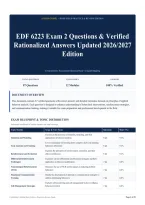
EDF 6223 Exam 2 Questions & Verified
Rationalized Answers Updated 2026/2027
Edition
Comprehensive Examination Question Bank • Concept Mapping
TOTAL QUESTIONS EXAM TOPICS ANSWERS
87 Questions 12 Modules 100% Verified
DOCUMENT OVERVIEW
This document contains 87 verified questions with correct answers and detailed rationales focused on principles of applied
behavior analysis. Each question is designed to enhance understanding of behavioral interventions, reinforcement strategies,
and communication training, making it suitable for exam preparation and professional development in the field.
EXAM BLUEPRINT & TOPIC DISTRIBUTION
Systematic breakdown of subject domains and exam coverage.
Topic Module Scope & Core Focus Questions Share (%)
Focuses on the processes of imitation, modeling, and their
Imitation and Modeling applications in behavior analysis. 8 Qs 9.2%
Covers techniques for breaking down complex skills and chaining
Task Analysis and Chaining behaviors effectively. 8 Qs 9.2%
Explores the principles of reinforcement, extinction, and their
Reinforcement and Extinction effects on behavior. 8 Qs 9.2%
Differential Reinforcement Examines various differential reinforcement strategies and their
Techniques application in behavior modification. 7 Qs 8.0%
Noncontingent Reinforcement Discusses the use of NCR and its impact on reducing problem
(NCR) behaviors. 7 Qs 8.0%
Functional Communication Details the development of alternative communication strategies to
Training address challenging behaviors. 7 Qs 8.0%
Explains self-monitoring and self-management tactics to enhance
Self-Management Strategies behavioral control. 7 Qs 8.0%
Confidential • Student Study Edition • Practice & Review Guide Page 1 of 29
,STUDENT STUDY & MASTERY EDITION PRACTICE & REVIEW GUIDE
Analyzes the structure and effectiveness of group contingencies in
Group Contingencies behavior management. 7 Qs 8.0%
Covers the implementation and considerations of token economy
Token Economies systems. 7 Qs 8.0%
Focuses on the elements and effectiveness of behavioral contracts in
Behavioral Contracts behavior modification. 7 Qs 8.0%
Discusses the ethical implications and considerations within applied
Ethical Considerations in ABA behavior analysis. 7 Qs 8.0%
Behavioral Definitions and Covers the importance of clear behavioral definitions and various
Measurement measurement techniques. 7 Qs 8.0%
Total Exam Coverage 12 Integrated Topic Modules 87 Qs 100.0%
TOPIC 1: IMITATION AND MODELING
8 Questions • 9.2% of Exam • Focuses on the processes of imitation, modeling, and their applications in behavior analysis.
QUESTION 1
With an understanding of the imitation process, applied behavior analysts can use imitation as an
intervention to...
Answer: Evoke New behaviors.
Rationale: By understanding the imitation process, applied behavior analysts can use imitation as an intervention to evoke new
behaviors in individuals, as imitation is a powerful way to teach new skills and behaviors by observing and mimicking
others. This is because imitation allows individuals to learn through observation and imitation, rather than trial and error, making it a
effective way to teach new behaviors and promote learning.
QUESTION 2
Regardless of the behavior modeled, the objective of imitation training is for the learner to do
what?
Answer: What the model does.
Rationale: The objective of imitation training is for the learner to do what the model does because the learner is directly copying the
actions, behaviors, and strategies demonstrated by the model, with the goal of developing similar skills and abilities. By imitating the
model, the learner is able to learn from their experiences and adapt to new situations, ultimately leading to improved performance and
mastery.
Confidential • Student Study Edition • Practice & Review Guide Page 2 of 29
, STUDENT STUDY & MASTERY EDITION PRACTICE & REVIEW GUIDE
QUESTION 3
What are the two types of models that are part of imitation?
Answer: Planned and Unplanned.
Rationale: Planned and unplanned models of imitation are the correct answer because planned imitation refers to deliberate and
intentional learning, whereas unplanned imitation involves unconscious and unintentional learning.
QUESTION 4
The controlling variable for an imitative behavior is:
Answer: A model.
Rationale: In operant conditioning, a model is the controlling variable for an imitative behavior because it provides the stimulus that
causes the learner to replicate the behavior, such as observing someone perform an action and then mimicking it.
QUESTION 5
Potential learners cannot imitate if they do not have this prerequisite skill:
Answer: Attending to the model.
Rationale: Imitation requires learners to pay attention to the model or teacher, as it is the foundation of observational learning.
Without this skill, learners are unable to focus on the model's behavior, making it impossible to accurately imitate the desired actions or
skills.
QUESTION 6
What are the two exceptions to components in a behavior chain serving a dual function?
Answer: First and last behaviors.
Rationale: First and last behaviors in a behavior chain serve a dual function in that they are often reinforced for their own sake,
whereas the behaviors in between are primarily serving to connect the first and last behaviors. This dual function is unique to the first
and last behaviors, making them the only exceptions to the general rule that components in a behavior chain typically serve a single
function.
Confidential • Student Study Edition • Practice & Review Guide Page 3 of 29
EDF 6223 Exam 2 Questions & Verified
Rationalized Answers Updated 2026/2027
Edition
Comprehensive Examination Question Bank • Concept Mapping
TOTAL QUESTIONS EXAM TOPICS ANSWERS
87 Questions 12 Modules 100% Verified
DOCUMENT OVERVIEW
This document contains 87 verified questions with correct answers and detailed rationales focused on principles of applied
behavior analysis. Each question is designed to enhance understanding of behavioral interventions, reinforcement strategies,
and communication training, making it suitable for exam preparation and professional development in the field.
EXAM BLUEPRINT & TOPIC DISTRIBUTION
Systematic breakdown of subject domains and exam coverage.
Topic Module Scope & Core Focus Questions Share (%)
Focuses on the processes of imitation, modeling, and their
Imitation and Modeling applications in behavior analysis. 8 Qs 9.2%
Covers techniques for breaking down complex skills and chaining
Task Analysis and Chaining behaviors effectively. 8 Qs 9.2%
Explores the principles of reinforcement, extinction, and their
Reinforcement and Extinction effects on behavior. 8 Qs 9.2%
Differential Reinforcement Examines various differential reinforcement strategies and their
Techniques application in behavior modification. 7 Qs 8.0%
Noncontingent Reinforcement Discusses the use of NCR and its impact on reducing problem
(NCR) behaviors. 7 Qs 8.0%
Functional Communication Details the development of alternative communication strategies to
Training address challenging behaviors. 7 Qs 8.0%
Explains self-monitoring and self-management tactics to enhance
Self-Management Strategies behavioral control. 7 Qs 8.0%
Confidential • Student Study Edition • Practice & Review Guide Page 1 of 29
,STUDENT STUDY & MASTERY EDITION PRACTICE & REVIEW GUIDE
Analyzes the structure and effectiveness of group contingencies in
Group Contingencies behavior management. 7 Qs 8.0%
Covers the implementation and considerations of token economy
Token Economies systems. 7 Qs 8.0%
Focuses on the elements and effectiveness of behavioral contracts in
Behavioral Contracts behavior modification. 7 Qs 8.0%
Discusses the ethical implications and considerations within applied
Ethical Considerations in ABA behavior analysis. 7 Qs 8.0%
Behavioral Definitions and Covers the importance of clear behavioral definitions and various
Measurement measurement techniques. 7 Qs 8.0%
Total Exam Coverage 12 Integrated Topic Modules 87 Qs 100.0%
TOPIC 1: IMITATION AND MODELING
8 Questions • 9.2% of Exam • Focuses on the processes of imitation, modeling, and their applications in behavior analysis.
QUESTION 1
With an understanding of the imitation process, applied behavior analysts can use imitation as an
intervention to...
Answer: Evoke New behaviors.
Rationale: By understanding the imitation process, applied behavior analysts can use imitation as an intervention to evoke new
behaviors in individuals, as imitation is a powerful way to teach new skills and behaviors by observing and mimicking
others. This is because imitation allows individuals to learn through observation and imitation, rather than trial and error, making it a
effective way to teach new behaviors and promote learning.
QUESTION 2
Regardless of the behavior modeled, the objective of imitation training is for the learner to do
what?
Answer: What the model does.
Rationale: The objective of imitation training is for the learner to do what the model does because the learner is directly copying the
actions, behaviors, and strategies demonstrated by the model, with the goal of developing similar skills and abilities. By imitating the
model, the learner is able to learn from their experiences and adapt to new situations, ultimately leading to improved performance and
mastery.
Confidential • Student Study Edition • Practice & Review Guide Page 2 of 29
, STUDENT STUDY & MASTERY EDITION PRACTICE & REVIEW GUIDE
QUESTION 3
What are the two types of models that are part of imitation?
Answer: Planned and Unplanned.
Rationale: Planned and unplanned models of imitation are the correct answer because planned imitation refers to deliberate and
intentional learning, whereas unplanned imitation involves unconscious and unintentional learning.
QUESTION 4
The controlling variable for an imitative behavior is:
Answer: A model.
Rationale: In operant conditioning, a model is the controlling variable for an imitative behavior because it provides the stimulus that
causes the learner to replicate the behavior, such as observing someone perform an action and then mimicking it.
QUESTION 5
Potential learners cannot imitate if they do not have this prerequisite skill:
Answer: Attending to the model.
Rationale: Imitation requires learners to pay attention to the model or teacher, as it is the foundation of observational learning.
Without this skill, learners are unable to focus on the model's behavior, making it impossible to accurately imitate the desired actions or
skills.
QUESTION 6
What are the two exceptions to components in a behavior chain serving a dual function?
Answer: First and last behaviors.
Rationale: First and last behaviors in a behavior chain serve a dual function in that they are often reinforced for their own sake,
whereas the behaviors in between are primarily serving to connect the first and last behaviors. This dual function is unique to the first
and last behaviors, making them the only exceptions to the general rule that components in a behavior chain typically serve a single
function.
Confidential • Student Study Edition • Practice & Review Guide Page 3 of 29


