
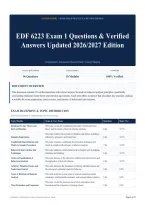
[STUDY GUIDE] • HIGH-YIELD PRACTICE & REVIEW EDITION
EDF 6223 Exam 1 Questions & Verified
Answers Updated 2026/2027 Edition
Comprehensive Examination Question Bank • Concept Mapping
TOTAL QUESTIONS EXAM TOPICS ANSWERS
56 Questions 10 Modules 100% Verified
DOCUMENT OVERVIEW
This document contains 56 verified questions with correct answers focused on behavior analysis principles, specifically
surrounding relational frame theory and stimulus equivalence. Each item offers an answer that elucidates key concepts, making
it suitable for exam preparation, course review, and mastery of behavioral interventions.
EXAM BLUEPRINT & TOPIC DISTRIBUTION
Systematic breakdown of subject domains and exam coverage.
Topic Module Scope & Core Focus Questions Share (%)
Relational Frame Theory and This topic covers the foundational principles of relational frame
Derived Relations theory and the nature of derived stimulus relations. 6 Qs 10.7%
This topic explores the concept of stimulus equivalence, including
Stimulus Equivalence reflexivity, symmetry, and transitivity. 6 Qs 10.7%
Conditional Discrimination and This topic examines conditional discrimination techniques and
Match-to-Sample Procedures match-to-sample methodologies in behavior analysis. 7 Qs 12.5%
Behavioral Interventions and This topic addresses various behavioral techniques such as shaping,
Techniques imitation, and chaining. 6 Qs 10.7%
Goals and Applications of This topic focuses on the objectives of behavioral interventions and
Behavioral Analysis the application of derived relations. 6 Qs 10.7%
Arbitrary Stimulus Classes and This topic discusses the formation of arbitrary stimulus classes and
Contextual Control the concept of contextual control in behavior. 5 Qs 8.9%
Types of Relations in Behavior This topic analyzes various types of relations including mutual
Analysis entailment, combinatorial entailment, and nonequivalence relations. 5 Qs 8.9%
This topic covers the processes involved in equivalence class
Class Formation and Expansion formation and the expansion of existing classes. 5 Qs 8.9%
Confidential • Student Study Edition • Practice & Review Guide Page 1 of 13
, STUDENT STUDY & MASTERY EDITION PRACTICE & REVIEW GUIDE
Naming Theory and This topic explores the dynamics of naming theory and its
Communication implications for communication in behavior analysis. 5 Qs 8.9%
Behavioral Measurement and This topic addresses methods used for measuring and assessing
Assessment behaviors in applied settings. 5 Qs 8.9%
Total Exam Coverage 10 Integrated Topic Modules 56 Qs 100.0%
TOPIC 1: RELATIONAL FRAME THEORY AND DERIVED RELATIONS
6 Questions • 10.7% of Exam • This topic covers the foundational principles of relational frame theory and the nature of derived stimulus relations.
QUESTION 1
Conditional Discrimination
Answer: Performance in a match-to-sample procedure in which discrimination between the comparison stimuli is
conditional on (or depends on) the sample stimulus present on each trial.
QUESTION 2
Relational Frame Theory
Answer: A theory of derived stimulus relations proposing that such relations are inherently verbal and that the
accumulated experience with relational exemplars creates generalized repertoires of relating.
QUESTION 3
Relational Frame Theory
Answer: Responding to one stimulus in terms of another.
QUESTION 4
Mutual entailment
Answer: The derived bidirectionality of some stimulus relations A generic term for the concept of "symmetry" in
stimulus equivalence.
Confidential • Student Study Edition • Practice & Review Guide Page 2 of 13
EDF 6223 Exam 1 Questions & Verified
Answers Updated 2026/2027 Edition
Comprehensive Examination Question Bank • Concept Mapping
TOTAL QUESTIONS EXAM TOPICS ANSWERS
56 Questions 10 Modules 100% Verified
DOCUMENT OVERVIEW
This document contains 56 verified questions with correct answers focused on behavior analysis principles, specifically
surrounding relational frame theory and stimulus equivalence. Each item offers an answer that elucidates key concepts, making
it suitable for exam preparation, course review, and mastery of behavioral interventions.
EXAM BLUEPRINT & TOPIC DISTRIBUTION
Systematic breakdown of subject domains and exam coverage.
Topic Module Scope & Core Focus Questions Share (%)
Relational Frame Theory and This topic covers the foundational principles of relational frame
Derived Relations theory and the nature of derived stimulus relations. 6 Qs 10.7%
This topic explores the concept of stimulus equivalence, including
Stimulus Equivalence reflexivity, symmetry, and transitivity. 6 Qs 10.7%
Conditional Discrimination and This topic examines conditional discrimination techniques and
Match-to-Sample Procedures match-to-sample methodologies in behavior analysis. 7 Qs 12.5%
Behavioral Interventions and This topic addresses various behavioral techniques such as shaping,
Techniques imitation, and chaining. 6 Qs 10.7%
Goals and Applications of This topic focuses on the objectives of behavioral interventions and
Behavioral Analysis the application of derived relations. 6 Qs 10.7%
Arbitrary Stimulus Classes and This topic discusses the formation of arbitrary stimulus classes and
Contextual Control the concept of contextual control in behavior. 5 Qs 8.9%
Types of Relations in Behavior This topic analyzes various types of relations including mutual
Analysis entailment, combinatorial entailment, and nonequivalence relations. 5 Qs 8.9%
This topic covers the processes involved in equivalence class
Class Formation and Expansion formation and the expansion of existing classes. 5 Qs 8.9%
Confidential • Student Study Edition • Practice & Review Guide Page 1 of 13
, STUDENT STUDY & MASTERY EDITION PRACTICE & REVIEW GUIDE
Naming Theory and This topic explores the dynamics of naming theory and its
Communication implications for communication in behavior analysis. 5 Qs 8.9%
Behavioral Measurement and This topic addresses methods used for measuring and assessing
Assessment behaviors in applied settings. 5 Qs 8.9%
Total Exam Coverage 10 Integrated Topic Modules 56 Qs 100.0%
TOPIC 1: RELATIONAL FRAME THEORY AND DERIVED RELATIONS
6 Questions • 10.7% of Exam • This topic covers the foundational principles of relational frame theory and the nature of derived stimulus relations.
QUESTION 1
Conditional Discrimination
Answer: Performance in a match-to-sample procedure in which discrimination between the comparison stimuli is
conditional on (or depends on) the sample stimulus present on each trial.
QUESTION 2
Relational Frame Theory
Answer: A theory of derived stimulus relations proposing that such relations are inherently verbal and that the
accumulated experience with relational exemplars creates generalized repertoires of relating.
QUESTION 3
Relational Frame Theory
Answer: Responding to one stimulus in terms of another.
QUESTION 4
Mutual entailment
Answer: The derived bidirectionality of some stimulus relations A generic term for the concept of "symmetry" in
stimulus equivalence.
Confidential • Student Study Edition • Practice & Review Guide Page 2 of 13


