
[STUDY GUIDE] • HIGH-YIELD PRACTICE & REVIEW EDITION
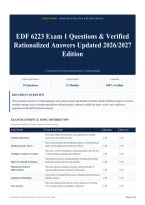
EDF 6223 Exam 1 Questions & Verified
Rationalized Answers Updated 2026/2027
Edition
Comprehensive Examination Question Bank • Concept Mapping
TOTAL QUESTIONS EXAM TOPICS ANSWERS
93 Questions 12 Modules 100% Verified
DOCUMENT OVERVIEW
This document contains 93 verified questions with correct answers and detailed rationales related to behavior analysis. It covers
essential concepts such as stimulus equivalence and task analysis, making it suitable for study, review, and certification
preparation in the field of behavior analysis.
EXAM BLUEPRINT & TOPIC DISTRIBUTION
Systematic breakdown of subject domains and exam coverage.
Topic Module Scope & Core Focus Questions Share (%)
This topic explores the principles and components of stimulus
Stimulus Equivalence equivalence and related concepts. 8 Qs 8.6%
This section examines the foundational aspects of relational frame
Relational Frame Theory theory and its applications in behavior analysis. 8 Qs 8.6%
This topic covers the matching to sample procedures and their role
Matching to Sample Procedures in demonstrating conditional discrimination. 8 Qs 8.6%
This section focuses on chaining methods, including forward and
Behavior Chaining Techniques backward chaining and total task chaining. 8 Qs 8.6%
Shaping and Response This topic discusses shaping techniques and the principles of
Differentiation response differentiation in behavior modification. 8 Qs 8.6%
This section investigates the processes of imitation and modeling in
Imitation and Modeling behavior analysis. 8 Qs 8.6%
This topic addresses task analysis and its importance in breaking
Task Analysis down complex skills into teachable components. 8 Qs 8.6%
Confidential • Student Study Edition • Practice & Review Guide Page 1 of 34
,STUDENT STUDY & MASTERY EDITION PRACTICE & REVIEW GUIDE
This section explores the formation, expansion, and merger of
Equivalence Class Dynamics equivalence classes in behavior analysis. 8 Qs 8.6%
This topic focuses on understanding conditional relations and their
Conditional Relations significance in behavior analysis. 8 Qs 8.6%
This section examines various types of stimuli and their functions in
Stimulus Types and Functions the context of behavior analysis. 7 Qs 7.5%
Delayed Emergence and Class This topic discusses concepts of delayed emergence and the
Formation measurement of class formation in behavior analysis. 7 Qs 7.5%
This section analyzes the concepts of generalization and stimulus
Generalization and Variability variability in the learning process. 7 Qs 7.5%
Total Exam Coverage 12 Integrated Topic Modules 93 Qs 100.0%
TOPIC 1: STIMULUS EQUIVALENCE
8 Questions • 8.6% of Exam • This topic explores the principles and components of stimulus equivalence and related concepts.
QUESTION 1
When has Stimulus Equivalence been achieved
Answer: When ALL reflexive, symmetrical and transitive matching has been learned.
Rationale: Stimulus Equivalence is achieved when all reflexive, symmetrical, and transitive matching has been learned because these
properties ensure that the relationships between stimuli are logical and consistent, allowing for the formation of a network of equivalent
stimuli that can be used to facilitate learning and problem-solving. In other words, reflexive, symmetrical, and transitive matching
guarantee that the equivalence relations are reflexive (stimuli match themselves), symmetrical (stimuli match each other reciprocally),
and transitive (stimuli match each other through an intermediate stimulus), thereby establishing a robust and coherent equivalence
structure.
QUESTION 2
Equivalence class
Answer: Is the collection of stimuli that evoke the same behavior.
Rationale: An equivalence class is a set of elements that are indistinguishable from one another, meaning they produce the same
response or behavior when presented to a system or organism. In this sense, "is the collection of stimuli that evoke the same behavior"
accurately captures the concept of equivalence class, as it represents a group of stimuli that are functionally equivalent and produce the
same outcome.
Confidential • Student Study Edition • Practice & Review Guide Page 2 of 34
,STUDENT STUDY & MASTERY EDITION PRACTICE & REVIEW GUIDE
QUESTION 3
Arbitrary stimulus class
Answer: He stimuli do not look alike but the share the same response.
Rationale: The arbitrary stimulus class refers to a group of stimuli that share a common response or behavior, despite being dissimilar
in appearance or characteristics. Therefore, "he stimuli do not look alike but the share the same response" is a correct description of an
arbitrary stimulus class because it highlights the lack of physical similarity among the stimuli, while emphasizing their shared
behavioral response.
QUESTION 4
NOT a key outcome obtained with equivalence approaches
Answer: Class substitution.
Rationale: Class substitution is not a key outcome obtained with equivalence approaches because equivalence designs aim to test the
same research question across different groups or conditions, whereas class substitution involves replacing an entire class of
participants with a new one, fundamentally altering the research design and question.
QUESTION 5
____________describes a behavior analytic approach to understanding and establishing symbolic
function
Answer: Stimulus equivalence.
Rationale: Stimulus equivalence is the correct answer because it refers to the process by which a behavior analytic approach establishes
relationships between stimuli, allowing an individual to understand that a particular symbol or sign (e.g., a word or picture)
corresponds to a specific meaning or function. This approach enables the development of symbolic communication by creating
equivalence classes of stimuli, which are essential for understanding and using symbolic language.
Confidential • Student Study Edition • Practice & Review Guide Page 3 of 34
, STUDENT STUDY & MASTERY EDITION PRACTICE & REVIEW GUIDE
QUESTION 6
Relational Frame Theory (RFT) is a theory of__________stimulus relations proposing that such
relations are inherently verbal and that the accumulated experience with relational examples
creates generalized repertoires of relating
Answer: Derived.
Rationale: RFT proposes that stimulus relations are verbally mediated, meaning they are derived from learned verbal labels and rules
rather than being inherent in the stimuli themselves. Therefore, "derived" is the correct answer because it suggests that these stimulus
relations are constructed through learning and experience, rather than being innate or naturally occurring.
QUESTION 7
Which of the scenarios below is the best example of relational responding?
Answer: When thirsty at a BBQ, you feel around for the coldest beer in the cooler.
Rationale: Relational responding involves the ability to recognize and respond to the relationships between stimuli, rather than just the
individual stimuli themselves. In the scenario "When thirsty at a BBQ, you feel around for the coldest beer in the cooler", the speaker is
not simply responding to the individual stimuli of thirst or beer, but rather to the relationship between the two, using the concept of
temperature to guide their action.
QUESTION 8
If you want to create a task analysis for a behavior you have no idea how to do yourself, how
could you construct it?
a) You could find people who are good at the behavior and ask them how to do it.
b) You could watch people who know how to do the task and observe what they do.
c) You could go to the literature to see if there are any published task analyses of the behavior.
d) All of these
Answer: D) All of these.
Rationale: When constructing a task analysis for a behavior you're unfamiliar with, it's essential to gather information from multiple
sources to ensure accuracy and comprehensiveness. By combining the approaches in options a, b, and c, you can leverage the expertise
of others, observe and record the steps involved, and consult existing research, thereby increasing the validity and reliability of your
task analysis.
TOPIC 2: RELATIONAL FRAME THEORY
Confidential • Student Study Edition • Practice & Review Guide Page 4 of 34
EDF 6223 Exam 1 Questions & Verified
Rationalized Answers Updated 2026/2027
Edition
Comprehensive Examination Question Bank • Concept Mapping
TOTAL QUESTIONS EXAM TOPICS ANSWERS
93 Questions 12 Modules 100% Verified
DOCUMENT OVERVIEW
This document contains 93 verified questions with correct answers and detailed rationales related to behavior analysis. It covers
essential concepts such as stimulus equivalence and task analysis, making it suitable for study, review, and certification
preparation in the field of behavior analysis.
EXAM BLUEPRINT & TOPIC DISTRIBUTION
Systematic breakdown of subject domains and exam coverage.
Topic Module Scope & Core Focus Questions Share (%)
This topic explores the principles and components of stimulus
Stimulus Equivalence equivalence and related concepts. 8 Qs 8.6%
This section examines the foundational aspects of relational frame
Relational Frame Theory theory and its applications in behavior analysis. 8 Qs 8.6%
This topic covers the matching to sample procedures and their role
Matching to Sample Procedures in demonstrating conditional discrimination. 8 Qs 8.6%
This section focuses on chaining methods, including forward and
Behavior Chaining Techniques backward chaining and total task chaining. 8 Qs 8.6%
Shaping and Response This topic discusses shaping techniques and the principles of
Differentiation response differentiation in behavior modification. 8 Qs 8.6%
This section investigates the processes of imitation and modeling in
Imitation and Modeling behavior analysis. 8 Qs 8.6%
This topic addresses task analysis and its importance in breaking
Task Analysis down complex skills into teachable components. 8 Qs 8.6%
Confidential • Student Study Edition • Practice & Review Guide Page 1 of 34
,STUDENT STUDY & MASTERY EDITION PRACTICE & REVIEW GUIDE
This section explores the formation, expansion, and merger of
Equivalence Class Dynamics equivalence classes in behavior analysis. 8 Qs 8.6%
This topic focuses on understanding conditional relations and their
Conditional Relations significance in behavior analysis. 8 Qs 8.6%
This section examines various types of stimuli and their functions in
Stimulus Types and Functions the context of behavior analysis. 7 Qs 7.5%
Delayed Emergence and Class This topic discusses concepts of delayed emergence and the
Formation measurement of class formation in behavior analysis. 7 Qs 7.5%
This section analyzes the concepts of generalization and stimulus
Generalization and Variability variability in the learning process. 7 Qs 7.5%
Total Exam Coverage 12 Integrated Topic Modules 93 Qs 100.0%
TOPIC 1: STIMULUS EQUIVALENCE
8 Questions • 8.6% of Exam • This topic explores the principles and components of stimulus equivalence and related concepts.
QUESTION 1
When has Stimulus Equivalence been achieved
Answer: When ALL reflexive, symmetrical and transitive matching has been learned.
Rationale: Stimulus Equivalence is achieved when all reflexive, symmetrical, and transitive matching has been learned because these
properties ensure that the relationships between stimuli are logical and consistent, allowing for the formation of a network of equivalent
stimuli that can be used to facilitate learning and problem-solving. In other words, reflexive, symmetrical, and transitive matching
guarantee that the equivalence relations are reflexive (stimuli match themselves), symmetrical (stimuli match each other reciprocally),
and transitive (stimuli match each other through an intermediate stimulus), thereby establishing a robust and coherent equivalence
structure.
QUESTION 2
Equivalence class
Answer: Is the collection of stimuli that evoke the same behavior.
Rationale: An equivalence class is a set of elements that are indistinguishable from one another, meaning they produce the same
response or behavior when presented to a system or organism. In this sense, "is the collection of stimuli that evoke the same behavior"
accurately captures the concept of equivalence class, as it represents a group of stimuli that are functionally equivalent and produce the
same outcome.
Confidential • Student Study Edition • Practice & Review Guide Page 2 of 34
,STUDENT STUDY & MASTERY EDITION PRACTICE & REVIEW GUIDE
QUESTION 3
Arbitrary stimulus class
Answer: He stimuli do not look alike but the share the same response.
Rationale: The arbitrary stimulus class refers to a group of stimuli that share a common response or behavior, despite being dissimilar
in appearance or characteristics. Therefore, "he stimuli do not look alike but the share the same response" is a correct description of an
arbitrary stimulus class because it highlights the lack of physical similarity among the stimuli, while emphasizing their shared
behavioral response.
QUESTION 4
NOT a key outcome obtained with equivalence approaches
Answer: Class substitution.
Rationale: Class substitution is not a key outcome obtained with equivalence approaches because equivalence designs aim to test the
same research question across different groups or conditions, whereas class substitution involves replacing an entire class of
participants with a new one, fundamentally altering the research design and question.
QUESTION 5
____________describes a behavior analytic approach to understanding and establishing symbolic
function
Answer: Stimulus equivalence.
Rationale: Stimulus equivalence is the correct answer because it refers to the process by which a behavior analytic approach establishes
relationships between stimuli, allowing an individual to understand that a particular symbol or sign (e.g., a word or picture)
corresponds to a specific meaning or function. This approach enables the development of symbolic communication by creating
equivalence classes of stimuli, which are essential for understanding and using symbolic language.
Confidential • Student Study Edition • Practice & Review Guide Page 3 of 34
, STUDENT STUDY & MASTERY EDITION PRACTICE & REVIEW GUIDE
QUESTION 6
Relational Frame Theory (RFT) is a theory of__________stimulus relations proposing that such
relations are inherently verbal and that the accumulated experience with relational examples
creates generalized repertoires of relating
Answer: Derived.
Rationale: RFT proposes that stimulus relations are verbally mediated, meaning they are derived from learned verbal labels and rules
rather than being inherent in the stimuli themselves. Therefore, "derived" is the correct answer because it suggests that these stimulus
relations are constructed through learning and experience, rather than being innate or naturally occurring.
QUESTION 7
Which of the scenarios below is the best example of relational responding?
Answer: When thirsty at a BBQ, you feel around for the coldest beer in the cooler.
Rationale: Relational responding involves the ability to recognize and respond to the relationships between stimuli, rather than just the
individual stimuli themselves. In the scenario "When thirsty at a BBQ, you feel around for the coldest beer in the cooler", the speaker is
not simply responding to the individual stimuli of thirst or beer, but rather to the relationship between the two, using the concept of
temperature to guide their action.
QUESTION 8
If you want to create a task analysis for a behavior you have no idea how to do yourself, how
could you construct it?
a) You could find people who are good at the behavior and ask them how to do it.
b) You could watch people who know how to do the task and observe what they do.
c) You could go to the literature to see if there are any published task analyses of the behavior.
d) All of these
Answer: D) All of these.
Rationale: When constructing a task analysis for a behavior you're unfamiliar with, it's essential to gather information from multiple
sources to ensure accuracy and comprehensiveness. By combining the approaches in options a, b, and c, you can leverage the expertise
of others, observe and record the steps involved, and consult existing research, thereby increasing the validity and reliability of your
task analysis.
TOPIC 2: RELATIONAL FRAME THEORY
Confidential • Student Study Edition • Practice & Review Guide Page 4 of 34


