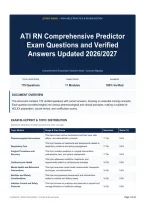
[STUDY GUIDE] • HIGH-YIELD PRACTICE & REVIEW EDITION
ATI RN Comprehensive Predictor
Exam Questions and Verified
Answers Updated 2026/2027
Comprehensive Examination Question Bank • Concept Mapping
TOTAL QUESTIONS EXAM TOPICS ANSWERS
179 Questions 11 Modules 100% Verified
DOCUMENT OVERVIEW
This document contains 179 verified questions with correct answers, focusing on essential nursing concepts.
Each question provides insights into various pharmacological and clinical principles, making it suitable for
NCLEX preparation, course review, and certification exams.
EXAM BLUEPRINT & TOPIC DISTRIBUTION
Systematic breakdown of subject domains and exam coverage.
Topic Module Scope & Core Focus Questions Share (%)
This topic covers various medications and their uses, side
Pharmacological Interventions effects, and administration protocols. 17 Qs 9.5%
This topic focuses on treatments and assessments related to
Respiratory Care respiratory conditions and airway management. 17 Qs 9.5%
Surgical Procedures and This topic includes questions on surgical interventions,
Recovery postoperative care, and patient assessments. 17 Qs 9.5%
This topic addresses conditions, treatments, and
Cardiovascular Health assessments related to cardiovascular diseases. 16 Qs 8.9%
Mental Health and Behavioral This topic examines mental health assessments, therapeutic
Interventions techniques, and interventions. 16 Qs 8.9%
Nutrition and Dietary This topic encompasses assessments and interventions
Considerations related to nutrition and dietary needs. 16 Qs 8.9%
Infection Control and Safety This topic focuses on practices and measures to prevent and
Protocols manage infections in healthcare settings. 16 Qs 8.9%
Confidential • Student Study Edition • Practice & Review Guide Page 1 of 34
,STUDENT STUDY & MASTERY EDITION PRACTICE & REVIEW GUIDE
Patient Assessment and This topic covers various assessments and vital sign
Monitoring monitoring techniques. 16 Qs 8.9%
This topic includes questions related to hospice care,
End-of-Life and Palliative Care palliative measures, and patient advocacy. 16 Qs 8.9%
Burn Management and Trauma This topic focuses on assessment and treatment of burns and
Care trauma-related conditions. 16 Qs 8.9%
Emergency and Critical Care This topic addresses protocols and interventions in
Procedures emergency situations. 16 Qs 8.9%
Total Exam Coverage 11 Integrated Topic Modules 179 Qs 100.0%
TOPIC 1: PHARMACOLOGICAL INTERVENTIONS
17 Questions • 9.5% of Exam • This topic covers various medications and their uses, side effects, and administration protocols.
QUESTION 1
Narcotic Analgesic
Answer: A class of medications used to relieve pain by acting on the central nervous system.
QUESTION 2
Skin Flushing
Answer: A common side effect of certain medications, characterized by redness and warmth of the skin.
QUESTION 3
Docusate sodium
Answer: A stool softener used to prevent constipation, especially important for patients on opioids.
QUESTION 4
Linezolid
Answer: An antibiotic used to treat certain bacterial infections, particularly those resistant to other
antibiotics.
Confidential • Student Study Edition • Practice & Review Guide Page 2 of 34
,STUDENT STUDY & MASTERY EDITION PRACTICE & REVIEW GUIDE
QUESTION 5
Pursed-Lip Breathing
Answer: A breathing technique used to help control shortness of breath, often used by patients with
respiratory conditions.
QUESTION 6
Diuretic
Answer: A medication that promotes the removal of excess fluid from the body, often used in conditions like
hypertension.
QUESTION 7
PIV (Peripheral Intravenous)
Answer: A small, flexible tube inserted into a vein to provide access for medication administration and fluid
therapy.
QUESTION 8
Vancomycin
Answer: An antibiotic used to treat serious bacterial infections, particularly those caused by resistant strains
like MRSA.
QUESTION 9
Enoxaparin sodium
Answer: An anticoagulant medication used to prevent and treat deep vein thrombosis and pulmonary
embolism.
Confidential • Student Study Edition • Practice & Review Guide Page 3 of 34
, STUDENT STUDY & MASTERY EDITION PRACTICE & REVIEW GUIDE
QUESTION 10
Speech therapy
Answer: A treatment that helps individuals improve their communication skills and manage swallowing
difficulties.
QUESTION 11
Morphine Sulfate
Answer: An opioid medication used to relieve severe pain and can also help reduce anxiety and respiratory
distress in heart failure.
QUESTION 12
Peripheral Edema
Answer: Swelling caused by excess fluid trapped in the body's tissues, often indicating underlying health
issues.
QUESTION 13
Toilet Training
Answer: The process of teaching a child to use the toilet for urination and defecation, which can vary in
duration and success.
QUESTION 14
Isoniazid
Answer: An antibiotic used to prevent and treat tuberculosis, which requires monitoring for liver function.
QUESTION 15
Oximeter
Answer: A device used to measure the oxygen saturation level in a person's blood, typically by attaching a
clip to a finger or earlobe.
Confidential • Student Study Edition • Practice & Review Guide Page 4 of 34