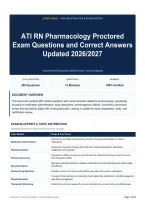
[STUDY GUIDE] • HIGH-YIELD PRACTICE & REVIEW EDITION
ATI RN Pharmacology Proctored
Exam Questions and Correct Answers
Updated 2026/2027
Comprehensive Examination Question Bank • Concept Mapping
TOTAL QUESTIONS EXAM TOPICS ANSWERS
295 Questions 12 Modules 100% Verified
DOCUMENT OVERVIEW
This document contains 295 verified questions with correct answers related to pharmacology, specifically
focusing on medication administration, drug interactions, and therapeutic effects. It provides a structured
review tool that directly aligns with nursing education, making it suitable for exam preparation, study, and
certification review.
EXAM BLUEPRINT & TOPIC DISTRIBUTION
Systematic breakdown of subject domains and exam coverage.
Topic Module Scope & Core Focus
Explores the principles and protocols involved in the safe administration of various
Medication Administration medications.
Covers the movement of drugs within the body, including absorption, distribution,
Pharmacokinetics metabolism, and excretion.
Examines the effects of drugs on the body and the mechanisms through which they exert
Pharmacodynamics their therapeutic effects.
Discusses potential interactions between medications and the implications for patient safety
Drug Interactions and efficacy.
Adverse Drug Reactions Identifies common and serious side effects associated with various medications.
Focuses on the importance of educating clients about their medications, including usage and
Patient Education side effect management.
Therapeutic Monitoring Details the monitoring required for various medications to ensure safety and effectiveness.
Confidential • Student Study Edition • Practice & Review Guide Page 1 of 98
,STUDENT STUDY & MASTERY EDITION PRACTICE & REVIEW GUIDE
Addresses the considerations for administering medications to special populations, such as
Special Populations pediatrics and geriatrics.
Examines the regulations and guidelines surrounding the use of controlled substances in
Controlled Substances healthcare.
Clinical Pharmacology Integrates pharmacological principles with clinical practices to optimize patient outcomes.
Explores the use of drugs to treat various medical conditions, including the rationale behind
Pharmacotherapy treatment choices.
Discusses the process of ensuring accurate and complete medication information during
Medication Reconciliation transitions of care.
Total Exam Coverage 12 Integrated Topic Modules • 295 Examination Questions
HIGH-YIELD: QUESTIONS & VERIFIED ANSWERS
Complete Examination Questions • 295 Questions • Sequential Exam Layout
QUESTION 1
A nurse is preparing to administer cefazolin 1 g in 0.9% sodium chloride 100 ml- via
intermittent IV bolus over 30 min. The drop factor of the manual IV tubing is I5 gtt/mL.
The nurse should set the manual IV infusion to deliver how many gtt/min? (Round the
answer to the nearest whole number. Use a leading zero if it applies. Do not use a
trailing zero.)
Answer: 50Gtt/min.
QUESTION 2
A nurse is performing a preoperative assessment of a client who is about to undergo an
aneurysm clipping. The nurse should identify a risk for increased bleeding when the
client reports taking which of the following dietary supplements?
A. Soy
B. Garlic
C. Black cohosh
D. Green tea
Answer: B. Garlic.
Confidential • Student Study Edition • Practice & Review Guide Page 2 of 98
,STUDENT STUDY & MASTERY EDITION PRACTICE & REVIEW GUIDE
QUESTION 3
Select all the early manifestations of lithium toxicity
A. Nausea
B. Hypotension
C. Renal Failure
D. Muscle Weakness
Answer: A. nausea
D. muscle weakness.
QUESTION 4
A nurse is providing teaching to a client who has heart failure and is taking
spironolactone. Which of the following statements by the client indicates an
understanding of the teaching?
A." I will increase my intake of citrus fruits, bananas, and potatoes."
B. "I will use salt substitutes on my food."
C. "I will drink as much water as i can while taking medication." D." I will watch for
increased breast tissue growth while taking this medication."
Answer: D." I will watch for increased breast tissue growth while taking this medication.".
QUESTION 5
How would you evaluate the medical effectiveness of Metformin?
a. assess serum electrolytes. ketones, glucose, blood PH, lactate, pyruvate levels, monitor serum glucose
b. check for resolution of hypothyroidism and normalization of hormone levels
c. check patient for pain reduction
d. Assess patient alertness
Answer: A. assess serum electrolytes, ketones, glucose, blood pH, lactate, pyruvate levels, monitor serum
glucose.
Confidential • Student Study Edition • Practice & Review Guide Page 3 of 98
, STUDENT STUDY & MASTERY EDITION PRACTICE & REVIEW GUIDE
QUESTION 6
A nurse is teaching self-administration of NPH insulin to a client who has type 2
diabetes mellitus. Which of the following instructions should the nurse include?
A. Alternate injecting doses between the abdomen and the thigh
B. Shake the vial before withdrawing the dosage
C. Rotate injection sites within the same area
D. Discard the vial if the insulin is cloudy
Answer: C. Rotate injection sites within the same area.
QUESTION 7
A nurse is reviewing the medication administration record for a client who has cancer
and is receiving morphine via a PCA pump. Which of the following prescriptions should
the nurse clarify with the provider?
A. Nalbuphine
B. Acetaminophen
C. Ondansetron
D. Insulin Glargine
Answer: A. Nalbuphine.
QUESTION 8
A nurse is teaching a newly license nurse about medication
reconciliation. The nurse should instruct the newly license nurse for medication
reconciliation for which of the following clients?
A. A client who has a referral for social services.
B. A client who is transported to radiology.
C. A client who is transferred to a step-down unit.
D. A client who has a consultation for physical therapy.
Answer: C. A client who is transferred to a step-down unit.
Confidential • Student Study Edition • Practice & Review Guide Page 4 of 98