[STUDY GUIDE] • HIGH-YIELD PRACTICE & REVIEW EDITION
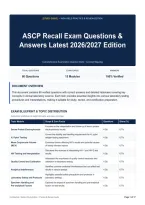
ASCP Recall Exam Questions &
Answers Latest 2026/2027 Edition
Comprehensive Examination Question Bank • Concept Mapping
TOTAL QUESTIONS EXAM TOPICS ANSWERS
60 Questions 15 Modules 100% Verified
DOCUMENT OVERVIEW
This document contains 60 verified questions with correct answers and detailed rationales covering key
concepts in clinical laboratory science. Each item provides essential insights into various laboratory testing
procedures and interpretations, making it suitable for study, review, and certification preparation.
EXAM BLUEPRINT & TOPIC DISTRIBUTION
Systematic breakdown of subject domains and exam coverage.
Topic Module Scope & Core Focus Questions Share (%)
Focuses on the interpretation and follow-up of serum protein
Serum Protein Electrophoresis electrophoresis results. 4 Qs 6.7%
Covers the stability and handling requirements for H. pylori
H. Pylori Testing antigen testing specimens. 4 Qs 6.7%
Mean Corpuscular Volume Examines factors affecting MCV results and potential causes
(MCV) of falsely elevated values. 4 Qs 6.7%
Discusses the nuances of interpreting HIV-1 and HIV-2 test
HIV Testing and Interpretation results. 4 Qs 6.7%
Addresses the importance of quality control measures and
Quality Control and Calibration calibration in laboratory testing. 4 Qs 6.7%
Identifies common analytical interferences that can affect test
Analytical Interferences results in various assays. 4 Qs 6.7%
Highlights essential safety precautions and protocols in
Laboratory Safety and Protocols laboratory settings. 4 Qs 6.7%
Specimen Handling and Explores the impact of specimen handling and pre-analytical
Pre-analytical Factors factors on test results. 4 Qs 6.7%
Confidential • Student Study Edition • Practice & Review Guide Page 1 of 17
,STUDENT STUDY & MASTERY EDITION PRACTICE & REVIEW GUIDE
Reviews various clinical laboratory testing procedures and
Clinical Laboratory Procedures their interpretations. 4 Qs 6.7%
Focuses on specific tests related to metabolic and endocrine
Metabolic and Endocrine Testing function. 4 Qs 6.7%
Blood Bank and Transfusion Covers critical aspects of blood banking and transfusion
Medicine practices. 4 Qs 6.7%
Discusses the methodologies and design of clinical research
Research and Study Design studies. 4 Qs 6.7%
Emerging Technologies in Examines the implementation of new technologies and
Laboratory Medicine methodologies in laboratory settings. 4 Qs 6.7%
Regulatory Compliance and Covers the importance of compliance with regulatory
Documentation standards and proper documentation. 4 Qs 6.7%
Quality Improvement and Focuses on quality improvement initiatives and performance
Performance Metrics measurement in laboratories. 4 Qs 6.7%
Total Exam Coverage 15 Integrated Topic Modules 60 Qs 100.0%
TOPIC 1: SERUM PROTEIN ELECTROPHORESIS
4 Questions • 6.7% of Exam • Focuses on the interpretation and follow-up of serum protein electrophoresis results.
QUESTION 1
A peripheral blood smear shows numerous immature granulocytes. Which stain is
most useful to identify a possible leukemoid reaction versus chronic myelogenous
leukemia?
Answer: LAP (leukocyte alkaline phosphatase)
Rationale: LAP activity differentiates reactive neutrophils (high) from CML (low).
QUESTION 2
Which of the following statements about the WHO International Standard for anti-HBs is
correct?
Answer: It is used to calibrate quantitative assays worldwide.
Rationale: The WHO standard provides a universal reference for anti-HBs quantitation.
Confidential • Student Study Edition • Practice & Review Guide Page 2 of 17
, STUDENT STUDY & MASTERY EDITION PRACTICE & REVIEW GUIDE
QUESTION 3
A patient's serum protein electrophoresis shows a sharp narrow spike in the γ region.
Which follow-up test is most appropriate?
Answer: Immunofixation electrophoresis.
Rationale: Immunofixation identifies the monoclonal protein responsible for the spike.
QUESTION 4
A lab adopts a new reagent for serum protein electrophoresis that contains a
proprietary dye. What documentation is required before clinical use?
Answer: Internal validation report and FDA clearance.
Rationale: Verification of performance and regulatory clearance are mandatory before implementation.
TOPIC 2: H. PYLORI TESTING
4 Questions • 6.7% of Exam • Covers the stability and handling requirements for H. pylori antigen testing specimens.
QUESTION 5
A lab receives a stool specimen for H. pylori antigen testing that has been stored at 4
°C for 72
hours. What is the most appropriate action?
Answer: Reject the specimen and request a new sample.
Rationale: H. pylori antigen stability declines after 48 hours at 4 °C, requiring a fresh specimen.
QUESTION 6
Which of the following best describes the three steps of a standard PCR cycle?
Answer: Denaturation, annealing, extension.
Rationale: PCR cycles consist of denaturation, primer annealing, and DNA polymerase-mediated extension.
Confidential • Student Study Edition • Practice & Review Guide Page 3 of 17
ASCP Recall Exam Questions &
Answers Latest 2026/2027 Edition
Comprehensive Examination Question Bank • Concept Mapping
TOTAL QUESTIONS EXAM TOPICS ANSWERS
60 Questions 15 Modules 100% Verified
DOCUMENT OVERVIEW
This document contains 60 verified questions with correct answers and detailed rationales covering key
concepts in clinical laboratory science. Each item provides essential insights into various laboratory testing
procedures and interpretations, making it suitable for study, review, and certification preparation.
EXAM BLUEPRINT & TOPIC DISTRIBUTION
Systematic breakdown of subject domains and exam coverage.
Topic Module Scope & Core Focus Questions Share (%)
Focuses on the interpretation and follow-up of serum protein
Serum Protein Electrophoresis electrophoresis results. 4 Qs 6.7%
Covers the stability and handling requirements for H. pylori
H. Pylori Testing antigen testing specimens. 4 Qs 6.7%
Mean Corpuscular Volume Examines factors affecting MCV results and potential causes
(MCV) of falsely elevated values. 4 Qs 6.7%
Discusses the nuances of interpreting HIV-1 and HIV-2 test
HIV Testing and Interpretation results. 4 Qs 6.7%
Addresses the importance of quality control measures and
Quality Control and Calibration calibration in laboratory testing. 4 Qs 6.7%
Identifies common analytical interferences that can affect test
Analytical Interferences results in various assays. 4 Qs 6.7%
Highlights essential safety precautions and protocols in
Laboratory Safety and Protocols laboratory settings. 4 Qs 6.7%
Specimen Handling and Explores the impact of specimen handling and pre-analytical
Pre-analytical Factors factors on test results. 4 Qs 6.7%
Confidential • Student Study Edition • Practice & Review Guide Page 1 of 17
,STUDENT STUDY & MASTERY EDITION PRACTICE & REVIEW GUIDE
Reviews various clinical laboratory testing procedures and
Clinical Laboratory Procedures their interpretations. 4 Qs 6.7%
Focuses on specific tests related to metabolic and endocrine
Metabolic and Endocrine Testing function. 4 Qs 6.7%
Blood Bank and Transfusion Covers critical aspects of blood banking and transfusion
Medicine practices. 4 Qs 6.7%
Discusses the methodologies and design of clinical research
Research and Study Design studies. 4 Qs 6.7%
Emerging Technologies in Examines the implementation of new technologies and
Laboratory Medicine methodologies in laboratory settings. 4 Qs 6.7%
Regulatory Compliance and Covers the importance of compliance with regulatory
Documentation standards and proper documentation. 4 Qs 6.7%
Quality Improvement and Focuses on quality improvement initiatives and performance
Performance Metrics measurement in laboratories. 4 Qs 6.7%
Total Exam Coverage 15 Integrated Topic Modules 60 Qs 100.0%
TOPIC 1: SERUM PROTEIN ELECTROPHORESIS
4 Questions • 6.7% of Exam • Focuses on the interpretation and follow-up of serum protein electrophoresis results.
QUESTION 1
A peripheral blood smear shows numerous immature granulocytes. Which stain is
most useful to identify a possible leukemoid reaction versus chronic myelogenous
leukemia?
Answer: LAP (leukocyte alkaline phosphatase)
Rationale: LAP activity differentiates reactive neutrophils (high) from CML (low).
QUESTION 2
Which of the following statements about the WHO International Standard for anti-HBs is
correct?
Answer: It is used to calibrate quantitative assays worldwide.
Rationale: The WHO standard provides a universal reference for anti-HBs quantitation.
Confidential • Student Study Edition • Practice & Review Guide Page 2 of 17
, STUDENT STUDY & MASTERY EDITION PRACTICE & REVIEW GUIDE
QUESTION 3
A patient's serum protein electrophoresis shows a sharp narrow spike in the γ region.
Which follow-up test is most appropriate?
Answer: Immunofixation electrophoresis.
Rationale: Immunofixation identifies the monoclonal protein responsible for the spike.
QUESTION 4
A lab adopts a new reagent for serum protein electrophoresis that contains a
proprietary dye. What documentation is required before clinical use?
Answer: Internal validation report and FDA clearance.
Rationale: Verification of performance and regulatory clearance are mandatory before implementation.
TOPIC 2: H. PYLORI TESTING
4 Questions • 6.7% of Exam • Covers the stability and handling requirements for H. pylori antigen testing specimens.
QUESTION 5
A lab receives a stool specimen for H. pylori antigen testing that has been stored at 4
°C for 72
hours. What is the most appropriate action?
Answer: Reject the specimen and request a new sample.
Rationale: H. pylori antigen stability declines after 48 hours at 4 °C, requiring a fresh specimen.
QUESTION 6
Which of the following best describes the three steps of a standard PCR cycle?
Answer: Denaturation, annealing, extension.
Rationale: PCR cycles consist of denaturation, primer annealing, and DNA polymerase-mediated extension.
Confidential • Student Study Edition • Practice & Review Guide Page 3 of 17