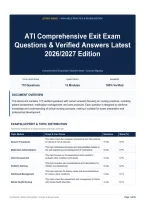
[STUDY GUIDE] • HIGH-YIELD PRACTICE & REVIEW EDITION
ATI Comprehensive Exit Exam
Questions & Verified Answers Latest
2026/2027 Edition
Comprehensive Examination Question Bank • Concept Mapping
TOTAL QUESTIONS EXAM TOPICS ANSWERS
172 Questions 12 Modules 100% Verified
DOCUMENT OVERVIEW
This document contains 172 verified questions with correct answers focusing on nursing practices, including
patient assessment, medication management, and care protocols. Each question is designed to reinforce
knowledge and understanding of critical nursing concepts, making it suitable for exam preparation and
professional development.
EXAM BLUEPRINT & TOPIC DISTRIBUTION
Systematic breakdown of subject domains and exam coverage.
Topic Module Scope & Core Focus Questions Share (%)
This topic covers the necessary precautions and interventions
Seizure Precautions for clients at risk of seizures. 15 Qs 8.7%
This topic addresses principles and responsibilities related to
Medication Administration the safe dispensing and management of medications. 15 Qs 8.7%
This topic focuses on the assessment skills needed to
Client Assessment evaluate client conditions and needs. 15 Qs 8.7%
This topic includes care considerations and interventions for
Pediatric Nursing children and adolescents. 15 Qs 8.7%
This topic explores the dietary needs and recommendations
Nutritional Management for various client conditions. 14 Qs 8.1%
This topic covers the assessment and management of clients
Mental Health Nursing with mental health disorders. 14 Qs 8.1%
Confidential • Student Study Edition • Practice & Review Guide Page 1 of 60
,STUDENT STUDY & MASTERY EDITION PRACTICE & REVIEW GUIDE
This topic includes the identification and management of
Complications and Emergencies acute complications in nursing. 14 Qs 8.1%
This topic encompasses care protocols and assessments
Maternal and Newborn Care related to pregnant clients and newborns. 14 Qs 8.1%
This topic focuses on practices to prevent and control
Infection Control infections in healthcare settings. 14 Qs 8.1%
This topic discusses strategies for ensuring client safety and
Patient Safety and Advocacy advocating for their rights. 14 Qs 8.1%
This topic covers the care and management of clients with
Chronic Illness Management chronic health conditions. 14 Qs 8.1%
This topic addresses the importance of fluid and electrolyte
Fluid and Electrolyte Balance management in various client conditions. 14 Qs 8.1%
Total Exam Coverage 12 Integrated Topic Modules 172 Qs 100.0%
TOPIC 1: SEIZURE PRECAUTIONS
15 Questions • 8.7% of Exam • This topic covers the necessary precautions and interventions for clients at risk of seizures.
QUESTION 1
A nurse is caring for a client who has UTI and has been taking cefaclor. Which of the
following serum laboratory results indicates the medication is effective?
a. Eosinophils 3.9%
b. WBC 9,200/mm3
c. Bun 32 mg/dL
d. Creatinine 2.3 mg/dL
Answer: B. WBC 9,200/mm3.
Confidential • Student Study Edition • Practice & Review Guide Page 2 of 60
,STUDENT STUDY & MASTERY EDITION PRACTICE & REVIEW GUIDE
QUESTION 2
A newly LPN working at an HIV clinic is reviewing the responsibilities of her position at
the clinic. Which of the following tasks should the nurse identify as tertiary prevention?
a. Using an electronic massaging system to remind clients when to take medications
b. Educating clients about contraindications to specific immunizations
c. Helping clients understand health screenings covered by their insurance plans
d. Providing clients with info about the benefits of exercise
Answer: A. Using an electronic massaging system to remind clients when to take medications.
QUESTION 3
A nurse is caring for a client who is 4 days postpartum. Which of the following
assessment findings should the nurse expect? (SATA)
a. Foul perineal odor
b. Fundus displaced to the right
c. Lochia serosa
d. Fundus 4 cm (1.6 in) below the umbilicus
e. Postpartum chill
Answer: C. Lochia serosa
d. Fundus 4 cm (1.6 in) below the umbilicus.
QUESTION 4
A nurse is caring for a client who has given informed consent for ECT. Just before the
procedure, the client tells the nurse she is considering not going forward with the
treatment. Which of the following statements by the nurse is appropriate?
a. "You don't have to go through with the treatment."
b. "Most people who have this procedure feel better following the treatment."
c. "It's okay to be nervous before this treatment."
d. "Your doctor wouldn't have ordered this treatment unless it was necessary."
Answer: A. "You don't have to go through with the treatment.".
Confidential • Student Study Edition • Practice & Review Guide Page 3 of 60
, STUDENT STUDY & MASTERY EDITION PRACTICE & REVIEW GUIDE
QUESTION 5
A nurse is caring for a newly client who has bacterial meningitis. Which of the following
actions should the nurse take?
a. Implement seizure precautions
b. Place the client in high-Fowler's position
c. Perform ROM exercises once per shift
d. Monitor the client for hypoglycemia
Answer: A. Implement seizure precautions.
QUESTION 6
Which of the following clients should the nurse place near the nurses' station?
a. A client who is in Buck's traction
b. A client who has orthostatic hypotension
c. A client who has an open wound
d. A client who is on fluid restriction
Answer: B. A client who has orthostatic hypotension.
QUESTION 7
A nurse in the emergency department is assessing client who has major depressive
disorder. Which of the following actions should the nurse take first?
a. Administer Zofran to the client for nausea
b. Implement seizure precautions for the client
c. Encourage the client to verbalize feelings
d. Obtain the client's weight
Answer: B. Implement seizure precautions for the client.
Confidential • Student Study Edition • Practice & Review Guide Page 4 of 60