
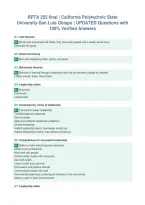
RPTA 255 final | California Polytechnic State
University-San Luis Obispo | UPDATED Questions with
100% Verified Answers
Q1: trait theories
A: Be like this and people will follow, they have traits people see a leader would have,
Alexander the great,
Q2: Great man theory
A: Born with leadership skills, profits, and poets
Q3: Behavioral theories
A: Behavior is learned through interactions with the environment shaped by rewards
LeBron James, Kobe, Rosa Parks
Q4: Leadership styles
A: Autocratic
Democratic
Laissez faire
Q5: Contemporary views of leadership
A: Transaction leader leadership
Transformational leadership
Servant leader
Agile and authentic leadership (adaption)
Shared leadership
Implicit leadership theory: how leader should act
Implicit followership theory: how follower should act
Q6: Competences for successful leadership
A: Ability to make ethical decision decisions
Ability to act professional
Work well with people
Communicate clearly with customers
Deal with public
Listen to staff and customer
Enthusiasm and positive attitude
Communicate clearly with staff
Demonstrate openness to serving all members of the community
Ability to work in team environments
Q7: Leadership skills
, A: Conceptual: strategic planning
Interpersonal: client services
Technical skills: computers
Q8: Followership
A: Assume responsibility
Serve
Challenge
Participate in transformation
Know when to leave
Q9: How does a leader emerge
A: Halo effect, appointed, election, emergence, charisma
Q10: Recognition of power
A: Charisma
Coercive power
Connections
Empowerment
Expert
Helplessness
Indirect
Information
Legitimate
Reward
Social status
Q11: Leadership levels
A: Frontline or direct: professors
Supervisor or Mid management: department head
Executive or admin
Dean
Q12: Piaget's stages of cognitive development
A: sensorimotor 0-2, preoperational 2-7, concrete operational 7-11, formal operational 12+
Q13: Carol Gilligan theory of moral development
A: Ethic of Care
Preconvention → selfish
Conventional → caring for others
Post conventional → caring for yourself and others
Q14: Kohlberg's theory of moral development


