
B.Com / B.Com (CA) | I SEMESTER | DISTANCE EDUCATION | ACADEMIC YEAR 2026-2027
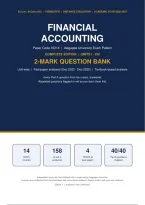
FINANCIAL
ACCOUNTING
Paper Code 10214 | Alagappa University Exam Pattern
COMPLETE EDITION | UNITS I - XIV
2-MARK QUESTION BANK
Unit-wise | Past-paper analysed (Dec 2022 - Dec 2025) | Textbook-based answers
Every Part A question from four years, answered.
Repeated questions flagged in red so you learn them first.
14 158 4 40/40
UNITS Q and A YEARS of Part A questions
covered answered past papers mapped
Independent study aid. Not affiliated with or endorsed by Alagappa University.
Answers are condensed from the prescribed Self-Instructional textbook. Always confirm with your own textbook.
Edition 1 | Academic Year 2026-2027
, What is inside this guide
• 158 questions with model answers across 14 units of Financial Accounting (10214), in the 2-mark (Part A)
format.
• Built from four years of papers (Dec 2022, 2023, 2024, 2025): 40 of the 40 Part A questions in this guide's
units are mapped to their unit and answered.
• Repeated questions highlighted in red. 10 repeated topics in these units account for 20 Part A questions.
• Answers written from the prescribed textbook in 40-60 words, the length that suits a 2-mark answer.
• Honest tags on every question: PYQ (asked once), REPEATED (asked more than once), or PREDICTED
(taken from the textbook, never asked in these four papers).
• Textbook page map for every unit, so you can read the full topic after the quick answer.
Contents
Unit Topic Q and A Page
I Basic Concepts of Financial Accounting 18 7
II Accounting Concepts, Principles and Conventions 17 9
III Recording of Transactions 11 11
IV Secondary (Subsidiary) Books 10 13
V Trial Balance and Rectification of Errors 11 15
VI Final Accounts I (Adjustments) 9 17
VII Final Accounts II (Trading, P and L, B/S) 10 18
VIII Bank Reconciliation Statement 9 20
IX Bills of Exchange 15 21
X Partnership Accounts: Admission, Goodwill 12 23
XI Retirement and Death of a Partner 5 25
XII Depreciation Accounting 12 26
XIII Company Accounts I (Share Capital) 9 28
XIV Company Accounts II (Forfeiture, Debentures) 10 29
Colour key used on every question: RED = REPEATED | GREEN = PYQ (asked once) | GREY = PREDICTED
Financial Accounting 10214 - 2-Mark Question Bank - Premium Edition Page 2
, Past-paper analysis: Part A (2 marks), Dec 2022 - Dec 2025
Every paper has 10 Part A questions, so 40 in four years. This table shows the 40 that fall in this guide's units.
Red topics were asked in more than one year. Learn those first.
Unit Dec 2022 Dec 2023 Dec 2024 Dec 2025 Total
I Book-keeping Accounting Book-keeping Accounting 5
Fictitious assets
II Realisation concept - - - 1
III Journal Journal - - 2
IV - Subsidiary books - Ledger 2
V Objects of Trial - Functions of TB Errors not shown by 4
Balance Suspense a/c TB
VI - Closing entries - - 1
VII Stock valuation - Objectives of P and L Balance sheet 3
VIII - - - Pass book 1
IX - Bill of exchange Trade bill Dishonour of bill 5
Grace days Bill of exchange
X Goodwill Revaluation a/c Goodwill - 5
Joint life policy Partnership
XI Gaining ratio - - Gaining ratio 2
XII Depreciation Depreciation - Sinking fund method 3
XIII Under subscription - Calls in arrear Calls in arrears 4
Under subscription
XIV - Forfeiture of shares - Capital Redemption 2
Reserve
Part A questions per unit (Dec 2022 - Dec 2025)
6
5 5 5
5
4 4
4
3 3
3
2 2 2 2
2
1 1 1
1
0
I II III IV V VI VII VIII IX X XI XII XIII XIV
Highest-yield units for 2-mark answers: Unit I (5), Unit IX (5), Unit X (5), Unit V (4). Most repeated topics
here: Accounting, Bill of exchange, Book-keeping, Calls in arrears, Depreciation, Gaining ratio, Goodwill,
Journal, Trial Balance objects, Under subscription.
Method: questions were read from the four official papers and matched to the syllabus unit by topic. Patterns show what was
asked before. They do not guarantee what will be asked next.
Financial Accounting 10214 - 2-Mark Question Bank - Premium Edition Page 3
, Syllabus to textbook map
Page numbers are from the Syllabi-Book Mapping Table of the prescribed Self-Instructional Material for
Financial Accounting. Use them to read the full topic.
Block Unit Topic Book pages Q and A
here
Block I I Basic Concepts of Financial Accounting 1-20 18
II Accounting Concepts, Principles and Conventions 21-39 17
III Recording of Transactions 40-56 11
IV Secondary (Subsidiary) Books 57-88 10
Block II V Trial Balance and Rectification of Errors 89-111 11
VI Final Accounts I (Adjustments) 112-139 9
VII Final Accounts II (Trading, P and L, B/S) 140-174 10
VIII Bank Reconciliation Statement 175-190 9
Block III IX Bills of Exchange 191-210 15
X Partnership Accounts: Admission, Goodwill 211-234 12
XI Retirement and Death of a Partner 235-254 5
Block IV XII Depreciation Accounting 255-280 12
XIII Company Accounts I (Share Capital) 281-320 9
XIV Company Accounts II (Forfeiture, Debentures) 321-354 10
Reference books listed in the syllabus
• Reddy T.S. and Murthy A., 2011. Financial Accounting (6th revised edition, reprint 2014). Margham
Publications, Chennai.
• Manikandan S. and Rakesh Shankar R., 2014. Financial Accounting (3rd edition). SCITECH Publications
(India) Pvt Ltd, Chennai.
• Dr. Radha V., 2010. Financial Accounting (1st edition, reprint 2012). KB Printers, Chennai.
• John Gabriel S. and Marcus A., 2010. Financial Accounting. Tata McGraw Hill Education Pvt Ltd.
Learning objectives of the paper (from the syllabus)
• Understand the basic concepts of accounting applied in the competitive corporate world.
• Understand accounting software easily.
• Gain basic knowledge of financial accounting concepts.
• Enhance practical applications of accounting.
Financial Accounting 10214 - 2-Mark Question Bank - Premium Edition Page 4
, How to use this guide: study plan
Day Units Focus
Day 1 Unit I and II Book-keeping, Accounting (red), fictitious assets, objectives; Realisation concept, concepts
and conventions, IFRS
Day 2 Unit III and IV Journal (red), rules of debit and credit, opening entry; Ledger, subsidiary books, cash book,
contra entry
Day 3 Unit V and VI Trial balance (red), suspense account, types of errors; Closing entries, adjustments,
outstanding and prepaid items
Day 4 Unit VII and VIII Balance sheet, P and L, stock valuation, trading account; Pass book, BRS reasons and
importance
Day 5 Unit IX and X Bill of exchange (red), dishonour, grace days, trade bill; Goodwill (red), partnership,
revaluation a/c
Day 6 Unit XI and XII Gaining ratio (red), rights of deceased partner; Depreciation (red), methods, sinking fund
method
Day 7 Unit XIII and XIV Under subscription (red), calls in arrears (red), buy-back; Forfeiture, Capital Redemption
Reserve, debentures
Day 8 Revision Re-read every red question, then the PREDICTED ones.
Exam tips for 2-mark answers
• Write 3 to 4 lines: a definition, one key feature, and an example or formula where the book gives one.
• Use the textbook's own terms. Examiners look for the standard keywords.
• There are 10 two-mark questions and all are compulsory, so no topic can be skipped safely.
• Numericals (journal, BRS, final accounts, partnership, company accounts) need practice from your textbook
and are not part of this 2-mark volume.
Please read: scope and honesty notes
• This is the 2-mark volume. It does not contain 5-mark or 10-mark answers or solved numericals.
• Where the textbook has no formal definition (for example Goodwill, Joint life policy, and base date and due
date), the guide says so clearly instead of inventing text.
• PREDICTED questions come from textbook topics and are not guaranteed to appear.
• Independent study aid. Not affiliated with or endorsed by Alagappa University. It is not a substitute for your
textbook or syllabus.
Financial Accounting 10214 - 2-Mark Question Bank - Premium Edition Page 5
, Financial Accounting - 2 Mark Question Bank with
Answers (Part 1)
Units I to VII | PYQ analysis: Dec 2022, 2023, 2024, 2025 | Answers from the prescribed textbook
Scope: Financial Accounting (10214), B.Com / B.Com (CA), Alagappa University, 1st Semester. Part 1 covers
Units I to VII (Blocks I and II up to Final Accounts). Part 2 covers Units VIII to XIV.
Source rules: every answer is written only from the uploaded textbook (Self-Instructional Material). Question tags come
only from the four uploaded papers (Dec 2022, 2023, 2024, 2025). RED = repeated in more than one year. GREEN =
asked once. GREY = PREDICTED from the textbook, never asked in these four papers; it is not a guarantee.
Part A (2-mark) questions found in the four papers, Units I-VII
Unit 2-mark question asked Where (Year, Part A, Q.No) Repeat?
I Book-keeping 2022 A-1; 2024 A-1 YES (2x)
I Accounting 2023 A-1; 2025 A-1 YES (2x)
I Fictitious assets 2022 A-5 -
II Realisation concept 2022 A-2 -
III Journal 2022 A-3; 2023 A-2 YES (2x)
IV Subsidiary books 2023 A-3 -
IV Ledger 2025 A-2 -
V Objects / functions of Trial Balance 2022 A-4; 2024 A-2 YES (2x)
V Suspense account 2024 A-3 -
V Errors not disclosed by Trial Balance 2025 A-3 -
VI Closing entries 2023 A-4 -
VII Objectives of Profit and Loss A/c 2024 A-4 -
VII Balance Sheet 2025 A-4 -
VII Stock valuation 2022 A-9 -
Financial Accounting 10214 - 2 Marks - Part 1 (Units I-VII) Page 6
, UNIT I - Basic Concepts of Financial Accounting
High-yield: Book-keeping and Accounting are repeated in 2022-2025. Learn those two word-for-word first.
Q1. What is Book-keeping?
[REPEATED: 2022 A-1, 2024 A-1]
Ans: Book-keeping is the art of recording pecuniary or business transactions in a regular and systematic
manner. It is mainly concerned with recording financial data relating to business operations in an orderly
way. A large part of a book-keeper's work is clerical and routine.
Q2. Define Accounting. / What is Accounting?
[REPEATED: 2023 A-1, 2025 A-1]
Ans: Accounting is the art of recording, classifying and summarising financial transactions and
interpreting the results (AICPA). It is concerned with designing systems for recording, classifying and
summarising data and interpreting them for internal and external users. It is called the language of
business.
Q3. What are Fictitious assets?
[PYQ: 2022 A-5]
Ans: Fictitious assets are assets which have no real value but are shown in the books of accounts only for
technical reasons. Examples: preliminary expenses incurred in establishing a business, and discount
allowed on issue of shares by a company.
Q4. Distinguish between Book-keeping and Accounting.
[PREDICTED (Unit I, book para 1.2)]
Ans: Book-keeping only records transactions in an orderly way and is routine, clerical work. Accounting
designs the system, classifies and summarises the data and interprets it for users. An accountant needs
higher knowledge and analytical skill and directs and reviews the book-keeper's work.
Q5. What is Accountancy?
[PREDICTED (Unit I, book para 1.2.1)]
Ans: Accountancy is the actual process of communicating information about the financial state of a
company to its shareholders, usually through financial statements showing the assets and resources
under the company's control in monetary terms. It is the parent term for bookkeeping, accounting and
auditing.
Q6. State the objectives of accounting.
[PREDICTED (Unit I, para 1.2.3)]
Ans: (1) To keep systematic records. (2) To protect business properties. (3) To ascertain operational
profit or loss. (4) To ascertain the financial position of the business. (5) To facilitate rational decision
making.
Q7. Who are the users of accounting information?
[PREDICTED (Unit I, para 1.2.2)]
Ans: Proprietors, managers, creditors, prospective investors, the Government, employees and ordinary
citizens. Each uses accounting information to judge profitability, financial soundness, taxation, bonus or
public accountability.
Q8. State the limitations of accounting.
[PREDICTED (Unit I, para 1.2.4)]
Ans: (1) Provides only limited information. (2) Treats figures as single, simple and silent items. (3) Gives
only a post-mortem record of transactions. (4) Considers only quantifiable information. (5) Fails to meet
the informational needs of different levels of management.
Financial Accounting 10214 - 2 Marks - Part 1 (Units I-VII) Page 7
, Q9. Write the accounting equation.
[PREDICTED (Unit I, para 1.3.1)]
Ans: Assets = Equities, or Assets = Liabilities + Capital. Assets are properties owned by the business and
equities are the rights (claims) of owners and outsiders against those properties. It is the basis of the
double entry system.
Q10. What are assets? Name the types.
[PREDICTED (Unit I, para 1.4)]
Ans: Assets are tangible objects or intangible rights owned by an enterprise carrying probable future
benefits. Types: fixed assets, current assets, liquid assets, fictitious assets and wasting assets.
Q11. What are liabilities? Name the types.
[PREDICTED (Unit I, para 1.4)]
Ans: Liabilities are amounts which a business owes and has to return or account for. They are of two
types: current liabilities (due within a short time, usually one year, e.g. creditors, bills payable) and fixed or
long-term liabilities (due after a long time).
Q12. What is Capital?
[PREDICTED (Unit I, para 1.4)]
Ans: Capital is the owner's equity in the business. It is the residual claim against the assets after
deducting total liabilities. It is also called owner's equity, proprietorship or net worth. Types: fixed capital,
circulating capital and working capital.
Q13. What is a Contingent liability?
[PREDICTED (Unit I, para 1.4)]
Ans: It is a possible obligation relating to an existing condition which may arise in future depending on
one or more uncertain events. It is not recognised in the books but may be disclosed as a note. Example:
a claim against the firm not acknowledged as a debt.
Q14. What is a Provision?
[PREDICTED (Unit I, para 1.4)]
Ans: A provision is an amount written off or retained to provide for depreciation or diminution in the value
of assets, or for a known liability whose amount cannot be determined with substantial accuracy.
Examples: provision for bad and doubtful debts, provision for discount on debtors.
Q15. Distinguish between Capital expenditure and Revenue expenditure.
[PREDICTED (Unit I, para 1.4)]
Ans: Capital expenditure is incurred to obtain a long-term advantage for the business. Revenue
expenditure is one whose benefits expire within a year, or which is incurred merely to maintain the
business or keep assets in good working condition.
Q16. Who is a Debtor and who is a Creditor?
[PREDICTED (Unit I, para 1.4)]
Ans: A debtor is a person who owes money to the business. A creditor is a person who has a claim for
money against the business.
Q17. Distinguish between Single entry and Double entry system.
[PREDICTED (Unit I, para 1.3)]
Ans: Single entry is an incomplete system in which as a rule only cash and personal accounts are
maintained; it is not reliable and suits small firms. Double entry recognises the two-fold effect of every
transaction and is the complete system of recording.
Q18. Distinguish between Trade discount and Cash discount.
[PREDICTED (Unit I para 1.4 and Unit IV)]
Ans: Trade discount is a deduction from the list price on bulk buying or business tradition and is not
recorded in the books (goods are recorded at net price). Cash discount is allowed for prompt payment and
is shown in the books of account.
Financial Accounting 10214 - 2 Marks - Part 1 (Units I-VII) Page 8
FINANCIAL
ACCOUNTING
Paper Code 10214 | Alagappa University Exam Pattern
COMPLETE EDITION | UNITS I - XIV
2-MARK QUESTION BANK
Unit-wise | Past-paper analysed (Dec 2022 - Dec 2025) | Textbook-based answers
Every Part A question from four years, answered.
Repeated questions flagged in red so you learn them first.
14 158 4 40/40
UNITS Q and A YEARS of Part A questions
covered answered past papers mapped
Independent study aid. Not affiliated with or endorsed by Alagappa University.
Answers are condensed from the prescribed Self-Instructional textbook. Always confirm with your own textbook.
Edition 1 | Academic Year 2026-2027
, What is inside this guide
• 158 questions with model answers across 14 units of Financial Accounting (10214), in the 2-mark (Part A)
format.
• Built from four years of papers (Dec 2022, 2023, 2024, 2025): 40 of the 40 Part A questions in this guide's
units are mapped to their unit and answered.
• Repeated questions highlighted in red. 10 repeated topics in these units account for 20 Part A questions.
• Answers written from the prescribed textbook in 40-60 words, the length that suits a 2-mark answer.
• Honest tags on every question: PYQ (asked once), REPEATED (asked more than once), or PREDICTED
(taken from the textbook, never asked in these four papers).
• Textbook page map for every unit, so you can read the full topic after the quick answer.
Contents
Unit Topic Q and A Page
I Basic Concepts of Financial Accounting 18 7
II Accounting Concepts, Principles and Conventions 17 9
III Recording of Transactions 11 11
IV Secondary (Subsidiary) Books 10 13
V Trial Balance and Rectification of Errors 11 15
VI Final Accounts I (Adjustments) 9 17
VII Final Accounts II (Trading, P and L, B/S) 10 18
VIII Bank Reconciliation Statement 9 20
IX Bills of Exchange 15 21
X Partnership Accounts: Admission, Goodwill 12 23
XI Retirement and Death of a Partner 5 25
XII Depreciation Accounting 12 26
XIII Company Accounts I (Share Capital) 9 28
XIV Company Accounts II (Forfeiture, Debentures) 10 29
Colour key used on every question: RED = REPEATED | GREEN = PYQ (asked once) | GREY = PREDICTED
Financial Accounting 10214 - 2-Mark Question Bank - Premium Edition Page 2
, Past-paper analysis: Part A (2 marks), Dec 2022 - Dec 2025
Every paper has 10 Part A questions, so 40 in four years. This table shows the 40 that fall in this guide's units.
Red topics were asked in more than one year. Learn those first.
Unit Dec 2022 Dec 2023 Dec 2024 Dec 2025 Total
I Book-keeping Accounting Book-keeping Accounting 5
Fictitious assets
II Realisation concept - - - 1
III Journal Journal - - 2
IV - Subsidiary books - Ledger 2
V Objects of Trial - Functions of TB Errors not shown by 4
Balance Suspense a/c TB
VI - Closing entries - - 1
VII Stock valuation - Objectives of P and L Balance sheet 3
VIII - - - Pass book 1
IX - Bill of exchange Trade bill Dishonour of bill 5
Grace days Bill of exchange
X Goodwill Revaluation a/c Goodwill - 5
Joint life policy Partnership
XI Gaining ratio - - Gaining ratio 2
XII Depreciation Depreciation - Sinking fund method 3
XIII Under subscription - Calls in arrear Calls in arrears 4
Under subscription
XIV - Forfeiture of shares - Capital Redemption 2
Reserve
Part A questions per unit (Dec 2022 - Dec 2025)
6
5 5 5
5
4 4
4
3 3
3
2 2 2 2
2
1 1 1
1
0
I II III IV V VI VII VIII IX X XI XII XIII XIV
Highest-yield units for 2-mark answers: Unit I (5), Unit IX (5), Unit X (5), Unit V (4). Most repeated topics
here: Accounting, Bill of exchange, Book-keeping, Calls in arrears, Depreciation, Gaining ratio, Goodwill,
Journal, Trial Balance objects, Under subscription.
Method: questions were read from the four official papers and matched to the syllabus unit by topic. Patterns show what was
asked before. They do not guarantee what will be asked next.
Financial Accounting 10214 - 2-Mark Question Bank - Premium Edition Page 3
, Syllabus to textbook map
Page numbers are from the Syllabi-Book Mapping Table of the prescribed Self-Instructional Material for
Financial Accounting. Use them to read the full topic.
Block Unit Topic Book pages Q and A
here
Block I I Basic Concepts of Financial Accounting 1-20 18
II Accounting Concepts, Principles and Conventions 21-39 17
III Recording of Transactions 40-56 11
IV Secondary (Subsidiary) Books 57-88 10
Block II V Trial Balance and Rectification of Errors 89-111 11
VI Final Accounts I (Adjustments) 112-139 9
VII Final Accounts II (Trading, P and L, B/S) 140-174 10
VIII Bank Reconciliation Statement 175-190 9
Block III IX Bills of Exchange 191-210 15
X Partnership Accounts: Admission, Goodwill 211-234 12
XI Retirement and Death of a Partner 235-254 5
Block IV XII Depreciation Accounting 255-280 12
XIII Company Accounts I (Share Capital) 281-320 9
XIV Company Accounts II (Forfeiture, Debentures) 321-354 10
Reference books listed in the syllabus
• Reddy T.S. and Murthy A., 2011. Financial Accounting (6th revised edition, reprint 2014). Margham
Publications, Chennai.
• Manikandan S. and Rakesh Shankar R., 2014. Financial Accounting (3rd edition). SCITECH Publications
(India) Pvt Ltd, Chennai.
• Dr. Radha V., 2010. Financial Accounting (1st edition, reprint 2012). KB Printers, Chennai.
• John Gabriel S. and Marcus A., 2010. Financial Accounting. Tata McGraw Hill Education Pvt Ltd.
Learning objectives of the paper (from the syllabus)
• Understand the basic concepts of accounting applied in the competitive corporate world.
• Understand accounting software easily.
• Gain basic knowledge of financial accounting concepts.
• Enhance practical applications of accounting.
Financial Accounting 10214 - 2-Mark Question Bank - Premium Edition Page 4
, How to use this guide: study plan
Day Units Focus
Day 1 Unit I and II Book-keeping, Accounting (red), fictitious assets, objectives; Realisation concept, concepts
and conventions, IFRS
Day 2 Unit III and IV Journal (red), rules of debit and credit, opening entry; Ledger, subsidiary books, cash book,
contra entry
Day 3 Unit V and VI Trial balance (red), suspense account, types of errors; Closing entries, adjustments,
outstanding and prepaid items
Day 4 Unit VII and VIII Balance sheet, P and L, stock valuation, trading account; Pass book, BRS reasons and
importance
Day 5 Unit IX and X Bill of exchange (red), dishonour, grace days, trade bill; Goodwill (red), partnership,
revaluation a/c
Day 6 Unit XI and XII Gaining ratio (red), rights of deceased partner; Depreciation (red), methods, sinking fund
method
Day 7 Unit XIII and XIV Under subscription (red), calls in arrears (red), buy-back; Forfeiture, Capital Redemption
Reserve, debentures
Day 8 Revision Re-read every red question, then the PREDICTED ones.
Exam tips for 2-mark answers
• Write 3 to 4 lines: a definition, one key feature, and an example or formula where the book gives one.
• Use the textbook's own terms. Examiners look for the standard keywords.
• There are 10 two-mark questions and all are compulsory, so no topic can be skipped safely.
• Numericals (journal, BRS, final accounts, partnership, company accounts) need practice from your textbook
and are not part of this 2-mark volume.
Please read: scope and honesty notes
• This is the 2-mark volume. It does not contain 5-mark or 10-mark answers or solved numericals.
• Where the textbook has no formal definition (for example Goodwill, Joint life policy, and base date and due
date), the guide says so clearly instead of inventing text.
• PREDICTED questions come from textbook topics and are not guaranteed to appear.
• Independent study aid. Not affiliated with or endorsed by Alagappa University. It is not a substitute for your
textbook or syllabus.
Financial Accounting 10214 - 2-Mark Question Bank - Premium Edition Page 5
, Financial Accounting - 2 Mark Question Bank with
Answers (Part 1)
Units I to VII | PYQ analysis: Dec 2022, 2023, 2024, 2025 | Answers from the prescribed textbook
Scope: Financial Accounting (10214), B.Com / B.Com (CA), Alagappa University, 1st Semester. Part 1 covers
Units I to VII (Blocks I and II up to Final Accounts). Part 2 covers Units VIII to XIV.
Source rules: every answer is written only from the uploaded textbook (Self-Instructional Material). Question tags come
only from the four uploaded papers (Dec 2022, 2023, 2024, 2025). RED = repeated in more than one year. GREEN =
asked once. GREY = PREDICTED from the textbook, never asked in these four papers; it is not a guarantee.
Part A (2-mark) questions found in the four papers, Units I-VII
Unit 2-mark question asked Where (Year, Part A, Q.No) Repeat?
I Book-keeping 2022 A-1; 2024 A-1 YES (2x)
I Accounting 2023 A-1; 2025 A-1 YES (2x)
I Fictitious assets 2022 A-5 -
II Realisation concept 2022 A-2 -
III Journal 2022 A-3; 2023 A-2 YES (2x)
IV Subsidiary books 2023 A-3 -
IV Ledger 2025 A-2 -
V Objects / functions of Trial Balance 2022 A-4; 2024 A-2 YES (2x)
V Suspense account 2024 A-3 -
V Errors not disclosed by Trial Balance 2025 A-3 -
VI Closing entries 2023 A-4 -
VII Objectives of Profit and Loss A/c 2024 A-4 -
VII Balance Sheet 2025 A-4 -
VII Stock valuation 2022 A-9 -
Financial Accounting 10214 - 2 Marks - Part 1 (Units I-VII) Page 6
, UNIT I - Basic Concepts of Financial Accounting
High-yield: Book-keeping and Accounting are repeated in 2022-2025. Learn those two word-for-word first.
Q1. What is Book-keeping?
[REPEATED: 2022 A-1, 2024 A-1]
Ans: Book-keeping is the art of recording pecuniary or business transactions in a regular and systematic
manner. It is mainly concerned with recording financial data relating to business operations in an orderly
way. A large part of a book-keeper's work is clerical and routine.
Q2. Define Accounting. / What is Accounting?
[REPEATED: 2023 A-1, 2025 A-1]
Ans: Accounting is the art of recording, classifying and summarising financial transactions and
interpreting the results (AICPA). It is concerned with designing systems for recording, classifying and
summarising data and interpreting them for internal and external users. It is called the language of
business.
Q3. What are Fictitious assets?
[PYQ: 2022 A-5]
Ans: Fictitious assets are assets which have no real value but are shown in the books of accounts only for
technical reasons. Examples: preliminary expenses incurred in establishing a business, and discount
allowed on issue of shares by a company.
Q4. Distinguish between Book-keeping and Accounting.
[PREDICTED (Unit I, book para 1.2)]
Ans: Book-keeping only records transactions in an orderly way and is routine, clerical work. Accounting
designs the system, classifies and summarises the data and interprets it for users. An accountant needs
higher knowledge and analytical skill and directs and reviews the book-keeper's work.
Q5. What is Accountancy?
[PREDICTED (Unit I, book para 1.2.1)]
Ans: Accountancy is the actual process of communicating information about the financial state of a
company to its shareholders, usually through financial statements showing the assets and resources
under the company's control in monetary terms. It is the parent term for bookkeeping, accounting and
auditing.
Q6. State the objectives of accounting.
[PREDICTED (Unit I, para 1.2.3)]
Ans: (1) To keep systematic records. (2) To protect business properties. (3) To ascertain operational
profit or loss. (4) To ascertain the financial position of the business. (5) To facilitate rational decision
making.
Q7. Who are the users of accounting information?
[PREDICTED (Unit I, para 1.2.2)]
Ans: Proprietors, managers, creditors, prospective investors, the Government, employees and ordinary
citizens. Each uses accounting information to judge profitability, financial soundness, taxation, bonus or
public accountability.
Q8. State the limitations of accounting.
[PREDICTED (Unit I, para 1.2.4)]
Ans: (1) Provides only limited information. (2) Treats figures as single, simple and silent items. (3) Gives
only a post-mortem record of transactions. (4) Considers only quantifiable information. (5) Fails to meet
the informational needs of different levels of management.
Financial Accounting 10214 - 2 Marks - Part 1 (Units I-VII) Page 7
, Q9. Write the accounting equation.
[PREDICTED (Unit I, para 1.3.1)]
Ans: Assets = Equities, or Assets = Liabilities + Capital. Assets are properties owned by the business and
equities are the rights (claims) of owners and outsiders against those properties. It is the basis of the
double entry system.
Q10. What are assets? Name the types.
[PREDICTED (Unit I, para 1.4)]
Ans: Assets are tangible objects or intangible rights owned by an enterprise carrying probable future
benefits. Types: fixed assets, current assets, liquid assets, fictitious assets and wasting assets.
Q11. What are liabilities? Name the types.
[PREDICTED (Unit I, para 1.4)]
Ans: Liabilities are amounts which a business owes and has to return or account for. They are of two
types: current liabilities (due within a short time, usually one year, e.g. creditors, bills payable) and fixed or
long-term liabilities (due after a long time).
Q12. What is Capital?
[PREDICTED (Unit I, para 1.4)]
Ans: Capital is the owner's equity in the business. It is the residual claim against the assets after
deducting total liabilities. It is also called owner's equity, proprietorship or net worth. Types: fixed capital,
circulating capital and working capital.
Q13. What is a Contingent liability?
[PREDICTED (Unit I, para 1.4)]
Ans: It is a possible obligation relating to an existing condition which may arise in future depending on
one or more uncertain events. It is not recognised in the books but may be disclosed as a note. Example:
a claim against the firm not acknowledged as a debt.
Q14. What is a Provision?
[PREDICTED (Unit I, para 1.4)]
Ans: A provision is an amount written off or retained to provide for depreciation or diminution in the value
of assets, or for a known liability whose amount cannot be determined with substantial accuracy.
Examples: provision for bad and doubtful debts, provision for discount on debtors.
Q15. Distinguish between Capital expenditure and Revenue expenditure.
[PREDICTED (Unit I, para 1.4)]
Ans: Capital expenditure is incurred to obtain a long-term advantage for the business. Revenue
expenditure is one whose benefits expire within a year, or which is incurred merely to maintain the
business or keep assets in good working condition.
Q16. Who is a Debtor and who is a Creditor?
[PREDICTED (Unit I, para 1.4)]
Ans: A debtor is a person who owes money to the business. A creditor is a person who has a claim for
money against the business.
Q17. Distinguish between Single entry and Double entry system.
[PREDICTED (Unit I, para 1.3)]
Ans: Single entry is an incomplete system in which as a rule only cash and personal accounts are
maintained; it is not reliable and suits small firms. Double entry recognises the two-fold effect of every
transaction and is the complete system of recording.
Q18. Distinguish between Trade discount and Cash discount.
[PREDICTED (Unit I para 1.4 and Unit IV)]
Ans: Trade discount is a deduction from the list price on bulk buying or business tradition and is not
recorded in the books (goods are recorded at net price). Cash discount is allowed for prompt payment and
is shown in the books of account.
Financial Accounting 10214 - 2 Marks - Part 1 (Units I-VII) Page 8


