
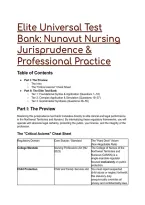
Elite Universal Test
Bank: Nunavut Nursing
Jurisprudence &
Professional Practice
Table of Contents
● Part I: The Preview
○ The Intro
○ The "Critical Axioms" Cheat Sheet
● Part II: The Elite Test Bank
○ Tier 1: Foundational Syntax & Application (Questions 1–18)
○ Tier 2: Complex Application & Simulation (Questions 19–37)
○ Tier 3: Grandmaster Synthesis (Questions 38–55)
Part I: The Preview
Mastering this jurisprudence test bank translates directly to elite clinical and legal performance
in the Northwest Territories and Nunavut. By internalizing these regulatory frameworks, you will
operate with absolute legal certainty, protecting the public, your license, and the integrity of the
profession.
The "Critical Axioms" Cheat Sheet
Regulatory Domain Core Statute / Standard The "Hard Deck" Axiom
(Non-Negotiable Rule)
College Mandate Nursing Professions Act (NU The College of Nurses of the
2023) Northwest Territories and
Nunavut (CANNN) is a
single-mandate regulator
focused exclusively on public
protection.
Child Protection Child and Family Services Act You must report suspected
child abuse or neglect forthwith;
this statutory duty
unequivocally overrides all
privacy and confidentiality laws.
,Regulatory Domain Core Statute / Standard The "Hard Deck" Axiom
(Non-Negotiable Rule)
Public Health Public Health Act Virulent and zoonotic
communicable diseases require
immediate reporting to the
Chief Public Health Officer
without requiring patient
consent.
Scope of Practice RN Prescriber Guidelines The Registered Nurse
Authorized Practice role allows
prescribing a limited range of
medications; it does not grant
autonomous CDSA authority
like a Nurse Practitioner.
Ethics & Safety Cultural Safety Standard Trauma-informed care and
anti-racism are legislated
standards; a "colorblind"
approach violates the mandate
for culturally equitable
Indigenous healthcare.
Part II: The Elite Test Bank
Tier 1: Foundational Syntax & Application
Q1: Under the current legislative framework in Nunavut, CANNN regulates the nursing
profession. Based on the principles of the Nursing Professions Act (NU 2023), which action
represents the EXCLUSIVE mandate of this regulatory body? A) Negotiating collective
bargaining agreements and ensuring competitive compensation for nurses. B) Protecting the
public through the regulation of nursing professionals and enforcing standards of practice. C)
Providing ongoing legal defense for nurses facing civil malpractice litigation. D) Securing
territorial government funding for continuous education programs.
● Answer: B (Protecting the public through the regulation of nursing professionals and
enforcing standards of practice.)
● Distractor Analysis:
○ A is incorrect: Negotiating collective agreements is the purview of a labor union, not
a regulatory college.
○ C is incorrect: Providing legal defense is the role of professional liability
associations (like CNPS), not the regulator.
○ D is incorrect: While continuing competence is mandated, securing educational
funding is outside the scope of a single-mandate regulator.
The Mentor's Analysis: Regulatory bodies exist for one primary reason: public protection. When
facing questions regarding the College's role, the immediate priority is identifying actions that
ensure safe, ethical care. By utilizing the single-mandate regulator concept, you bypass the
common trap of confusing a union's advocacy role with a college's duty. Professional Intuition:
The College protects the public; the Union protects the nurse.
Q2: A nurse working in an isolated Nunavut health center observes signs of physical neglect in
a 6-year-old child. Based on the principles of the Child and Family Services Act, which action is
, the IMMEDIATE legal requirement? A) Document the findings and monitor the child during the
next scheduled clinic visit. B) Contact the parents to collaboratively develop a culturally safe
care plan before escalating. C) Report the reasonable suspicion of neglect to a designated child
protection authority forthwith. D) Consult the health center's physician to confirm the diagnosis
of neglect before reporting.
● Answer: C (Report the reasonable suspicion of neglect to a designated child protection
authority forthwith.)
● Distractor Analysis:
○ A is incorrect: Monitoring delays critical intervention and violates the mandatory
"forthwith" reporting requirement.
○ B is incorrect: Notifying parents prior to reporting suspected abuse can endanger
the child and compromise investigations.
○ D is incorrect: The law requires reporting based on "reasonable grounds to
suspect," not a confirmed medical diagnosis; waiting creates unlawful delay.
The Mentor's Analysis: Mandatory reporting laws override standard confidentiality protocols.
When facing suspected child abuse or neglect, the immediate priority is notifying child protection
services. By utilizing your own reasonable suspicion, you bypass the common trap of seeking
external confirmation or delaying intervention. Professional Intuition: Reasonable suspicion is
the threshold for reporting; proof is the burden of the investigator.
Q3: An RN Prescriber is working in a primary care clinic. Based on the principles of CANNN's
expanded scope regulations, what is a PROHIBITED action for this designation? A) Prescribing
a limited range of medications for uncomplicated presentations. B) Ordering specific screening
diagnostic tests based on a clinical support tool. C) Independently prescribing controlled
substances under the CDSA. D) Administering a medication properly prescribed by an
authorized Nurse Practitioner.
● Answer: C (Independently prescribing controlled substances under the CDSA.)
● Distractor Analysis:
○ A is incorrect: RN Prescribers are explicitly authorized to prescribe a limited range
of medications.
○ B is incorrect: The role allows ordering a limited range of screening diagnostic tests.
○ D is incorrect: Administering medications prescribed by an NP is a standard RN
competency.
The Mentor's Analysis: The RN Prescriber role expands access to care but maintains strict
boundaries. When facing scope of practice dilemmas, the immediate priority is recognizing that
controlled substances remain heavily restricted. By utilizing the limited range parameter, you
bypass the common trap of confusing RN Authorized Practice with full Nurse Practitioner
authority. Professional Intuition: An RN Prescriber is limited by specialized tools; an NP
possesses autonomous diagnostic and CDSA prescriptive authority.
Q4: A nurse is promoting their new independent medical aesthetics practice on social media.
Based on the principles of CANNN's Advertising Standards, which element is MANDATORY in
all promotional materials? A) A guarantee of specific cosmetic outcomes to ensure
transparency. B) The nurse's name and professional designation. C) Endorsements from a
licensed medical director. D) Before-and-after photographs of previous clients.
● Answer: B (The nurse's name and professional designation.)
● Distractor Analysis:
○ A is incorrect: Guaranteeing outcomes is unethical and prohibited, as medical
results cannot be absolutely guaranteed.
○ C is incorrect: While collaboration is required for injectables, advertising does not
Bank: Nunavut Nursing
Jurisprudence &
Professional Practice
Table of Contents
● Part I: The Preview
○ The Intro
○ The "Critical Axioms" Cheat Sheet
● Part II: The Elite Test Bank
○ Tier 1: Foundational Syntax & Application (Questions 1–18)
○ Tier 2: Complex Application & Simulation (Questions 19–37)
○ Tier 3: Grandmaster Synthesis (Questions 38–55)
Part I: The Preview
Mastering this jurisprudence test bank translates directly to elite clinical and legal performance
in the Northwest Territories and Nunavut. By internalizing these regulatory frameworks, you will
operate with absolute legal certainty, protecting the public, your license, and the integrity of the
profession.
The "Critical Axioms" Cheat Sheet
Regulatory Domain Core Statute / Standard The "Hard Deck" Axiom
(Non-Negotiable Rule)
College Mandate Nursing Professions Act (NU The College of Nurses of the
2023) Northwest Territories and
Nunavut (CANNN) is a
single-mandate regulator
focused exclusively on public
protection.
Child Protection Child and Family Services Act You must report suspected
child abuse or neglect forthwith;
this statutory duty
unequivocally overrides all
privacy and confidentiality laws.
,Regulatory Domain Core Statute / Standard The "Hard Deck" Axiom
(Non-Negotiable Rule)
Public Health Public Health Act Virulent and zoonotic
communicable diseases require
immediate reporting to the
Chief Public Health Officer
without requiring patient
consent.
Scope of Practice RN Prescriber Guidelines The Registered Nurse
Authorized Practice role allows
prescribing a limited range of
medications; it does not grant
autonomous CDSA authority
like a Nurse Practitioner.
Ethics & Safety Cultural Safety Standard Trauma-informed care and
anti-racism are legislated
standards; a "colorblind"
approach violates the mandate
for culturally equitable
Indigenous healthcare.
Part II: The Elite Test Bank
Tier 1: Foundational Syntax & Application
Q1: Under the current legislative framework in Nunavut, CANNN regulates the nursing
profession. Based on the principles of the Nursing Professions Act (NU 2023), which action
represents the EXCLUSIVE mandate of this regulatory body? A) Negotiating collective
bargaining agreements and ensuring competitive compensation for nurses. B) Protecting the
public through the regulation of nursing professionals and enforcing standards of practice. C)
Providing ongoing legal defense for nurses facing civil malpractice litigation. D) Securing
territorial government funding for continuous education programs.
● Answer: B (Protecting the public through the regulation of nursing professionals and
enforcing standards of practice.)
● Distractor Analysis:
○ A is incorrect: Negotiating collective agreements is the purview of a labor union, not
a regulatory college.
○ C is incorrect: Providing legal defense is the role of professional liability
associations (like CNPS), not the regulator.
○ D is incorrect: While continuing competence is mandated, securing educational
funding is outside the scope of a single-mandate regulator.
The Mentor's Analysis: Regulatory bodies exist for one primary reason: public protection. When
facing questions regarding the College's role, the immediate priority is identifying actions that
ensure safe, ethical care. By utilizing the single-mandate regulator concept, you bypass the
common trap of confusing a union's advocacy role with a college's duty. Professional Intuition:
The College protects the public; the Union protects the nurse.
Q2: A nurse working in an isolated Nunavut health center observes signs of physical neglect in
a 6-year-old child. Based on the principles of the Child and Family Services Act, which action is
, the IMMEDIATE legal requirement? A) Document the findings and monitor the child during the
next scheduled clinic visit. B) Contact the parents to collaboratively develop a culturally safe
care plan before escalating. C) Report the reasonable suspicion of neglect to a designated child
protection authority forthwith. D) Consult the health center's physician to confirm the diagnosis
of neglect before reporting.
● Answer: C (Report the reasonable suspicion of neglect to a designated child protection
authority forthwith.)
● Distractor Analysis:
○ A is incorrect: Monitoring delays critical intervention and violates the mandatory
"forthwith" reporting requirement.
○ B is incorrect: Notifying parents prior to reporting suspected abuse can endanger
the child and compromise investigations.
○ D is incorrect: The law requires reporting based on "reasonable grounds to
suspect," not a confirmed medical diagnosis; waiting creates unlawful delay.
The Mentor's Analysis: Mandatory reporting laws override standard confidentiality protocols.
When facing suspected child abuse or neglect, the immediate priority is notifying child protection
services. By utilizing your own reasonable suspicion, you bypass the common trap of seeking
external confirmation or delaying intervention. Professional Intuition: Reasonable suspicion is
the threshold for reporting; proof is the burden of the investigator.
Q3: An RN Prescriber is working in a primary care clinic. Based on the principles of CANNN's
expanded scope regulations, what is a PROHIBITED action for this designation? A) Prescribing
a limited range of medications for uncomplicated presentations. B) Ordering specific screening
diagnostic tests based on a clinical support tool. C) Independently prescribing controlled
substances under the CDSA. D) Administering a medication properly prescribed by an
authorized Nurse Practitioner.
● Answer: C (Independently prescribing controlled substances under the CDSA.)
● Distractor Analysis:
○ A is incorrect: RN Prescribers are explicitly authorized to prescribe a limited range
of medications.
○ B is incorrect: The role allows ordering a limited range of screening diagnostic tests.
○ D is incorrect: Administering medications prescribed by an NP is a standard RN
competency.
The Mentor's Analysis: The RN Prescriber role expands access to care but maintains strict
boundaries. When facing scope of practice dilemmas, the immediate priority is recognizing that
controlled substances remain heavily restricted. By utilizing the limited range parameter, you
bypass the common trap of confusing RN Authorized Practice with full Nurse Practitioner
authority. Professional Intuition: An RN Prescriber is limited by specialized tools; an NP
possesses autonomous diagnostic and CDSA prescriptive authority.
Q4: A nurse is promoting their new independent medical aesthetics practice on social media.
Based on the principles of CANNN's Advertising Standards, which element is MANDATORY in
all promotional materials? A) A guarantee of specific cosmetic outcomes to ensure
transparency. B) The nurse's name and professional designation. C) Endorsements from a
licensed medical director. D) Before-and-after photographs of previous clients.
● Answer: B (The nurse's name and professional designation.)
● Distractor Analysis:
○ A is incorrect: Guaranteeing outcomes is unethical and prohibited, as medical
results cannot be absolutely guaranteed.
○ C is incorrect: While collaboration is required for injectables, advertising does not


