
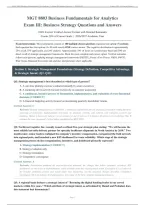
MGT 8803 Business Fundamentals for Analytics | Exam III: Business Strategy | 2026/2027 Counts 20% of Course Grade
MGT 8803 Business Fundamentals for Analytics
Exam III: Business Strategy Questions and Answers
100% Correct Verified Answer Format with Detailed Rationales
Counts 20% of Course Grade | 2026/2027 Academic Year
Exam Instructions: This examination consists of 100 multiple-choice questions organized into seven (7) sections.
Each question has four options (A–D) with exactly ONE correct answer. The cognitive distribution is approximately
25% recall, 55% application, and 20% analysis. Approximately 70% of items are scenario/case-based and 30% are
direct recall of strategic management frameworks. Mark the most complete and correct option. Verified rationales
follow each question, applying strategic management frameworks (PESTEL, Porter’s Five Forces, VRIO, SWOT,
Blue Ocean, Balanced Scorecard) and analytics interpretation where applicable.
Section 1: Strategic Management Foundations (Strategy Definition, Competitive Advantage,
& Strategic Intent) (Q1–Q12)
Q1: Strategic management is best described as which type of process?
A. A one-time planning exercise conducted annually by senior executives
B. A marketing-driven activity focused exclusively on customer acquisition
C. A continuous, iterative process of formulation, implementation, and evaluation of cross-functional
decisions [CORRECT]
D. A financial budgeting activity focused on maximizing quarterly shareholder returns
Correct Answer: C
Rationale: Strategic management is, by definition, a continuous and iterative process spanning formulation (setting direction,
analyzing environments), implementation (executing via structure, controls, and culture), and evaluation (control and
learning). Option A incorrectly reduces it to an annual exercise; C narrows it to finance; D narrows it to marketing. Only B
captures the cross-functional, cyclical nature emphasized in MGT 8803.
Q2: Northwest Logistics Inc. recently issued a refined five-year strategic plan stating: "We will become the
most reliable last-mile delivery partner for specialty healthcare shipments in North America by 2030." Two
months later, senior leaders realigned the company’s incentive compensation, reorganized the field network
into regional pods, and launched a new KPI dashboard for route reliability. Which stage of the strategic
management process do the reorganization, incentives, and dashboard primarily represent?
A. Strategy implementation [CORRECT]
B. Strategy evaluation only
C. Strategy formulation
D. Competitive convergence
Correct Answer: A
Rationale: Formulation produced the mission-direction statement; the changes that follow (structure, incentives, KPI
dashboard) are the levers of implementation, which translate intent into organizational action. Evaluation (C) is a subset of
the broader continuous process and would imply only monitoring, not the structural changes described. Competitive
convergence (D) is an industry-level phenomenon, not a stage of the firm’s strategic management process.
Q3: A regional bank declares a strategic intent of "Becoming the digital banking leader in our served
markets within five years." Which attribute of strategic intent, as articulated by Hamel and Prahalad, does
this statement best demonstrate?
Page 1
,MGT 8803 Business Fundamentals for Analytics | Exam III: Business Strategy | 2026/2027 Counts 20% of Course Grade
A. It is modest, achievable with existing resources
B. It is identical to a tactical five-year operating plan
C. It is a guaranteed outcome requiring no resource reallocation
D. It captures an ambitious stretch goal that forces the firm to leverage underutilized capabilities
[CORRECT]
Correct Answer: D
Rationale: Strategic intent is characterized by a stretch ambition that exceeds current resources and capabilities, requiring the
firm to inventively leverage underutilized assets. Modest goals (A) and guaranteed outcomes (D) contradict the stretch
concept, while tactical plans (C) are operational, not strategic. The digital banking ambition is a textbook stretch goal that
compels capability building rather than incremental improvement.
Q4: Which of the following is the MOST accurate definition of sustainable competitive advantage?
A. Any temporary edge a firm gains by lowering its prices below competitors
B. A value-creating position that competitors cannot easily imitate, trade away, or substitute over time
[CORRECT]
C. The achievement of being the lowest-cost producer in an industry for one quarter
D. The mere possession of any valuable resource regardless of imitation risk
Correct Answer: B
Rationale: Sustainable competitive advantage requires not just value creation, but also barriers to imitation, trade-off
protection, and substitutability defenses. Option A confuses pricing tactics with sustained advantage; C narrows sustainability
to a single quarter of cost leadership; D ignores rarity and imitability (the R and I in VRIO). Option B captures the durability
dimensions central to Barney’s resource-based view.
Q5: Pinnacle Home Builders has identified a sustainable cost advantage from its proprietary modular wall
fabrication process. Rivals have tried to copy the process for three years without matching Pinnacle’s
per-unit cost. Which form of competitive advantage does Pinnacle most likely possess?
A. Differentiation advantage
B. Cost advantage [CORRECT]
C. Substitution advantage
D. Network advantage
Correct Answer: B
Rationale: A per-unit cost that competitors cannot match is the textbook signature of a cost advantage. Differentiation
advantage (A) would manifest as premium willingness-to-pay, not lower cost. Network advantage (C) arises from network
effects in platform markets; substitution advantage (D) is not a recognized form of competitive advantage. The proprietary
fabrication process is a rare and inimitable cost-driver.
Q6: Lumen Cosmetics charges a 40% price premium because consumers perceive its clean-ingredient
formulations as uniquely trustworthy, and that perception has persisted despite multiple rival launches.
Which advantage type is Lumen exhibiting?
A. Cost advantage
B. Cost focus advantage
C. Vertical integration advantage
D. Differentiation advantage [CORRECT]
Correct Answer: D
Rationale: Premium pricing grounded in perceived uniqueness and customer willingness-to-pay is the hallmark of a
differentiation advantage. Cost advantage (A) would reflect lower per-unit cost; cost focus (C) targets a narrow cost
segment; vertical integration (D) describes ownership across value chain stages. The brand trust premium is a non-price value
Page 2
, MGT 8803 Business Fundamentals for Analytics | Exam III: Business Strategy | 2026/2027 Counts 20% of Course Grade
driver that supports the differentiation position.
Q7: Which component of the balanced scorecard explicitly captures learning and growth indicators such as
employee training hours, system uptime, and innovation pipeline strength?
A. Learning and growth perspective [CORRECT]
B. Customer perspective
C. Internal business process perspective
D. Financial perspective
Correct Answer: A
Rationale: Kaplan and Norton’s balanced scorecard contains four perspectives: financial, customer, internal business
process, and learning and growth. Training hours, system uptime, and innovation pipeline are leading indicators of
capability building that fall squarely in the learning and growth perspective. The other perspectives capture financial
outcomes, customer-facing value, and process efficiency, respectively, but not the underlying capability investments.
Q8: A CEO has stated an ambitious vision but the executive team’s quarterly objectives remain focused
exclusively on earnings per share. When the CEO asks the analytics team to design a corrective
performance system, which framework most directly addresses the disconnect between long-term vision
and short-term financials?
A. Porter’s Five Forces
B. PESTEL analysis
C. Balanced scorecard [CORRECT]
D. Industry life cycle model
Correct Answer: C
Rationale: The balanced scorecard was created precisely to translate vision and strategy into a balanced set of objectives
across financial, customer, internal process, and learning/growth perspectives, preventing over-reliance on short-term
financials. PESTEL (A) and Five Forces (B) are environmental analysis tools, not performance measurement systems, and
the industry life cycle (D) describes industry evolution rather than firm-level performance alignment.
Q9: A fintech startup’s founders drafted a one-line vision statement: "Be the best fintech." The board’s
strategy committee finds it vague. Which revised statement most improves the vision per strategic
management best practice?
A. "Continue current operations with modest improvements"
B. "Be a profitable fintech with strong EPS growth"
C. "Maximize quarterly shareholder distributions"
D. "Make affordable financial services universally accessible in emerging markets within ten years"
[CORRECT]
Correct Answer: D
Rationale: A strong vision is forward-looking, inspiring, specific enough to guide resource allocation, and bounded by a
meaningful time horizon. Option B specifies a customer (emerging markets), a stretch ambition (universal access), and a
horizon (ten years). Option A is financial, not visionary; C is a maintenance statement, not a vision; D returns to short-term
shareholder distributions and contradicts the long-term nature of vision statements.
Q10: Helix Pharma’s leadership team spent six months analyzing the external environment and selecting a
differentiation strategy in oncology therapeutics. After the plan was approved, the COO immediately
announced a reorganization to align R&D;, commercial, and medical affairs under a single Therapeutic
Area leader. Why is the reorganization a critical step in strategy implementation rather than formulation?
A. Because reorganization is always a marketing activity
B. Because reorganization changes the industry life cycle stage
Page 3
MGT 8803 Business Fundamentals for Analytics
Exam III: Business Strategy Questions and Answers
100% Correct Verified Answer Format with Detailed Rationales
Counts 20% of Course Grade | 2026/2027 Academic Year
Exam Instructions: This examination consists of 100 multiple-choice questions organized into seven (7) sections.
Each question has four options (A–D) with exactly ONE correct answer. The cognitive distribution is approximately
25% recall, 55% application, and 20% analysis. Approximately 70% of items are scenario/case-based and 30% are
direct recall of strategic management frameworks. Mark the most complete and correct option. Verified rationales
follow each question, applying strategic management frameworks (PESTEL, Porter’s Five Forces, VRIO, SWOT,
Blue Ocean, Balanced Scorecard) and analytics interpretation where applicable.
Section 1: Strategic Management Foundations (Strategy Definition, Competitive Advantage,
& Strategic Intent) (Q1–Q12)
Q1: Strategic management is best described as which type of process?
A. A one-time planning exercise conducted annually by senior executives
B. A marketing-driven activity focused exclusively on customer acquisition
C. A continuous, iterative process of formulation, implementation, and evaluation of cross-functional
decisions [CORRECT]
D. A financial budgeting activity focused on maximizing quarterly shareholder returns
Correct Answer: C
Rationale: Strategic management is, by definition, a continuous and iterative process spanning formulation (setting direction,
analyzing environments), implementation (executing via structure, controls, and culture), and evaluation (control and
learning). Option A incorrectly reduces it to an annual exercise; C narrows it to finance; D narrows it to marketing. Only B
captures the cross-functional, cyclical nature emphasized in MGT 8803.
Q2: Northwest Logistics Inc. recently issued a refined five-year strategic plan stating: "We will become the
most reliable last-mile delivery partner for specialty healthcare shipments in North America by 2030." Two
months later, senior leaders realigned the company’s incentive compensation, reorganized the field network
into regional pods, and launched a new KPI dashboard for route reliability. Which stage of the strategic
management process do the reorganization, incentives, and dashboard primarily represent?
A. Strategy implementation [CORRECT]
B. Strategy evaluation only
C. Strategy formulation
D. Competitive convergence
Correct Answer: A
Rationale: Formulation produced the mission-direction statement; the changes that follow (structure, incentives, KPI
dashboard) are the levers of implementation, which translate intent into organizational action. Evaluation (C) is a subset of
the broader continuous process and would imply only monitoring, not the structural changes described. Competitive
convergence (D) is an industry-level phenomenon, not a stage of the firm’s strategic management process.
Q3: A regional bank declares a strategic intent of "Becoming the digital banking leader in our served
markets within five years." Which attribute of strategic intent, as articulated by Hamel and Prahalad, does
this statement best demonstrate?
Page 1
,MGT 8803 Business Fundamentals for Analytics | Exam III: Business Strategy | 2026/2027 Counts 20% of Course Grade
A. It is modest, achievable with existing resources
B. It is identical to a tactical five-year operating plan
C. It is a guaranteed outcome requiring no resource reallocation
D. It captures an ambitious stretch goal that forces the firm to leverage underutilized capabilities
[CORRECT]
Correct Answer: D
Rationale: Strategic intent is characterized by a stretch ambition that exceeds current resources and capabilities, requiring the
firm to inventively leverage underutilized assets. Modest goals (A) and guaranteed outcomes (D) contradict the stretch
concept, while tactical plans (C) are operational, not strategic. The digital banking ambition is a textbook stretch goal that
compels capability building rather than incremental improvement.
Q4: Which of the following is the MOST accurate definition of sustainable competitive advantage?
A. Any temporary edge a firm gains by lowering its prices below competitors
B. A value-creating position that competitors cannot easily imitate, trade away, or substitute over time
[CORRECT]
C. The achievement of being the lowest-cost producer in an industry for one quarter
D. The mere possession of any valuable resource regardless of imitation risk
Correct Answer: B
Rationale: Sustainable competitive advantage requires not just value creation, but also barriers to imitation, trade-off
protection, and substitutability defenses. Option A confuses pricing tactics with sustained advantage; C narrows sustainability
to a single quarter of cost leadership; D ignores rarity and imitability (the R and I in VRIO). Option B captures the durability
dimensions central to Barney’s resource-based view.
Q5: Pinnacle Home Builders has identified a sustainable cost advantage from its proprietary modular wall
fabrication process. Rivals have tried to copy the process for three years without matching Pinnacle’s
per-unit cost. Which form of competitive advantage does Pinnacle most likely possess?
A. Differentiation advantage
B. Cost advantage [CORRECT]
C. Substitution advantage
D. Network advantage
Correct Answer: B
Rationale: A per-unit cost that competitors cannot match is the textbook signature of a cost advantage. Differentiation
advantage (A) would manifest as premium willingness-to-pay, not lower cost. Network advantage (C) arises from network
effects in platform markets; substitution advantage (D) is not a recognized form of competitive advantage. The proprietary
fabrication process is a rare and inimitable cost-driver.
Q6: Lumen Cosmetics charges a 40% price premium because consumers perceive its clean-ingredient
formulations as uniquely trustworthy, and that perception has persisted despite multiple rival launches.
Which advantage type is Lumen exhibiting?
A. Cost advantage
B. Cost focus advantage
C. Vertical integration advantage
D. Differentiation advantage [CORRECT]
Correct Answer: D
Rationale: Premium pricing grounded in perceived uniqueness and customer willingness-to-pay is the hallmark of a
differentiation advantage. Cost advantage (A) would reflect lower per-unit cost; cost focus (C) targets a narrow cost
segment; vertical integration (D) describes ownership across value chain stages. The brand trust premium is a non-price value
Page 2
, MGT 8803 Business Fundamentals for Analytics | Exam III: Business Strategy | 2026/2027 Counts 20% of Course Grade
driver that supports the differentiation position.
Q7: Which component of the balanced scorecard explicitly captures learning and growth indicators such as
employee training hours, system uptime, and innovation pipeline strength?
A. Learning and growth perspective [CORRECT]
B. Customer perspective
C. Internal business process perspective
D. Financial perspective
Correct Answer: A
Rationale: Kaplan and Norton’s balanced scorecard contains four perspectives: financial, customer, internal business
process, and learning and growth. Training hours, system uptime, and innovation pipeline are leading indicators of
capability building that fall squarely in the learning and growth perspective. The other perspectives capture financial
outcomes, customer-facing value, and process efficiency, respectively, but not the underlying capability investments.
Q8: A CEO has stated an ambitious vision but the executive team’s quarterly objectives remain focused
exclusively on earnings per share. When the CEO asks the analytics team to design a corrective
performance system, which framework most directly addresses the disconnect between long-term vision
and short-term financials?
A. Porter’s Five Forces
B. PESTEL analysis
C. Balanced scorecard [CORRECT]
D. Industry life cycle model
Correct Answer: C
Rationale: The balanced scorecard was created precisely to translate vision and strategy into a balanced set of objectives
across financial, customer, internal process, and learning/growth perspectives, preventing over-reliance on short-term
financials. PESTEL (A) and Five Forces (B) are environmental analysis tools, not performance measurement systems, and
the industry life cycle (D) describes industry evolution rather than firm-level performance alignment.
Q9: A fintech startup’s founders drafted a one-line vision statement: "Be the best fintech." The board’s
strategy committee finds it vague. Which revised statement most improves the vision per strategic
management best practice?
A. "Continue current operations with modest improvements"
B. "Be a profitable fintech with strong EPS growth"
C. "Maximize quarterly shareholder distributions"
D. "Make affordable financial services universally accessible in emerging markets within ten years"
[CORRECT]
Correct Answer: D
Rationale: A strong vision is forward-looking, inspiring, specific enough to guide resource allocation, and bounded by a
meaningful time horizon. Option B specifies a customer (emerging markets), a stretch ambition (universal access), and a
horizon (ten years). Option A is financial, not visionary; C is a maintenance statement, not a vision; D returns to short-term
shareholder distributions and contradicts the long-term nature of vision statements.
Q10: Helix Pharma’s leadership team spent six months analyzing the external environment and selecting a
differentiation strategy in oncology therapeutics. After the plan was approved, the COO immediately
announced a reorganization to align R&D;, commercial, and medical affairs under a single Therapeutic
Area leader. Why is the reorganization a critical step in strategy implementation rather than formulation?
A. Because reorganization is always a marketing activity
B. Because reorganization changes the industry life cycle stage
Page 3


