
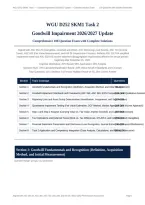
WGU D252 SKM1 Task 2 — Goodwill Impairment 2026/2027 Update — Complete Solution Exam 100 Questions with Detailed Rationales
WGU D252 SKM1 Task 2
Goodwill Impairment 2026/2027 Update
Comprehensive 100-Question Exam with Complete Solutions
Aligned with ASC 350-20 (Intangibles—Goodwill and Other), ASC 360 (Long-Lived Assets), ASC 740 (Income
Taxes), ASC 820 (Fair Value Measurement), and IAS 36 (Impairment of Assets). Reflects ASU 2017-04 simplified
impairment model and ASU 2024-03 income-statement disaggregation requirements effective for annual periods
beginning after December 15, 2026.
Cognitive Distribution: 25% Recall | 55% Application | 20% Analysis
Question Style: 70% Calculation/Application-Based | 30% Direct Recall of Standards and Concepts
Total Questions: 100 | Sections: 8 | Format: Multiple Choice (A–D), One Correct Answer
Section Topic Coverage Questions
Section 1 Goodwill Fundamentals and Recognition (Definition, Acquisition Method, and Initial Measurement)
Q1-Q12
Section 2 Goodwill Impairment Standards and Framework (ASC 350, ASC 360, IFRS Comparison,
Q13-Q26and Qualitative Assessm
Section 3 Reporting Units and Asset Group Determination (Identification, Assignment, and Segmentation)
Q27-Q38
Section 4 Quantitative Impairment Testing (Fair Value Estimation, DCF Method, Market Approach,
Q39-Q54
and Income Approach)
Section 5 Step 1 and Step 2 Analysis (Carrying Value vs. Fair Value, Implied Goodwill, and Loss
Q55-Q68
Measurement)
Section 6 Tax Implications and Deferred Taxes (Book vs. Tax Differences, DTL/DTA, and Indefinite-Lived
Q69-Q80 Intangibles)
Section 7 Financial Statement Presentation and Disclosure (Loss Recognition, Journal Entries,
Q81-Q92
and Required Disclosures)
Section 8 Task 2 Application and Competency Integration (Case Analysis, Calculations, and Q93-Q100
Written Submission)
Section 1: Goodwill Fundamentals and Recognition (Definition, Acquisition
Method, and Initial Measurement)
Question Range: Q1-Q12 | 12 Questions
Aligned with ASC 350-20, ASC 360, ASC 740, ASC 820, and IAS 36 | WGU D252 Performance Assessment Page 1
,WGU D252 SKM1 Task 2 — Goodwill Impairment 2026/2027 Update — Complete Solution Exam 100 Questions with Detailed Rationales
Q1: Under ASC 805, goodwill is best defined as:
A. The fair value of all identifiable tangible assets acquired in a business combination.
B. An intangible asset arising from a business combination representing the excess of consideration
transferred over the acquirer's interest in the fair value of net identifiable assets acquired. [CORRECT]
C. The book value of net assets acquired in a business combination.
D. The difference between the acquisition cost and the book value of the acquired entity's assets.
Correct Answer: B
Rationale: ASC 805-30-30-1 defines goodwill as the excess of the consideration transferred over the acquirer's interest in
the acquisition-date fair value of identifiable net assets acquired. Option A excludes intangible assets and the excess
concept; Option C conflates book value with fair value; Option D ignores the fair value adjustment required by ASC 805.
WGU Task 2 requires students to articulate this definition precisely when documenting the acquisition method.
Q2: Which of the following is NOT a key step in applying the acquisition method under ASC 805-10-25?
A. Identifying the acquirer.
B. Determining the acquisition date.
C. Recognizing and measuring the identifiable assets acquired, liabilities assumed, and any noncontrolling interest.
D. Allocating goodwill to reporting units based on the tax basis of the acquired assets. [CORRECT]
Correct Answer: D
Rationale: ASC 805-10-25-4 through 25-20 specify four steps: identify the acquirer, determine the acquisition date,
recognize and measure identifiable assets/liabilities/noncontrolling interests, and recognize and measure goodwill or gain on
bargain purchase. Tax-basis allocation is not a separate step in the acquisition method; it is addressed under ASC 805-740
for deferred taxes. WGU Task 2 expects students to demonstrate all four steps with proper ASC citations.
Q3: Pinnacle Corp acquired 100% of Sycamore Inc. for $5,200,000 cash. Sycamore's identifiable net assets
had a fair value of $4,100,000 and a book value of $3,800,000. What is the goodwill recognized in the
acquisition?
A. $1,400,000
B. $1,100,000 [CORRECT]
C. $400,000
D. $5,200,000
Correct Answer: B
Rationale: Goodwill = Consideration transferred ($5,200,000) - Fair value of identifiable net assets acquired ($4,100,000) =
$1,100,000. Book value ($3,800,000) is irrelevant for goodwill measurement under ASC 805-30-30-1; only fair value
matters. Option A incorrectly subtracts book value; Option C measures only the fair value adjustment; Option D is the
consideration itself. Task 2 calculations must use fair value, not book value.
Q4: Which of the following is NOT a component of goodwill as described in ASC 805-30-30-9?
A. Going-concern value of the acquired business.
B. Synergies expected from combining the businesses of the acquirer and the acquiree.
C. Internally developed goodwill of the acquirer existing prior to the acquisition. [CORRECT]
D. Intangible assets that do not qualify for separate recognition.
Correct Answer: C
Rationale: ASC 805-30-30-9 identifies components of goodwill as: (a) going-concern value, (b) synergies expected from
combining operations, and (c) intangible assets that do not qualify for separate recognition. Internally developed goodwill is
never recognized under US GAAP (ASC 350-30-25-4 prohibits recognition of internally developed goodwill). Task 2
analysis requires students to distinguish acquired goodwill from internally developed goodwill.
Aligned with ASC 350-20, ASC 360, ASC 740, ASC 820, and IAS 36 | WGU D252 Performance Assessment Page 2
,WGU D252 SKM1 Task 2 — Goodwill Impairment 2026/2027 Update — Complete Solution Exam 100 Questions with Detailed Rationales
Q5: When the acquisition-date fair value of net identifiable assets acquired exceeds the consideration
transferred, the acquirer shall:
A. Recognize the excess as goodwill over a 10-year amortization period.
B. Recognize a gain from a bargain purchase in earnings on the acquisition date. [CORRECT]
C. Recognize the excess as deferred income on the balance sheet.
D. Reduce the fair value of identifiable intangibles until goodwill equals zero.
Correct Answer: B
Rationale: Under ASC 805-30-25-2, a bargain purchase (negative goodwill) results in a gain recognized in earnings at the
acquisition date after the acquirer reassesses whether all identifiable assets and liabilities have been properly identified.
Option A is wrong because there is no goodwill to amortize; Option C misclassifies the gain as deferred income; Option D
contradicts the measurement principle. WGU Task 2 may include a bargain purchase scenario requiring this analysis.
Q6: Apex Corp paid $3,000,000 cash and issued 100,000 shares (fair value $25 per share) to acquire Beta Inc.
Apex also paid $200,000 in legal fees to its external counsel and $150,000 in stock registration fees to the SEC.
What is the consideration transferred for goodwill measurement?
A. $5,500,000
B. $5,700,000
C. $5,350,000 [CORRECT]
D. $5,200,000
Correct Answer: C
Rationale: Consideration transferred = Cash ($3,000,000) + Equity issued at fair value (100,000 × $25 = $2,500,000) -
Registration fees paid by issuer are treated as a reduction of equity proceeds under ASC 470-20 but for acquisition
consideration the standard practice excludes $150,000 of registration fees from consideration: $3,000,000 + $2,500,000 -
$150,000 = $5,350,000. Legal fees ($200,000) are expensed as incurred per ASC 805-10-25-23 and are NOT part of
consideration. Task 2 students must distinguish acquisition-related costs (expensed) from consideration transferred
(capitalized in goodwill).
Q7: Under ASC 805-30-30-7, the acquirer may measure noncontrolling interest at:
A. Fair value only, resulting in gross (full) goodwill.
B. Either fair value (gross goodwill method) or the proportionate share of the acquiree's identifiable net assets
(net goodwill method). [CORRECT]
C. Book value only, since fair value is not determinable for noncontrolling interest.
D. The lower of cost or market, consistent with inventory accounting.
Correct Answer: B
Rationale: ASC 805-30-30-7 permits an entity-level election to measure noncontrolling interest at either (a) fair value,
which includes goodwill attributable to the NCI (gross method), or (b) the proportionate share of identifiable net assets,
which excludes NCI goodwill (net method). The election must be applied consistently. Option A is overly restrictive;
Option C and D are incorrect measurement bases. Task 2 students must disclose which method was elected.
Aligned with ASC 350-20, ASC 360, ASC 740, ASC 820, and IAS 36 | WGU D252 Performance Assessment Page 3
, WGU D252 SKM1 Task 2 — Goodwill Impairment 2026/2027 Update — Complete Solution Exam 100 Questions with Detailed Rationales
Q8: Which statement best describes the nature of goodwill under US GAAP?
A. Goodwill is a wasting asset that must be amortized over its useful life not to exceed 40 years.
B. Goodwill is an indefinite-lived intangible asset subject to impairment testing at least annually, with no
amortization for public business entities. [CORRECT]
C. Goodwill is a financial asset measured at fair value through profit or loss.
D. Goodwill is a contra-asset that reduces total assets on the balance sheet.
Correct Answer: B
Rationale: Under ASC 350-20-35, public business entities do not amortize goodwill; instead, goodwill is tested for
impairment at least annually at the reporting unit level. Private companies may elect the ASC 350-20-35-8A alternative to
amortize goodwill on a straight-line basis over 10 years (or less). Option A reflects pre-2001 GAAP; Option C and D are
incorrect classifications. Task 2 expectations align with the public entity model unless the alternative is explicitly addressed.
Q9: Direct costs of the acquisition such as finder's fees, advisory fees, legal fees, and consulting fees should be:
A. Capitalized as part of goodwill in the consolidated balance sheet.
B. Expensed as incurred in the period the related services are received. [CORRECT]
C. Deferred and amortized over the useful life of goodwill.
D. Included in the fair value of consideration transferred for goodwill measurement.
Correct Answer: B
Rationale: ASC 805-10-25-23 requires acquisition-related costs (finder's, advisory, legal, accounting) to be expensed as
incurred because the acquirer receives a service, not an asset. These costs are NOT part of consideration transferred and do
not affect goodwill. Option A and D incorrectly capitalize these costs; Option C defers them improperly. WGU Task 2
calculations must exclude these costs from goodwill.
Q10: Contingent consideration classified as a liability at the acquisition date is subsequently:
A. Measured at cost and not remeasured until settlement.
B. Remeasured at fair value at each reporting date with changes recognized in earnings. [CORRECT]
C. Remeasured at fair value with changes recognized in other comprehensive income.
D. Adjusted against goodwill when the contingent payment is made.
Correct Answer: B
Rationale: Under ASC 805-20-30-7 and ASC 805-20-35-3, contingent consideration classified as a liability is remeasured
at fair value at each reporting date, with changes recognized in earnings. Contingent consideration classified as equity is
NOT remeasured. Option C confuses the accounting with available-for-sale securities; Option D contradicts post-acquisition
measurement guidance. Task 2 may require journal entries for remeasurement.
Aligned with ASC 350-20, ASC 360, ASC 740, ASC 820, and IAS 36 | WGU D252 Performance Assessment Page 4
WGU D252 SKM1 Task 2
Goodwill Impairment 2026/2027 Update
Comprehensive 100-Question Exam with Complete Solutions
Aligned with ASC 350-20 (Intangibles—Goodwill and Other), ASC 360 (Long-Lived Assets), ASC 740 (Income
Taxes), ASC 820 (Fair Value Measurement), and IAS 36 (Impairment of Assets). Reflects ASU 2017-04 simplified
impairment model and ASU 2024-03 income-statement disaggregation requirements effective for annual periods
beginning after December 15, 2026.
Cognitive Distribution: 25% Recall | 55% Application | 20% Analysis
Question Style: 70% Calculation/Application-Based | 30% Direct Recall of Standards and Concepts
Total Questions: 100 | Sections: 8 | Format: Multiple Choice (A–D), One Correct Answer
Section Topic Coverage Questions
Section 1 Goodwill Fundamentals and Recognition (Definition, Acquisition Method, and Initial Measurement)
Q1-Q12
Section 2 Goodwill Impairment Standards and Framework (ASC 350, ASC 360, IFRS Comparison,
Q13-Q26and Qualitative Assessm
Section 3 Reporting Units and Asset Group Determination (Identification, Assignment, and Segmentation)
Q27-Q38
Section 4 Quantitative Impairment Testing (Fair Value Estimation, DCF Method, Market Approach,
Q39-Q54
and Income Approach)
Section 5 Step 1 and Step 2 Analysis (Carrying Value vs. Fair Value, Implied Goodwill, and Loss
Q55-Q68
Measurement)
Section 6 Tax Implications and Deferred Taxes (Book vs. Tax Differences, DTL/DTA, and Indefinite-Lived
Q69-Q80 Intangibles)
Section 7 Financial Statement Presentation and Disclosure (Loss Recognition, Journal Entries,
Q81-Q92
and Required Disclosures)
Section 8 Task 2 Application and Competency Integration (Case Analysis, Calculations, and Q93-Q100
Written Submission)
Section 1: Goodwill Fundamentals and Recognition (Definition, Acquisition
Method, and Initial Measurement)
Question Range: Q1-Q12 | 12 Questions
Aligned with ASC 350-20, ASC 360, ASC 740, ASC 820, and IAS 36 | WGU D252 Performance Assessment Page 1
,WGU D252 SKM1 Task 2 — Goodwill Impairment 2026/2027 Update — Complete Solution Exam 100 Questions with Detailed Rationales
Q1: Under ASC 805, goodwill is best defined as:
A. The fair value of all identifiable tangible assets acquired in a business combination.
B. An intangible asset arising from a business combination representing the excess of consideration
transferred over the acquirer's interest in the fair value of net identifiable assets acquired. [CORRECT]
C. The book value of net assets acquired in a business combination.
D. The difference between the acquisition cost and the book value of the acquired entity's assets.
Correct Answer: B
Rationale: ASC 805-30-30-1 defines goodwill as the excess of the consideration transferred over the acquirer's interest in
the acquisition-date fair value of identifiable net assets acquired. Option A excludes intangible assets and the excess
concept; Option C conflates book value with fair value; Option D ignores the fair value adjustment required by ASC 805.
WGU Task 2 requires students to articulate this definition precisely when documenting the acquisition method.
Q2: Which of the following is NOT a key step in applying the acquisition method under ASC 805-10-25?
A. Identifying the acquirer.
B. Determining the acquisition date.
C. Recognizing and measuring the identifiable assets acquired, liabilities assumed, and any noncontrolling interest.
D. Allocating goodwill to reporting units based on the tax basis of the acquired assets. [CORRECT]
Correct Answer: D
Rationale: ASC 805-10-25-4 through 25-20 specify four steps: identify the acquirer, determine the acquisition date,
recognize and measure identifiable assets/liabilities/noncontrolling interests, and recognize and measure goodwill or gain on
bargain purchase. Tax-basis allocation is not a separate step in the acquisition method; it is addressed under ASC 805-740
for deferred taxes. WGU Task 2 expects students to demonstrate all four steps with proper ASC citations.
Q3: Pinnacle Corp acquired 100% of Sycamore Inc. for $5,200,000 cash. Sycamore's identifiable net assets
had a fair value of $4,100,000 and a book value of $3,800,000. What is the goodwill recognized in the
acquisition?
A. $1,400,000
B. $1,100,000 [CORRECT]
C. $400,000
D. $5,200,000
Correct Answer: B
Rationale: Goodwill = Consideration transferred ($5,200,000) - Fair value of identifiable net assets acquired ($4,100,000) =
$1,100,000. Book value ($3,800,000) is irrelevant for goodwill measurement under ASC 805-30-30-1; only fair value
matters. Option A incorrectly subtracts book value; Option C measures only the fair value adjustment; Option D is the
consideration itself. Task 2 calculations must use fair value, not book value.
Q4: Which of the following is NOT a component of goodwill as described in ASC 805-30-30-9?
A. Going-concern value of the acquired business.
B. Synergies expected from combining the businesses of the acquirer and the acquiree.
C. Internally developed goodwill of the acquirer existing prior to the acquisition. [CORRECT]
D. Intangible assets that do not qualify for separate recognition.
Correct Answer: C
Rationale: ASC 805-30-30-9 identifies components of goodwill as: (a) going-concern value, (b) synergies expected from
combining operations, and (c) intangible assets that do not qualify for separate recognition. Internally developed goodwill is
never recognized under US GAAP (ASC 350-30-25-4 prohibits recognition of internally developed goodwill). Task 2
analysis requires students to distinguish acquired goodwill from internally developed goodwill.
Aligned with ASC 350-20, ASC 360, ASC 740, ASC 820, and IAS 36 | WGU D252 Performance Assessment Page 2
,WGU D252 SKM1 Task 2 — Goodwill Impairment 2026/2027 Update — Complete Solution Exam 100 Questions with Detailed Rationales
Q5: When the acquisition-date fair value of net identifiable assets acquired exceeds the consideration
transferred, the acquirer shall:
A. Recognize the excess as goodwill over a 10-year amortization period.
B. Recognize a gain from a bargain purchase in earnings on the acquisition date. [CORRECT]
C. Recognize the excess as deferred income on the balance sheet.
D. Reduce the fair value of identifiable intangibles until goodwill equals zero.
Correct Answer: B
Rationale: Under ASC 805-30-25-2, a bargain purchase (negative goodwill) results in a gain recognized in earnings at the
acquisition date after the acquirer reassesses whether all identifiable assets and liabilities have been properly identified.
Option A is wrong because there is no goodwill to amortize; Option C misclassifies the gain as deferred income; Option D
contradicts the measurement principle. WGU Task 2 may include a bargain purchase scenario requiring this analysis.
Q6: Apex Corp paid $3,000,000 cash and issued 100,000 shares (fair value $25 per share) to acquire Beta Inc.
Apex also paid $200,000 in legal fees to its external counsel and $150,000 in stock registration fees to the SEC.
What is the consideration transferred for goodwill measurement?
A. $5,500,000
B. $5,700,000
C. $5,350,000 [CORRECT]
D. $5,200,000
Correct Answer: C
Rationale: Consideration transferred = Cash ($3,000,000) + Equity issued at fair value (100,000 × $25 = $2,500,000) -
Registration fees paid by issuer are treated as a reduction of equity proceeds under ASC 470-20 but for acquisition
consideration the standard practice excludes $150,000 of registration fees from consideration: $3,000,000 + $2,500,000 -
$150,000 = $5,350,000. Legal fees ($200,000) are expensed as incurred per ASC 805-10-25-23 and are NOT part of
consideration. Task 2 students must distinguish acquisition-related costs (expensed) from consideration transferred
(capitalized in goodwill).
Q7: Under ASC 805-30-30-7, the acquirer may measure noncontrolling interest at:
A. Fair value only, resulting in gross (full) goodwill.
B. Either fair value (gross goodwill method) or the proportionate share of the acquiree's identifiable net assets
(net goodwill method). [CORRECT]
C. Book value only, since fair value is not determinable for noncontrolling interest.
D. The lower of cost or market, consistent with inventory accounting.
Correct Answer: B
Rationale: ASC 805-30-30-7 permits an entity-level election to measure noncontrolling interest at either (a) fair value,
which includes goodwill attributable to the NCI (gross method), or (b) the proportionate share of identifiable net assets,
which excludes NCI goodwill (net method). The election must be applied consistently. Option A is overly restrictive;
Option C and D are incorrect measurement bases. Task 2 students must disclose which method was elected.
Aligned with ASC 350-20, ASC 360, ASC 740, ASC 820, and IAS 36 | WGU D252 Performance Assessment Page 3
, WGU D252 SKM1 Task 2 — Goodwill Impairment 2026/2027 Update — Complete Solution Exam 100 Questions with Detailed Rationales
Q8: Which statement best describes the nature of goodwill under US GAAP?
A. Goodwill is a wasting asset that must be amortized over its useful life not to exceed 40 years.
B. Goodwill is an indefinite-lived intangible asset subject to impairment testing at least annually, with no
amortization for public business entities. [CORRECT]
C. Goodwill is a financial asset measured at fair value through profit or loss.
D. Goodwill is a contra-asset that reduces total assets on the balance sheet.
Correct Answer: B
Rationale: Under ASC 350-20-35, public business entities do not amortize goodwill; instead, goodwill is tested for
impairment at least annually at the reporting unit level. Private companies may elect the ASC 350-20-35-8A alternative to
amortize goodwill on a straight-line basis over 10 years (or less). Option A reflects pre-2001 GAAP; Option C and D are
incorrect classifications. Task 2 expectations align with the public entity model unless the alternative is explicitly addressed.
Q9: Direct costs of the acquisition such as finder's fees, advisory fees, legal fees, and consulting fees should be:
A. Capitalized as part of goodwill in the consolidated balance sheet.
B. Expensed as incurred in the period the related services are received. [CORRECT]
C. Deferred and amortized over the useful life of goodwill.
D. Included in the fair value of consideration transferred for goodwill measurement.
Correct Answer: B
Rationale: ASC 805-10-25-23 requires acquisition-related costs (finder's, advisory, legal, accounting) to be expensed as
incurred because the acquirer receives a service, not an asset. These costs are NOT part of consideration transferred and do
not affect goodwill. Option A and D incorrectly capitalize these costs; Option C defers them improperly. WGU Task 2
calculations must exclude these costs from goodwill.
Q10: Contingent consideration classified as a liability at the acquisition date is subsequently:
A. Measured at cost and not remeasured until settlement.
B. Remeasured at fair value at each reporting date with changes recognized in earnings. [CORRECT]
C. Remeasured at fair value with changes recognized in other comprehensive income.
D. Adjusted against goodwill when the contingent payment is made.
Correct Answer: B
Rationale: Under ASC 805-20-30-7 and ASC 805-20-35-3, contingent consideration classified as a liability is remeasured
at fair value at each reporting date, with changes recognized in earnings. Contingent consideration classified as equity is
NOT remeasured. Option C confuses the accounting with available-for-sale securities; Option D contradicts post-acquisition
measurement guidance. Task 2 may require journal entries for remeasurement.
Aligned with ASC 350-20, ASC 360, ASC 740, ASC 820, and IAS 36 | WGU D252 Performance Assessment Page 4


