
RASMUSSEN UNIVERSITY
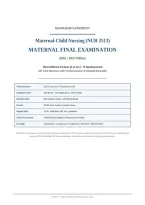
Maternal-Child Nursing (NUR 2513)
MATERNAL FINAL EXAMINATION
Edition
Three Different Versions (A, B, & C) - 75 Questions Each
225 Total Questions with Verified Answers & Detailed Rationales
Total Questions 225 (3 versions x 75 questions each)
Cognitive Levels 30% Recall | 50% Application | 20% Analysis
Question Style 80% Scenario-based | 20% Direct Recall
Format NCLEX-style 4-option multiple choice
Aligned With ACOG, AWHONN, AAP, NCC guidelines
Clinical Framework NCSBN Clinical Judgment Measurement Model
Coverage Antepartum | Intrapartum | Postpartum | Newborn | Meds & Ethics
Verification: All answers and rationales have been reviewed for 100% accuracy against Rasmussen NUR 2513 course materials and
current ACOG/AWHONN/AAP clinical guidelines. Each rationale includes test-taking strategy notes.
NUR 2513 - Maternal-Child Nursing Final Exam | Page 1
, VERSION A - MATERNAL FINAL EXAM
75 Questions | Sections A1 - A5 | Questions 1-75
Version A Overview: This version covers all five maternal-newborn content domains: Antepartum Care &
Complications (Q1-15), Intrapartum Care & Fetal Monitoring (Q16-32), Postpartum Care & Complications (Q33-47),
Newborn Care & Complications (Q48-62), and Maternal-Newborn Medications, Legal/Ethical Issues, & Prioritization
(Q63-75). Questions are designed to assess entry-level RN clinical judgment across the antepartum, intrapartum,
postpartum, and newborn care continuum, aligned with NCSBN Clinical Judgment Measurement Model and current
ACOG/AWHONN/AAP guidelines.
VERSION B - MATERNAL FINAL EXAM
75 Questions | Sections B1 - B5 | Questions 76-150
Version B Overview: This version presents parallel content domains to Version A with unique scenario-based
questions testing equivalent clinical judgment. Coverage: Antepartum Care & Complications (Q76-90), Intrapartum
Care & Fetal Monitoring (Q91-107), Postpartum Care & Complications (Q108-122), Newborn Care & Complications
(Q123-137), and Maternal-Newborn Medications, Legal/Ethical Issues, & Prioritization (Q138-150). Distractors reflect
common maternal-newborn nursing exam pitfalls requiring critical thinking.
VERSION C - MATERNAL FINAL EXAM
75 Questions | Sections C1 - C5 | Questions 151-225
Version C Overview: The third version completes comprehensive Maternal Final Exam preparation with unique
questions of equivalent difficulty. Coverage: Antepartum Care & Complications (Q151-165), Intrapartum Care & Fetal
Monitoring (Q166-182), Postpartum Care & Complications (Q183-197), Newborn Care & Complications (Q198-212),
and Maternal-Newborn Medications, Legal/Ethical Issues, & Prioritization (Q213-225). All rationales include
test-taking strategy notes for Maternal Final Exam preparation.
Section A1: Antepartum Care and Complications
Prenatal Care, High-Risk Pregnancy, & Antepartum Testing (Q1-Q15)
NUR 2513 - Maternal-Child Nursing Final Exam | Page 2
,Q1: A 28-year-old primigravida at 8 weeks gestation presents for her first prenatal visit. Using Nagele's
rule with a last menstrual period (LMP) of March 14, what is the estimated date of delivery (EDD)?
A. December 7 of the same year
B. December 21 of the same year [CORRECT]
C. December 28 of the same year
D. January 7 of the following year
Correct Answer: B. December 21 of the same year
Rationale: Nagele's rule: subtract 3 months from the first day of the LMP and add 7 days. March 14 minus 3 months =
December 14, plus 7 days = December 21. This calculation is the standard method taught in NUR 2513 for establishing
the EDD at the initial prenatal visit, but it assumes a regular 28-day cycle with ovulation on day 14. Test-taking strategy:
always add 7 days AFTER subtracting 3 months; do not subtract 3 days or add 14 days, which are common distractor
errors.
Q2: A pregnant client's obstetric history is documented as G4 T1 P1 A1 L2. Which interpretation by the
nurse is correct?
A. Four pregnancies: one term birth, one preterm birth, one abortion, two living children [CORRECT]
B. Four pregnancies: one twin birth, one preterm birth, one abortion, two living children
C. Four term births, one preterm birth, one abortion, two living children
D. Four pregnancies: one term birth, one preterm labor, one abortion, two losses
Correct Answer: A. Four pregnancies: one term birth, one preterm birth, one abortion, two living children
Rationale: GTPAL stands for Gravida (total pregnancies), Term births, Preterm births, Abortions (spontaneous or elective
before 20 weeks or <500 g), and Living children. G4 T1 P1 A1 L2 = four pregnancies, one term delivery, one preterm
delivery, one abortion, and two living children. Twins count as one pregnancy in gravida, but each infant is counted
separately in T, P, and L only if multiple gestation. Test-taking strategy: Gravida counts pregnancies, not fetuses; term
and preterm count deliveries of infants >20 weeks, and abortions include spontaneous and induced.
Q3: A pregnant client at 10 weeks gestation reports nausea and vomiting throughout the day. Which
nonpharmacologic intervention should the nurse recommend FIRST?
A. Take ondansetron 4 mg every 8 hours as needed
B. Eat three large meals daily to maintain blood glucose
C. Consume dry crackers before rising in the morning [CORRECT]
D. Restrict oral fluids to between meals only
Correct Answer: C. Consume dry crackers before rising in the morning
Rationale: Morning sickness in the first trimester is best managed initially with nonpharmacologic measures: eating dry
crackers or toast before rising (to prevent prolonged fasting hypoglycemia), small frequent meals, and avoiding strong
odors. Pharmacologic options like ondansetron (a 5-HT3 antagonist) require a prescription and are reserved for
persistent symptoms or hyperemesis gravidarum after conservative measures fail. Three large meals worsen nausea, and
oral fluid restriction is contraindicated due to dehydration risk. Test-taking strategy: choose the safest, least invasive
FIRST intervention; pharmacologic options are not first-line.
NUR 2513 - Maternal-Child Nursing Final Exam | Page 3
, Q4: A client at 12 weeks gestation has a maternal serum alpha-fetoprotein (MSAFP) level of 3.0 MoM
(multiple of the median). Which action should the nurse anticipate NEXT?
A. Schedule an immediate cesarean delivery
B. Refer for a targeted ultrasound examination [CORRECT]
C. Administer RhoGAM within 72 hours
D. Initiate magnesium sulfate therapy
Correct Answer: B. Refer for a targeted ultrasound examination
Rationale: Elevated MSAFP (greater than 2.0-2.5 MoM) is associated with open neural tube defects (such as spina bifida
or anencephaly), gastroschisis, omphalocele, multiple gestation, incorrect gestational age, or fetal demise. The NEXT
step is a targeted (level II) ultrasound to confirm gestational age and evaluate fetal anatomy. MSAFP is a screening test,
not diagnostic. Cesarean delivery, RhoGAM, and magnesium sulfate are unrelated to an elevated MSAFP. Test-taking
strategy: an abnormal screening test is followed by a diagnostic imaging study, not a treatment.
Q5: A pregnant client with gestational diabetes mellitus (GDM) asks the nurse about fetal risks associated
with her condition. Which response by the nurse is MOST accurate?
A. Fetal macrosomia, hypoglycemia, and respiratory distress syndrome [CORRECT]
B. Intrauterine growth restriction, hyperglycemia, and polycythemia
C. Anencephaly, macrosomia, and hypoglycemia
D. Microsomia, hyperglycemia, and hypocalcemia
Correct Answer: A. Fetal macrosomia, hypoglycemia, and respiratory distress syndrome
Rationale: GDM exposes the fetus to maternal hyperglycemia, causing fetal hyperinsulinemia, which leads to fetal
macrosomia (excessive growth), neonatal hypoglycemia after delivery (loss of maternal glucose supply), polycythemia,
hypocalcemia, hyperbilirubinemia, and an increased risk of respiratory distress syndrome due to delayed surfactant
production. Intrauterine growth restriction is more typical of preexisting type 1 or type 2 diabetes with vascular disease.
Anencephaly is linked to folate deficiency, not GDM. Test-taking strategy: macrosomia + hypoglycemia = the classic GDM
newborn complications pair.
Q6: A client at 32 weeks gestation is diagnosed with preeclampsia with severe features. Which finding
requires IMMEDIATE nursing intervention?
A. Blood pressure of 144/92 mmHg
B. Persistent headache unresponsive to acetaminophen [CORRECT]
C. Deep tendon reflexes rated 2+
D. Urinary protein 300 mg/24 hours
Correct Answer: B. Persistent headache unresponsive to acetaminophen
Rationale: A persistent headache unresponsive to acetaminophen is a neurologic sign of worsening preeclampsia and
may herald an impending eclamptic seizure. The nurse should immediately assess the client, notify the provider, and
anticipate IV magnesium sulfate therapy for seizure prophylaxis. Preeclampsia with severe features is defined as BP >=
160 systolic or >= 110 diastolic, platelets < 100,000, elevated liver enzymes, renal insufficiency, pulmonary edema, or
new-onset cerebral/visual disturbance. Test-taking strategy: the ABCs and neurologic symptoms always supersede
laboratory values; a "worsening neurologic status" answer is almost always the priority in preeclampsia.
NUR 2513 - Maternal-Child Nursing Final Exam | Page 4
Maternal-Child Nursing (NUR 2513)
MATERNAL FINAL EXAMINATION
Edition
Three Different Versions (A, B, & C) - 75 Questions Each
225 Total Questions with Verified Answers & Detailed Rationales
Total Questions 225 (3 versions x 75 questions each)
Cognitive Levels 30% Recall | 50% Application | 20% Analysis
Question Style 80% Scenario-based | 20% Direct Recall
Format NCLEX-style 4-option multiple choice
Aligned With ACOG, AWHONN, AAP, NCC guidelines
Clinical Framework NCSBN Clinical Judgment Measurement Model
Coverage Antepartum | Intrapartum | Postpartum | Newborn | Meds & Ethics
Verification: All answers and rationales have been reviewed for 100% accuracy against Rasmussen NUR 2513 course materials and
current ACOG/AWHONN/AAP clinical guidelines. Each rationale includes test-taking strategy notes.
NUR 2513 - Maternal-Child Nursing Final Exam | Page 1
, VERSION A - MATERNAL FINAL EXAM
75 Questions | Sections A1 - A5 | Questions 1-75
Version A Overview: This version covers all five maternal-newborn content domains: Antepartum Care &
Complications (Q1-15), Intrapartum Care & Fetal Monitoring (Q16-32), Postpartum Care & Complications (Q33-47),
Newborn Care & Complications (Q48-62), and Maternal-Newborn Medications, Legal/Ethical Issues, & Prioritization
(Q63-75). Questions are designed to assess entry-level RN clinical judgment across the antepartum, intrapartum,
postpartum, and newborn care continuum, aligned with NCSBN Clinical Judgment Measurement Model and current
ACOG/AWHONN/AAP guidelines.
VERSION B - MATERNAL FINAL EXAM
75 Questions | Sections B1 - B5 | Questions 76-150
Version B Overview: This version presents parallel content domains to Version A with unique scenario-based
questions testing equivalent clinical judgment. Coverage: Antepartum Care & Complications (Q76-90), Intrapartum
Care & Fetal Monitoring (Q91-107), Postpartum Care & Complications (Q108-122), Newborn Care & Complications
(Q123-137), and Maternal-Newborn Medications, Legal/Ethical Issues, & Prioritization (Q138-150). Distractors reflect
common maternal-newborn nursing exam pitfalls requiring critical thinking.
VERSION C - MATERNAL FINAL EXAM
75 Questions | Sections C1 - C5 | Questions 151-225
Version C Overview: The third version completes comprehensive Maternal Final Exam preparation with unique
questions of equivalent difficulty. Coverage: Antepartum Care & Complications (Q151-165), Intrapartum Care & Fetal
Monitoring (Q166-182), Postpartum Care & Complications (Q183-197), Newborn Care & Complications (Q198-212),
and Maternal-Newborn Medications, Legal/Ethical Issues, & Prioritization (Q213-225). All rationales include
test-taking strategy notes for Maternal Final Exam preparation.
Section A1: Antepartum Care and Complications
Prenatal Care, High-Risk Pregnancy, & Antepartum Testing (Q1-Q15)
NUR 2513 - Maternal-Child Nursing Final Exam | Page 2
,Q1: A 28-year-old primigravida at 8 weeks gestation presents for her first prenatal visit. Using Nagele's
rule with a last menstrual period (LMP) of March 14, what is the estimated date of delivery (EDD)?
A. December 7 of the same year
B. December 21 of the same year [CORRECT]
C. December 28 of the same year
D. January 7 of the following year
Correct Answer: B. December 21 of the same year
Rationale: Nagele's rule: subtract 3 months from the first day of the LMP and add 7 days. March 14 minus 3 months =
December 14, plus 7 days = December 21. This calculation is the standard method taught in NUR 2513 for establishing
the EDD at the initial prenatal visit, but it assumes a regular 28-day cycle with ovulation on day 14. Test-taking strategy:
always add 7 days AFTER subtracting 3 months; do not subtract 3 days or add 14 days, which are common distractor
errors.
Q2: A pregnant client's obstetric history is documented as G4 T1 P1 A1 L2. Which interpretation by the
nurse is correct?
A. Four pregnancies: one term birth, one preterm birth, one abortion, two living children [CORRECT]
B. Four pregnancies: one twin birth, one preterm birth, one abortion, two living children
C. Four term births, one preterm birth, one abortion, two living children
D. Four pregnancies: one term birth, one preterm labor, one abortion, two losses
Correct Answer: A. Four pregnancies: one term birth, one preterm birth, one abortion, two living children
Rationale: GTPAL stands for Gravida (total pregnancies), Term births, Preterm births, Abortions (spontaneous or elective
before 20 weeks or <500 g), and Living children. G4 T1 P1 A1 L2 = four pregnancies, one term delivery, one preterm
delivery, one abortion, and two living children. Twins count as one pregnancy in gravida, but each infant is counted
separately in T, P, and L only if multiple gestation. Test-taking strategy: Gravida counts pregnancies, not fetuses; term
and preterm count deliveries of infants >20 weeks, and abortions include spontaneous and induced.
Q3: A pregnant client at 10 weeks gestation reports nausea and vomiting throughout the day. Which
nonpharmacologic intervention should the nurse recommend FIRST?
A. Take ondansetron 4 mg every 8 hours as needed
B. Eat three large meals daily to maintain blood glucose
C. Consume dry crackers before rising in the morning [CORRECT]
D. Restrict oral fluids to between meals only
Correct Answer: C. Consume dry crackers before rising in the morning
Rationale: Morning sickness in the first trimester is best managed initially with nonpharmacologic measures: eating dry
crackers or toast before rising (to prevent prolonged fasting hypoglycemia), small frequent meals, and avoiding strong
odors. Pharmacologic options like ondansetron (a 5-HT3 antagonist) require a prescription and are reserved for
persistent symptoms or hyperemesis gravidarum after conservative measures fail. Three large meals worsen nausea, and
oral fluid restriction is contraindicated due to dehydration risk. Test-taking strategy: choose the safest, least invasive
FIRST intervention; pharmacologic options are not first-line.
NUR 2513 - Maternal-Child Nursing Final Exam | Page 3
, Q4: A client at 12 weeks gestation has a maternal serum alpha-fetoprotein (MSAFP) level of 3.0 MoM
(multiple of the median). Which action should the nurse anticipate NEXT?
A. Schedule an immediate cesarean delivery
B. Refer for a targeted ultrasound examination [CORRECT]
C. Administer RhoGAM within 72 hours
D. Initiate magnesium sulfate therapy
Correct Answer: B. Refer for a targeted ultrasound examination
Rationale: Elevated MSAFP (greater than 2.0-2.5 MoM) is associated with open neural tube defects (such as spina bifida
or anencephaly), gastroschisis, omphalocele, multiple gestation, incorrect gestational age, or fetal demise. The NEXT
step is a targeted (level II) ultrasound to confirm gestational age and evaluate fetal anatomy. MSAFP is a screening test,
not diagnostic. Cesarean delivery, RhoGAM, and magnesium sulfate are unrelated to an elevated MSAFP. Test-taking
strategy: an abnormal screening test is followed by a diagnostic imaging study, not a treatment.
Q5: A pregnant client with gestational diabetes mellitus (GDM) asks the nurse about fetal risks associated
with her condition. Which response by the nurse is MOST accurate?
A. Fetal macrosomia, hypoglycemia, and respiratory distress syndrome [CORRECT]
B. Intrauterine growth restriction, hyperglycemia, and polycythemia
C. Anencephaly, macrosomia, and hypoglycemia
D. Microsomia, hyperglycemia, and hypocalcemia
Correct Answer: A. Fetal macrosomia, hypoglycemia, and respiratory distress syndrome
Rationale: GDM exposes the fetus to maternal hyperglycemia, causing fetal hyperinsulinemia, which leads to fetal
macrosomia (excessive growth), neonatal hypoglycemia after delivery (loss of maternal glucose supply), polycythemia,
hypocalcemia, hyperbilirubinemia, and an increased risk of respiratory distress syndrome due to delayed surfactant
production. Intrauterine growth restriction is more typical of preexisting type 1 or type 2 diabetes with vascular disease.
Anencephaly is linked to folate deficiency, not GDM. Test-taking strategy: macrosomia + hypoglycemia = the classic GDM
newborn complications pair.
Q6: A client at 32 weeks gestation is diagnosed with preeclampsia with severe features. Which finding
requires IMMEDIATE nursing intervention?
A. Blood pressure of 144/92 mmHg
B. Persistent headache unresponsive to acetaminophen [CORRECT]
C. Deep tendon reflexes rated 2+
D. Urinary protein 300 mg/24 hours
Correct Answer: B. Persistent headache unresponsive to acetaminophen
Rationale: A persistent headache unresponsive to acetaminophen is a neurologic sign of worsening preeclampsia and
may herald an impending eclamptic seizure. The nurse should immediately assess the client, notify the provider, and
anticipate IV magnesium sulfate therapy for seizure prophylaxis. Preeclampsia with severe features is defined as BP >=
160 systolic or >= 110 diastolic, platelets < 100,000, elevated liver enzymes, renal insufficiency, pulmonary edema, or
new-onset cerebral/visual disturbance. Test-taking strategy: the ABCs and neurologic symptoms always supersede
laboratory values; a "worsening neurologic status" answer is almost always the priority in preeclampsia.
NUR 2513 - Maternal-Child Nursing Final Exam | Page 4


