
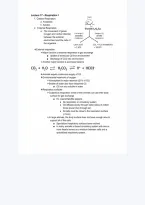
Lecture 17 - Respiration I
1. Cellular Respiration
a. Anaerobic
b. Aerobic
2. External Respiration
a. The movement of gases
(oxygen and carbon dioxide)
between the external
environment and the cells of
the organism
❖External respiration
➢Major function of external respiration is gas exchange
■ Uptake of molecular O2 from environment
■ Discharge of CO2 into environment
➢Another major function is acid base balance
❖Animals require continuous supply of O2
❖Environmental reservoirs of oxygen
➢Atmosphere is major reservoir (21% of O2)
➢Bodies of water also have dissolved O2
■ O2 not very soluble in water
❖Respiratory surfaces
➢Cutaneous respiration: small or thin animals can use their body
surface for gas exchange
■ Ex. caenorhabditis elegans
● No respiratory or circulatory system
● O2 diffuses slowly through water (about 3 million
times slower than through air)
● All cells must be close to the respiratory surface
(<1mm)
➢In large animals, the body surface does not have enough area to
support all of the cells
■ Specialized respiratory surfaces have evolved
■ In many animals a closed circulatory system with one or
more hearts serves as a medium between cells and a
specialized respiratory system.
, ■ However not all animals with specialized respiratory surfaces
transport O2 and CO2 via a closed circulatory system
❖Aquatic animals
➢Advantage of aqueous respiratory medium
■ Respiratory surfaces stay moist
■ Water not lost by evaporation
➢Disadvantage of aqueous respiratory medium
■ O2 concentration relatively low
■ Therefore, exchange must be very efficient
❖Aquatic animals - gills
➢Gills originate as evaginations (out
foldings) of the body surface
■ In general, gills are organs that
absorb dissolved oxygen from an
aqueous respiratory medium and
excrete CO2
■ Can be located all over the body
(ex. Sea star)
■ Can be restricted to a local body
region (ex. fish)
➢Gas exchange at gills is maximized by:
■ Large surface area
■ Countercurrent exchange
■ Ventilation: increase water flow over gills
❖Counter current exchange
❖Aquatic Animals - Ventilation
➢Ventilation - any method of increasing contact between the respiratory
medium and the respiratory surface
, ■ Usually requires expenditure of energy
➢Examples of ventilation
■ Ciliated surface
■ Paddle like appendages to push water over gills
■ Swimming: increased water flow over gills “ram ventilation”
❖Respiratory systems of echinoderms
➢Sea stars have external papulae that function as gills for gas exchange
➢Papulae are scattered over the body surface
➢Each papula projects outward through
a hole in the dermal skeleton
➢Cilia on the inner and outer surfaces
beat in opposite directions, allowing
counter - current exchange of gases
➢Fluid in coelom (body cavity) transports
dissolved gases
➢Tube feet of sea stars are also
important sites of gas exchange
❖respiratory system of Teleost fish
➢Gills are anatomically localized
➢Large surface area for gas exchange
➢Ventilate by bulk flow of water over gills
➢Closed circulatory system
➢Counter current exchange


