
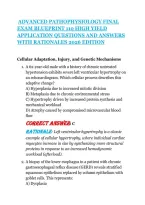
ADVANCED PATHOPHYSIOLOGY FINAL
EXAM BLUEPRINT 110 HIGH YIELD
APPLICATION QUESTIONS AND ANSWERS
WITH RATIONALES 2026 EDITION
Cellular Adaptation, Injury, and Genetic Mechanisms
1. A 62-year-old male with a history of chronic untreated
hypertension exhibits severe left ventricular hypertrophy on
an echocardiogram. Which cellular process describes this
adaptive change?
A) Hyperplasia due to increased mitotic division
B) Metaplasia due to chronic environmental stress
C) Hypertrophy driven by increased protein synthesis and
mechanical workload
D) Atrophy caused by compromised microvascular blood
flow
CORRECT ANSWER: C
RATiONAlE: Left ventricular hypertrophy is a classic
example of cellular hypertrophy, where individual cardiac
myocytes increase in size by synthesizing more structural
proteins in response to an increased hemodynamic
workload (afterload).
2. A biopsy of the lower esophagus in a patient with chronic
gastroesophageal reflux disease (GERD) reveals stratified
squamous epithelium replaced by column epithelium with
goblet cells. This represents:
A) Dysplasia
, B) Metaplasia
C) Anaplasia
D) Hyperplasia
CORRECT ANSWER: B
RATiONAlE: Metaplasia is the reversible replacement of
one mature cell type by another mature cell type, usually in
response to chronic irritation or inflammation, such as acid
exposure in Barrett's esophagus.
3. During myocardial ischemia, a profound decrease in
intracellular ATP levels leads directly to cellular swelling.
What is the primary underlying mechanism of this swelling?
A) Failure of the sodium-potassium pump
(\(Na^{+}/K^{+}\) ATPase) causing intracellular sodium
accumulation
B) Influx of extracellular calcium triggering lysosomal
enzyme activation
C) Accelerated anaerobic glycolysis causing lactic acidosis
D) Detachment of ribosomes from the rough endoplasmic
reticulum
CORRECT ANSWER: A
RATiONAlE: Ischemia deprives cells of oxygen, halting
oxidative phosphorylation and ATP production. Without
ATP, the \(Na^{+}/K^{+}\) ATPase pump fails, causing
sodium to accumulate inside the cell, which draws water in
osmotically and results in cellular swelling.
4. A 4-day-old infant is diagnosed with an autosomal recessive
metabolic disorder. Both parents are clinically unaffected.
What is the mathematical probability that the patient's
, healthy older sibling is a carrier of the mutated gene?
A) 25%
B) 50%
C) 66% (2/3)
D) 100%
CORRECT ANSWER: C
RATiONAlE: In autosomal recessive inheritance, if both
parents are carriers, each offspring has a 25% chance of
being unaffected/non-carrier, a 50% chance of being a
carrier, and a 25% chance of being affected. Because the
older sibling is known to be healthy (unaffected), the 25%
affected possibility is eliminated, leaving a 2/3 (66%)
chance that they are a carrier.
5. A patient presents with clinical features of Marfan syndrome,
including ectopia lentis, aortic root dilation, and
arachnodactyly. This disorder is caused by a mutation in the
gene encoding which structural matrix component?
A) Collagen Type I
B) Elastin
C) Fibrillin-1
D) Laminin
CORRECT ANSWER: C
RATiONAlE: Marfan syndrome is an autosomal
dominant connective tissue disorder caused by mutations in
the FBN1 gene on chromosome 15, which encodes the
glycoprotein fibrillin-1, an essential component of
extracellular matrix microfibrils.
, Section 2: Immunity, Inflammation, and
Hypersensitivity
6. A 24-year-old female presents with a malar rash, arthralgias,
and progressive proteinuria. Laboratory testing reveals high
titers of antinuclear antibodies (ANA) and anti-double-
stranded DNA (anti-dsDNA) antibodies. Which
hypersensitivity mechanism primarily mediates the tissue
damage seen in her kidneys?
A) Type I (IgE-mediated mast cell degranulation)
B) Type II (Antibody-dependent cellular cytotoxicity)
C) Type III (Immune complex deposition and complement
activation)
D) Type IV (T-cell-mediated delayed-type hypersensitivity)
CORRECT ANSWER: C
RATiONAlE: Systemic Lupus Erythematosus (SLE) is a
classic Type III hypersensitivity reaction where circulating
antigen-antibody (immune) complexes deposit in tissue
basements, such as the renal glomerulus, inciting
complement activation and neutrophilic inflammation.
7. An emergency department patient presents with acute
anaphylaxis after a bee sting, demonstrating severe
bronchoconstriction and hypotension. Which mediator,
rapidly released by mast cells, is responsible for the
immediate vasodilation and increased vascular permeability?
A) Leukotriene D4
B) Histamine
C) Interleukin-4
D) Thromboxane A2


