
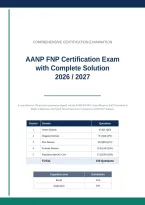
COMPREHENSIVE CERTIFICATION EXAMINATION
AANP FNP Certification Exam
with Complete Solution
A comprehensive 150-question examination aligned with the AANPCB FNP-C Exam Blueprint, AACN Essentials of
Master's Education, and Family Nurse Practitioner Competencies (2026/2027 Edition).
Section Domain Questions
1 Assess Domain 43 (Q1-Q43)
2 Diagnose Domain 36 (Q44-Q79)
3 Plan Domain 36 (Q80-Q115)
4 Evaluate Domain 20 (Q116-Q135)
5 Population-Specific Care 15 (Q136-Q150)
TOTAL 150 Questions
Cognitive Level Distribution
Recall 25%
Application 50%
,AANP FNP Certification Exam with Complete Solution 2026/2027 Page 2
Analysis (clinical reasoning) 25%
Aligned with AANPCB FNP-C Exam Blueprint | AACN Essentials | FNP Competencies 2026/2027
,AANP FNP Certification Exam with Complete Solution 2026/2027 Page 3
Section 1: Assess Domain
43 Questions | Cognitive focus: comprehensive and focused health history, review of systems, physical examination
techniques, developmental assessment, functional assessment, risk assessment, screening and diagnostic tests,
laboratory interpretation, diagnostic reasoning, clinical decision-making, and evidence-based screening guidelines.
*Q1:* A 54-year-old female presents to the clinic for an initial comprehensive health assessment. She is
new to the area and has not seen a provider in 6 years. She reports fatigue, occasional palpitations, and a
10-pound weight gain over the past year. Her mother had type 2 diabetes and her father had coronary
artery disease. Which component of the comprehensive health history should the FNP obtain FIRST to
best inform subsequent targeted questioning?
A. Detailed review of systems (ROS) covering all 14 systems
B. Family history including three generations of maternal and paternal lineage
C. History of present illness (HPI) using OLDCARTS for the chief complaint *[CORRECT]*
D. Past medical history including hospitalizations, surgeries, and chronic conditions
Correct Answer: C
Rationale:
Per AANPCB FNP-C Blueprint Assess Domain, the chief complaint and HPI direct the focus and prioritization of all
subsequent history components. Starting with the HPI (OLDCARTS—Onset, Location, Duration, Character,
Aggravating/Alleviating, Radiation, Timing, Severity) ensures the visit remains patient-centered and allows targeted
ROS, family, and past medical history gathering. Beginning with ROS (A) or family history (B) before understanding
the presenting concern risks missing time-critical symptoms. Past medical history (D) is essential but follows HPI in
sequence to contextualize the current presentation.
*Q2:* A 47-year-old male presents with a 3-week history of progressive dyspnea on exertion and bilateral
lower extremity edema. During the review of systems, the patient denies chest pain but reports occasional
orthopnea and paroxysmal nocturnal dyspnea. Which additional ROS finding would be most clinically
significant in supporting a working diagnosis of heart failure?
A. Nocturia of new onset *[CORRECT]*
B. Recent unintentional 5-pound weight loss
C. Increased frequency of migraine headaches
D. Daytime somnolence and morning headaches
Correct Answer: A
Rationale:
New-onset nocturia is a classic ROS finding in heart failure resulting from nocturnal redistribution of interstitial fluid
back into the vasculature, increasing renal perfusion and urine output at night. This symptom correlates with the Assess
Domain competency of clinical pattern recognition. Weight loss (B) suggests malignancy or hyperthyroidism rather than
HF, which typically causes fluid retention and weight gain. Migraines (C) are unrelated to cardiac pathophysiology.
Daytime somnolence and morning headaches (D) more strongly suggest obstructive sleep apnea or hypercapnia.
*Q3:* A 32-year-old female presents with a 2-day history of right upper quadrant abdominal pain that
radiates to the right shoulder, worsens after fatty meals, and is associated with nausea. Vital signs are
stable. Which physical examination technique should the FNP perform to best support a suspected
diagnosis of cholecystitis?
Aligned with AANPCB FNP-C Exam Blueprint | AACN Essentials | FNP Competencies 2026/2027
, AANP FNP Certification Exam with Complete Solution 2026/2027 Page 4
A. Deep palpation in the left lower quadrant with rebound assessment
B. Murphy's sign through inspiratory arrest during RUQ palpation *[CORRECT]*
C. Psoas sign assessment in the supine position
D. Heel strike test for referred peritoneal irritation
Correct Answer: B
Rationale:
Murphy's sign—palpation of the RUQ during inspiration that produces inspiratory arrest due to pain—is the hallmark
physical exam finding for acute cholecystitis and aligns with the Assess Domain competency of physical examination
techniques. The patient stops inhaling as the inflamed gallbladder contacts the examiner's hand. Psoas sign (C) and heel
strike (D) assess retrocecal appendicitis or peritoneal inflammation. LLQ palpation (A) would not assess biliary
pathology. A positive Murphy's sign has approximately 97% sensitivity for cholecystitis in the clinical setting.
*Q4:* A parent brings their 18-month-old child for a well-child visit. The child uses approximately 10
words, walks independently, points to objects of interest, and can stack three blocks. Which statement by
the FNP best documents this child's developmental milestone attainment?
A. Development is delayed in language and requires immediate speech therapy referral
B. Development is age-appropriate across all assessed domains *[CORRECT]*
C. Development shows mild motor delay requiring physical therapy evaluation
D. Development is accelerated and suggests giftedness requiring early education planning
Correct Answer: B
Rationale:
At 18 months, expected milestones include walking independently, using 5-10 words, pointing to objects of interest, and
stacking 2-3 blocks, which this child has met or exceeded across all domains. This aligns with the Assess Domain
competency of developmental assessment and Population-Specific Care. Option A is incorrect because the 10-word
vocabulary is at the lower end of normal. Option C is wrong because stacking three blocks is appropriate at this age.
Option D is unsupported by the data—no milestone is significantly advanced.
*Q5:* An 82-year-old male lives alone and presents for a comprehensive geriatric assessment. He reports
occasional difficulty reaching items on high shelves and has fallen twice in the past 6 months without
injury. Which functional assessment tool provides the most comprehensive evaluation of his ability to live
safely and independently?
A. Katz Index of Independence in Activities of Daily Living
B. Lawton-Brody Instrumental Activities of Daily Living (IADL) Scale *[CORRECT]*
C. Mini-Cognitive Assessment for dementia screening
D. Timed Up and Go (TUG) test for mobility evaluation
Correct Answer: B
Rationale:
The Lawton-Brody IADL Scale evaluates higher-order functions necessary for independent community
living—telephone use, shopping, food preparation, housekeeping, laundry, transportation, medication management, and
finances—which are most relevant for an 82-year-old living alone. This aligns with Assess Domain functional
assessment competencies. The Katz ADL (A) measures basic self-care (bathing, dressing, toileting, transfer, continence,
feeding) but is less sensitive for community-dwelling elders. Mini-Cog (C) screens cognition. TUG (D) assesses
mobility and fall risk but not functional independence comprehensively.
Aligned with AANPCB FNP-C Exam Blueprint | AACN Essentials | FNP Competencies 2026/2027


