
EKG STRIPS FREQUENTLY TESTED ACTUAL EXAM
QUESTIONS WITH CORRECT ANSWERS
Question 1.
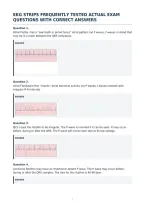
Atrial Flutter -has a "saw tooth or picket fence" atrial pattern (no P waves, F-waves in stead that
may be in a ratio) between the QRS complexes.
ANSWER
Question 2.
Atrial Fibrillation-Has "chaotic" atrial electrical activity (no P waves, f-waves instead) with
irregular R-R intervals.
ANSWER
Question 3.
PJCs cause the rhythm to be irregular. The P wave is inverted if it can be seen. It may occur
before, during or after the QRS. The P wave will not be seen due to its low voltage.
ANSWER
Question 4.
Junctional Rhythm may have an inverted or absent P wave. The P wave may occur before,
during or after the QRS complex. The rate for this rhythm is 40-60 bpm.
ANSWER
1
, Question 5.
Accelerated Junctional Rhythm may have an inverted or absent P wave. The P wave may occur
before, during or after the QRS complex. The rate for this rhythm is 60-100 bpm.
ANSWER
Question 6.
Junctional Tachycardia Rhythm may have an inverted or absent P wave. The P wave may occur
before, during or after the QRS complex. The rate for this rhythm is 100-180 bpm
ANSWER
Question 7.
Supraventricular Tachycardia presents with a "normal-narrow" appearing QRS complex and a
rate of greater than 150 bpm. Remember for heart rates approaching 150 or higher, it will be
very likely that the P wave will be buried. Be prepared to increase the paper speed for this
rhythm.
ANSWER
Question 8.
First Degree AV Block, the PR interval is constant and measures greater than 0.20 second.
ANSWER
2
QUESTIONS WITH CORRECT ANSWERS
Question 1.
Atrial Flutter -has a "saw tooth or picket fence" atrial pattern (no P waves, F-waves in stead that
may be in a ratio) between the QRS complexes.
ANSWER
Question 2.
Atrial Fibrillation-Has "chaotic" atrial electrical activity (no P waves, f-waves instead) with
irregular R-R intervals.
ANSWER
Question 3.
PJCs cause the rhythm to be irregular. The P wave is inverted if it can be seen. It may occur
before, during or after the QRS. The P wave will not be seen due to its low voltage.
ANSWER
Question 4.
Junctional Rhythm may have an inverted or absent P wave. The P wave may occur before,
during or after the QRS complex. The rate for this rhythm is 40-60 bpm.
ANSWER
1
, Question 5.
Accelerated Junctional Rhythm may have an inverted or absent P wave. The P wave may occur
before, during or after the QRS complex. The rate for this rhythm is 60-100 bpm.
ANSWER
Question 6.
Junctional Tachycardia Rhythm may have an inverted or absent P wave. The P wave may occur
before, during or after the QRS complex. The rate for this rhythm is 100-180 bpm
ANSWER
Question 7.
Supraventricular Tachycardia presents with a "normal-narrow" appearing QRS complex and a
rate of greater than 150 bpm. Remember for heart rates approaching 150 or higher, it will be
very likely that the P wave will be buried. Be prepared to increase the paper speed for this
rhythm.
ANSWER
Question 8.
First Degree AV Block, the PR interval is constant and measures greater than 0.20 second.
ANSWER
2


