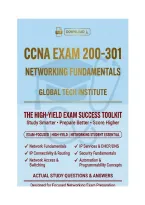
,CCNA 200-301 Exam Prep 2026/2027 —
Practice Questions, Answers, Networking
Concepts & Detailed Rationales
QUESTION 1
A network engineer is analyzing a captured Ethernet frame and notices the destination MAC
address is `FF:FF:FF:FF:FF:FF`. What type of frame is this?
A. Unicast
B. Multicast
C. Broadcast
D. Anycast
Correct Answer: C. Broadcast
Rationale: A destination MAC address of all F's (`FF:FF:FF:FF:FF:FF`) is the Ethernet broadcast
address. All devices on the local segment process broadcast frames. Unicast (A) is a single
destination. Multicast (B) uses the `01:00:5E` prefix for IPv4 multicast. Anycast (D) is an IPv6
concept where the nearest node responds. Key Takeaway: Broadcast MAC = FF:FF:FF:FF:FF:FF;
flooded to all ports except the source.
QUESTION 2
,A technician is troubleshooting a network where a host with IP 10.1.1.50/24 cannot ping
10.1.1.200. The technician runs `show ip interface brief` on the router and sees the interface is
up/up. Which step of the troubleshooting methodology should the technician perform NEXT?
A. Establish a theory of probable cause
B. Verify full system functionality
C. Document findings, actions, and outcomes
D. Identify the problem
Correct Answer: A. Establish a theory of probable cause
Rationale: The technician has already identified the problem (host cannot ping). The next step in
the CompTIA/Cisco troubleshooting methodology is to establish a theory of probable cause —
for example, a VLAN mismatch, ACL blocking ICMP, or incorrect subnet mask. Verifying full
functionality (B) comes after implementing a solution. Documentation (C) is the final step.
Identifying the problem (D) has already occurred. Key Takeaway: Troubleshooting order: Identify
→ Establish theory → Test theory → Plan/implement → Verify → Document.
QUESTION 3
Which cable type is used to connect a router's console port to a laptop's USB port for out-of-
band management?
A. Straight-through Ethernet
B. Rollover cable with USB adapter
C. Crossover Ethernet
D. Fiber optic patch cable
, Correct Answer: B. Rollover cable with USB adapter
Rationale: A rollover cable (also called a console cable) connects a computer to a Cisco device's
console port for out-of-band management. Modern laptops require a USB-to-serial adapter or a
USB console cable. Straight-through (A) and crossover (C) are Ethernet cables for data. Fiber (D)
is for high-speed backbone links. Key Takeaway: Console access = rollover cable (RJ-45 to DB-
9/USB).
QUESTION 4
Which layer of the OSI model is responsible for logical addressing and path determination?
A. Layer 1 (Physical)
B. Layer 2 (Data Link)
C. Layer 3 (Network)
D. Layer 4 (Transport)
Correct Answer: C. Layer 3 (Network)
Rationale: Layer 3 (Network) handles logical addressing (IP addresses) and path determination
(routing). Layer 1 (A) transmits bits. Layer 2 (B) handles physical addressing (MAC). Layer 4 (D)
provides end-to-end delivery (TCP/UDP). Key Takeaway: Layer 3 = IP addressing + routing; Layer
2 = MAC addressing + switching.
Practice Questions, Answers, Networking
Concepts & Detailed Rationales
QUESTION 1
A network engineer is analyzing a captured Ethernet frame and notices the destination MAC
address is `FF:FF:FF:FF:FF:FF`. What type of frame is this?
A. Unicast
B. Multicast
C. Broadcast
D. Anycast
Correct Answer: C. Broadcast
Rationale: A destination MAC address of all F's (`FF:FF:FF:FF:FF:FF`) is the Ethernet broadcast
address. All devices on the local segment process broadcast frames. Unicast (A) is a single
destination. Multicast (B) uses the `01:00:5E` prefix for IPv4 multicast. Anycast (D) is an IPv6
concept where the nearest node responds. Key Takeaway: Broadcast MAC = FF:FF:FF:FF:FF:FF;
flooded to all ports except the source.
QUESTION 2
,A technician is troubleshooting a network where a host with IP 10.1.1.50/24 cannot ping
10.1.1.200. The technician runs `show ip interface brief` on the router and sees the interface is
up/up. Which step of the troubleshooting methodology should the technician perform NEXT?
A. Establish a theory of probable cause
B. Verify full system functionality
C. Document findings, actions, and outcomes
D. Identify the problem
Correct Answer: A. Establish a theory of probable cause
Rationale: The technician has already identified the problem (host cannot ping). The next step in
the CompTIA/Cisco troubleshooting methodology is to establish a theory of probable cause —
for example, a VLAN mismatch, ACL blocking ICMP, or incorrect subnet mask. Verifying full
functionality (B) comes after implementing a solution. Documentation (C) is the final step.
Identifying the problem (D) has already occurred. Key Takeaway: Troubleshooting order: Identify
→ Establish theory → Test theory → Plan/implement → Verify → Document.
QUESTION 3
Which cable type is used to connect a router's console port to a laptop's USB port for out-of-
band management?
A. Straight-through Ethernet
B. Rollover cable with USB adapter
C. Crossover Ethernet
D. Fiber optic patch cable
, Correct Answer: B. Rollover cable with USB adapter
Rationale: A rollover cable (also called a console cable) connects a computer to a Cisco device's
console port for out-of-band management. Modern laptops require a USB-to-serial adapter or a
USB console cable. Straight-through (A) and crossover (C) are Ethernet cables for data. Fiber (D)
is for high-speed backbone links. Key Takeaway: Console access = rollover cable (RJ-45 to DB-
9/USB).
QUESTION 4
Which layer of the OSI model is responsible for logical addressing and path determination?
A. Layer 1 (Physical)
B. Layer 2 (Data Link)
C. Layer 3 (Network)
D. Layer 4 (Transport)
Correct Answer: C. Layer 3 (Network)
Rationale: Layer 3 (Network) handles logical addressing (IP addresses) and path determination
(routing). Layer 1 (A) transmits bits. Layer 2 (B) handles physical addressing (MAC). Layer 4 (D)
provides end-to-end delivery (TCP/UDP). Key Takeaway: Layer 3 = IP addressing + routing; Layer
2 = MAC addressing + switching.