
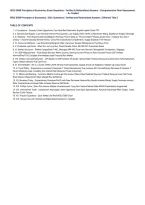
WGU D089 Principles of Economics Exam Questions - Verified & Rationalized Answers - Comprehensive Final Assessment
- A+ Graded
WGU D089 Principles of Economics | 300+ Questions | Verified and Rationalized Answers | Different Title 5
TABLE OF CONTENTS
1. I. Foundations - Scarcity Choice Opportunity Cost Next Best Alternative Explicit Implicit Costs PPF
2. II. Demand and Supply - Law Demand Inverse Price Quantity, Law Supply Direct, Shifts vs Movement Along, Equilibrium Surplus Shortage
3. III. Elasticity - Price Elasticity Demand Midpoint Formula Percent Delta Q / Percent Delta P Elastic greater than 1 Inelastic less than 1
Unitary 1, Income Elasticity Normal Inferior, Cross Price Substitutes Complements, Supply Elasticity Time Horizon
4. IV. Consumer Behavior - Law Diminishing Marginal Utility, Consumer Surplus Willingness to Pay Minus Price
5. V. Production and Costs - Short Run vs Long Run, Fixed Variable Costs, MC MR AC, Economies Scale
6. VI. Market Structures - Perfect Competition P=MC, Monopoly MR=MC Price from Demand, Monopolistic Competition, Oligopoly
7. VII. GDP Measurement - Final Goods Services Within Country, Nominal Current Prices vs Real Constant Prices GDP Deflator
Nominal/Real*100, Excludes Intermediate Used Financial Non-Market
8. VIII. Inflation and Unemployment - CPI Basket vs GDP Deflator All Goods, Natural Rate Frictional Structural Cyclical Zero Full Employment,
Types Inflation Demand Pull Cost Push
9. IX. AD-AS Model - AD C+I+G+NX, SRAS LRAS Vertical Full Employment, Supply Shock Oil Stagflation Inflation Up Output Down
10. X. Fiscal Policy - Expansionary Increase G Decrease T Close Recessionary Gap Increase AD, Contractionary Decrease G Increase T
Close Inflationary Gap, Crowding Out Interest Rate Reduces Private Investment
11. XI. Money and Banking - Functions Medium Exchange Unit Account Store Value Deferred Payment, Federal Reserve Tools Fed Funds
Rate Reserve Requirement Open Market Buy Sell Bonds
12. XII. Monetary Policy - Expansionary Decrease Fed Funds Rate Decrease Reserve Buy Bonds Increase Money Supply Decrease Interest
Rate, Contractionary Increase Rate Increase Reserve Sell Bonds
13. XIII. Phillips Curve - Short Run Inverse Inflation Unemployment, Long Run Vertical Natural Rate NAIRU Expectations-Augmented
14. XIV. International Trade - Comparative Advantage Lower Opportunity Cost Basis Specialization, Absolute Advantage More Output, Trade
Barriers Tariffs Quotas
15. XV. Practice Questions - Each Asked Like Real WGU D089 Exam
16. XVI. Answer Key with Verified and Rationalized Answers A+ Graded
,WGU D089 PRINCIPLES OF ECONOMICS - PRACTICE QUESTIONS - EACH QUESTION ASKED LIKE REAL EXAM
Based on WGU D089 Principles of Economics Competency - Microeconomics Macroeconomics Policy. High Yield.
1. A coffee shop raises price from $4 to $5 and quantity demanded falls from 100 to 80 cups per day. What is price elasticity of demand and
type?
A. Perfectly elastic
B. Elastic - price elasticity = (Delta Q/Qavg)/(Delta P/Pavg) = (-20/90)/(1/4.5)= -1.0 unitary elastic
C. Perfectly inelastic
D. Inelastic 0.5
Answer: B
Rationale: Elasticity mid-point: Qavg 90, Pavg 4.5, percent Delta Q -22.2 percent, percent Delta P 22.2 percent, elasticity -1 unitary elastic.
2. GDP includes which?
A. Intermediate goods
B. Used goods
C. Financial transactions
D. Final goods and services produced within country in given period, excludes intermediate to avoid double counting, excludes non-market
Answer: D
Rationale: GDP final goods services produced within country period, excludes intermediate used financial.
3. Monopoly profit maximization where?
A. MR=MC - monopoly MR less than P due to downward demand, produces where MR=MC then charges demand price
B. MC=0
C. P=MC
D. MR greater than P
Answer: A
Rationale: Monopoly MR=MC profit max, price from demand greater than MR.
4. What is natural rate of unemployment includes?
A. Only structural
B. Only cyclical
C. Frictional plus structural - natural rate around 4-5 percent, cyclical 0 at full employment
D. Zero unemployment
Answer: C
Rationale: Natural rate frictional plus structural, cyclical 0 at full employment.
5. Fiscal policy to close recessionary gap?
A. Increase government spending G decrease taxes T increase AD - expansionary fiscal
B. Decrease G increase T
C. Decrease money supply
D. Increase interest rate
Answer: A
Rationale: Recessionary gap expansionary fiscal increase G decrease T increase AD.
6. Supply shock example?
A. No shock
B. Oil price increase shifts SRAS left - stagflation inflation up output down
C. Demand increase
D. Technology improvement
Answer: B
Rationale: Supply shock oil price increase SRAS left stagflation.
7. What is opportunity cost?
A. Only money cost
B. No cost
C. Sunk cost
D. Value of next best alternative forgone when making a choice - includes explicit and implicit costs
Answer: D
Rationale: Opportunity cost next best alternative forgone explicit plus implicit.
8. What is difference between nominal GDP and real GDP?
A. Same
B. Nominal uses current prices, real uses base year constant prices adjusted for inflation - real = nominal/GDP deflator*100
C. No difference
D. Real includes inflation
Answer: B
Rationale: Nominal current prices, real constant base year prices inflation-adjusted.
9. Supply shock example?
,A. Technology improvement
B. No shock
C. Demand increase
D. Oil price increase shifts SRAS left - stagflation inflation up output down
Answer: D
Rationale: Supply shock oil price increase SRAS left stagflation.
10. Elasticity of supply determinants?
A. Only price
B. Only demand
C. No determinants
D. Time horizon, availability inputs, excess capacity, storability - more elastic long run
Answer: D
Rationale: Supply elasticity time horizon inputs capacity storability.
11. What is natural rate of unemployment includes?
A. Frictional plus structural - natural rate around 4-5 percent, cyclical 0 at full employment
B. Zero unemployment
C. Only cyclical
D. Only structural
Answer: A
Rationale: Natural rate frictional plus structural, cyclical 0 at full employment.
12. What does Federal Reserve use for contractionary monetary policy?
A. Decrease interest rate
B. Buy bonds
C. Increase federal funds rate, increase reserve requirement, sell bonds open market operations - decrease money supply increase interest rate
D. Decrease reserve requirement
Answer: C
Rationale: Contractionary monetary increase fed funds rate increase reserve requirement sell bonds decrease money supply.
13. What is difference between nominal GDP and real GDP?
A. No difference
B. Same
C. Real includes inflation
D. Nominal uses current prices, real uses base year constant prices adjusted for inflation - real = nominal/GDP deflator*100
Answer: D
Rationale: Nominal current prices, real constant base year prices inflation-adjusted.
14. What is law of diminishing marginal utility?
A. As consumption of good increases, additional satisfaction from each extra unit decreases
B. Utility constant
C. No diminishing
D. Utility always increases
Answer: A
Rationale: Diminishing marginal utility extra unit less satisfaction.
15. What is comparative advantage?
A. Ability to produce at lower opportunity cost - basis for trade specialization
B. Produce more
C. Absolute advantage
D. No trade benefit
Answer: A
Rationale: Comparative advantage lower opportunity cost basis trade.
16. Elasticity of supply determinants?
A. Only demand
B. Only price
C. No determinants
D. Time horizon, availability inputs, excess capacity, storability - more elastic long run
Answer: D
Rationale: Supply elasticity time horizon inputs capacity storability.
17. Supply shock example?
A. No shock
B. Oil price increase shifts SRAS left - stagflation inflation up output down
C. Technology improvement
D. Demand increase
Answer: B
, Rationale: Supply shock oil price increase SRAS left stagflation.
18. What is opportunity cost?
A. Value of next best alternative forgone when making a choice - includes explicit and implicit costs
B. No cost
C. Sunk cost
D. Only money cost
Answer: A
Rationale: Opportunity cost next best alternative forgone explicit plus implicit.
19. What is GDP deflator formula?
A. GDP deflator = Nominal GDP/Real GDP*100 measures price level all goods
B. Real/Nominal
C. CPI*100
D. No formula
Answer: A
Rationale: GDP deflator Nominal/Real*100 price level all goods vs CPI basket.
20. What is crowding out?
A. Expansionary fiscal increases interest rate reduces private investment I - crowding out reduces multiplier effectiveness
B. No effect
C. No crowding
D. Increases investment
Answer: A
Rationale: Crowding out fiscal increase interest rate reduces private investment.
21. What does the law of demand state?
A. Price up quantity up
B. No relationship
C. Price up quantity demanded down, price down quantity demanded up - inverse relationship ceteris paribus
D. Price and quantity same
Answer: C
Rationale: Law of demand inverse price-quantity demanded ceteris paribus.
22. What is law of diminishing marginal utility?
A. No diminishing
B. As consumption of good increases, additional satisfaction from each extra unit decreases
C. Utility always increases
D. Utility constant
Answer: B
Rationale: Diminishing marginal utility extra unit less satisfaction.
23. What does Federal Reserve use for contractionary monetary policy?
A. Decrease reserve requirement
B. Increase federal funds rate, increase reserve requirement, sell bonds open market operations - decrease money supply increase interest rate
C. Buy bonds
D. Decrease interest rate
Answer: B
Rationale: Contractionary monetary increase fed funds rate increase reserve requirement sell bonds decrease money supply.
24. Fiscal policy to close recessionary gap?
A. Increase interest rate
B. Decrease money supply
C. Increase government spending G decrease taxes T increase AD - expansionary fiscal
D. Decrease G increase T
Answer: C
Rationale: Recessionary gap expansionary fiscal increase G decrease T increase AD.
25. If MPC is 0.8, what is spending multiplier?
A. 0.8
B. 5 - multiplier = 1/(1-MPC)=1/0.2=5 - MPS=0.2
C. 1.25
D. 0.2
Answer: B
Rationale: Multiplier 1/(1-MPC)=1/MPS. MPC 0.8 MPS 0.2 multiplier 5.
26. If MPC is 0.8, what is spending multiplier?
A. 1.25
B. 5 - multiplier = 1/(1-MPC)=1/0.2=5 - MPS=0.2
C. 0.8
- A+ Graded
WGU D089 Principles of Economics | 300+ Questions | Verified and Rationalized Answers | Different Title 5
TABLE OF CONTENTS
1. I. Foundations - Scarcity Choice Opportunity Cost Next Best Alternative Explicit Implicit Costs PPF
2. II. Demand and Supply - Law Demand Inverse Price Quantity, Law Supply Direct, Shifts vs Movement Along, Equilibrium Surplus Shortage
3. III. Elasticity - Price Elasticity Demand Midpoint Formula Percent Delta Q / Percent Delta P Elastic greater than 1 Inelastic less than 1
Unitary 1, Income Elasticity Normal Inferior, Cross Price Substitutes Complements, Supply Elasticity Time Horizon
4. IV. Consumer Behavior - Law Diminishing Marginal Utility, Consumer Surplus Willingness to Pay Minus Price
5. V. Production and Costs - Short Run vs Long Run, Fixed Variable Costs, MC MR AC, Economies Scale
6. VI. Market Structures - Perfect Competition P=MC, Monopoly MR=MC Price from Demand, Monopolistic Competition, Oligopoly
7. VII. GDP Measurement - Final Goods Services Within Country, Nominal Current Prices vs Real Constant Prices GDP Deflator
Nominal/Real*100, Excludes Intermediate Used Financial Non-Market
8. VIII. Inflation and Unemployment - CPI Basket vs GDP Deflator All Goods, Natural Rate Frictional Structural Cyclical Zero Full Employment,
Types Inflation Demand Pull Cost Push
9. IX. AD-AS Model - AD C+I+G+NX, SRAS LRAS Vertical Full Employment, Supply Shock Oil Stagflation Inflation Up Output Down
10. X. Fiscal Policy - Expansionary Increase G Decrease T Close Recessionary Gap Increase AD, Contractionary Decrease G Increase T
Close Inflationary Gap, Crowding Out Interest Rate Reduces Private Investment
11. XI. Money and Banking - Functions Medium Exchange Unit Account Store Value Deferred Payment, Federal Reserve Tools Fed Funds
Rate Reserve Requirement Open Market Buy Sell Bonds
12. XII. Monetary Policy - Expansionary Decrease Fed Funds Rate Decrease Reserve Buy Bonds Increase Money Supply Decrease Interest
Rate, Contractionary Increase Rate Increase Reserve Sell Bonds
13. XIII. Phillips Curve - Short Run Inverse Inflation Unemployment, Long Run Vertical Natural Rate NAIRU Expectations-Augmented
14. XIV. International Trade - Comparative Advantage Lower Opportunity Cost Basis Specialization, Absolute Advantage More Output, Trade
Barriers Tariffs Quotas
15. XV. Practice Questions - Each Asked Like Real WGU D089 Exam
16. XVI. Answer Key with Verified and Rationalized Answers A+ Graded
,WGU D089 PRINCIPLES OF ECONOMICS - PRACTICE QUESTIONS - EACH QUESTION ASKED LIKE REAL EXAM
Based on WGU D089 Principles of Economics Competency - Microeconomics Macroeconomics Policy. High Yield.
1. A coffee shop raises price from $4 to $5 and quantity demanded falls from 100 to 80 cups per day. What is price elasticity of demand and
type?
A. Perfectly elastic
B. Elastic - price elasticity = (Delta Q/Qavg)/(Delta P/Pavg) = (-20/90)/(1/4.5)= -1.0 unitary elastic
C. Perfectly inelastic
D. Inelastic 0.5
Answer: B
Rationale: Elasticity mid-point: Qavg 90, Pavg 4.5, percent Delta Q -22.2 percent, percent Delta P 22.2 percent, elasticity -1 unitary elastic.
2. GDP includes which?
A. Intermediate goods
B. Used goods
C. Financial transactions
D. Final goods and services produced within country in given period, excludes intermediate to avoid double counting, excludes non-market
Answer: D
Rationale: GDP final goods services produced within country period, excludes intermediate used financial.
3. Monopoly profit maximization where?
A. MR=MC - monopoly MR less than P due to downward demand, produces where MR=MC then charges demand price
B. MC=0
C. P=MC
D. MR greater than P
Answer: A
Rationale: Monopoly MR=MC profit max, price from demand greater than MR.
4. What is natural rate of unemployment includes?
A. Only structural
B. Only cyclical
C. Frictional plus structural - natural rate around 4-5 percent, cyclical 0 at full employment
D. Zero unemployment
Answer: C
Rationale: Natural rate frictional plus structural, cyclical 0 at full employment.
5. Fiscal policy to close recessionary gap?
A. Increase government spending G decrease taxes T increase AD - expansionary fiscal
B. Decrease G increase T
C. Decrease money supply
D. Increase interest rate
Answer: A
Rationale: Recessionary gap expansionary fiscal increase G decrease T increase AD.
6. Supply shock example?
A. No shock
B. Oil price increase shifts SRAS left - stagflation inflation up output down
C. Demand increase
D. Technology improvement
Answer: B
Rationale: Supply shock oil price increase SRAS left stagflation.
7. What is opportunity cost?
A. Only money cost
B. No cost
C. Sunk cost
D. Value of next best alternative forgone when making a choice - includes explicit and implicit costs
Answer: D
Rationale: Opportunity cost next best alternative forgone explicit plus implicit.
8. What is difference between nominal GDP and real GDP?
A. Same
B. Nominal uses current prices, real uses base year constant prices adjusted for inflation - real = nominal/GDP deflator*100
C. No difference
D. Real includes inflation
Answer: B
Rationale: Nominal current prices, real constant base year prices inflation-adjusted.
9. Supply shock example?
,A. Technology improvement
B. No shock
C. Demand increase
D. Oil price increase shifts SRAS left - stagflation inflation up output down
Answer: D
Rationale: Supply shock oil price increase SRAS left stagflation.
10. Elasticity of supply determinants?
A. Only price
B. Only demand
C. No determinants
D. Time horizon, availability inputs, excess capacity, storability - more elastic long run
Answer: D
Rationale: Supply elasticity time horizon inputs capacity storability.
11. What is natural rate of unemployment includes?
A. Frictional plus structural - natural rate around 4-5 percent, cyclical 0 at full employment
B. Zero unemployment
C. Only cyclical
D. Only structural
Answer: A
Rationale: Natural rate frictional plus structural, cyclical 0 at full employment.
12. What does Federal Reserve use for contractionary monetary policy?
A. Decrease interest rate
B. Buy bonds
C. Increase federal funds rate, increase reserve requirement, sell bonds open market operations - decrease money supply increase interest rate
D. Decrease reserve requirement
Answer: C
Rationale: Contractionary monetary increase fed funds rate increase reserve requirement sell bonds decrease money supply.
13. What is difference between nominal GDP and real GDP?
A. No difference
B. Same
C. Real includes inflation
D. Nominal uses current prices, real uses base year constant prices adjusted for inflation - real = nominal/GDP deflator*100
Answer: D
Rationale: Nominal current prices, real constant base year prices inflation-adjusted.
14. What is law of diminishing marginal utility?
A. As consumption of good increases, additional satisfaction from each extra unit decreases
B. Utility constant
C. No diminishing
D. Utility always increases
Answer: A
Rationale: Diminishing marginal utility extra unit less satisfaction.
15. What is comparative advantage?
A. Ability to produce at lower opportunity cost - basis for trade specialization
B. Produce more
C. Absolute advantage
D. No trade benefit
Answer: A
Rationale: Comparative advantage lower opportunity cost basis trade.
16. Elasticity of supply determinants?
A. Only demand
B. Only price
C. No determinants
D. Time horizon, availability inputs, excess capacity, storability - more elastic long run
Answer: D
Rationale: Supply elasticity time horizon inputs capacity storability.
17. Supply shock example?
A. No shock
B. Oil price increase shifts SRAS left - stagflation inflation up output down
C. Technology improvement
D. Demand increase
Answer: B
, Rationale: Supply shock oil price increase SRAS left stagflation.
18. What is opportunity cost?
A. Value of next best alternative forgone when making a choice - includes explicit and implicit costs
B. No cost
C. Sunk cost
D. Only money cost
Answer: A
Rationale: Opportunity cost next best alternative forgone explicit plus implicit.
19. What is GDP deflator formula?
A. GDP deflator = Nominal GDP/Real GDP*100 measures price level all goods
B. Real/Nominal
C. CPI*100
D. No formula
Answer: A
Rationale: GDP deflator Nominal/Real*100 price level all goods vs CPI basket.
20. What is crowding out?
A. Expansionary fiscal increases interest rate reduces private investment I - crowding out reduces multiplier effectiveness
B. No effect
C. No crowding
D. Increases investment
Answer: A
Rationale: Crowding out fiscal increase interest rate reduces private investment.
21. What does the law of demand state?
A. Price up quantity up
B. No relationship
C. Price up quantity demanded down, price down quantity demanded up - inverse relationship ceteris paribus
D. Price and quantity same
Answer: C
Rationale: Law of demand inverse price-quantity demanded ceteris paribus.
22. What is law of diminishing marginal utility?
A. No diminishing
B. As consumption of good increases, additional satisfaction from each extra unit decreases
C. Utility always increases
D. Utility constant
Answer: B
Rationale: Diminishing marginal utility extra unit less satisfaction.
23. What does Federal Reserve use for contractionary monetary policy?
A. Decrease reserve requirement
B. Increase federal funds rate, increase reserve requirement, sell bonds open market operations - decrease money supply increase interest rate
C. Buy bonds
D. Decrease interest rate
Answer: B
Rationale: Contractionary monetary increase fed funds rate increase reserve requirement sell bonds decrease money supply.
24. Fiscal policy to close recessionary gap?
A. Increase interest rate
B. Decrease money supply
C. Increase government spending G decrease taxes T increase AD - expansionary fiscal
D. Decrease G increase T
Answer: C
Rationale: Recessionary gap expansionary fiscal increase G decrease T increase AD.
25. If MPC is 0.8, what is spending multiplier?
A. 0.8
B. 5 - multiplier = 1/(1-MPC)=1/0.2=5 - MPS=0.2
C. 1.25
D. 0.2
Answer: B
Rationale: Multiplier 1/(1-MPC)=1/MPS. MPC 0.8 MPS 0.2 multiplier 5.
26. If MPC is 0.8, what is spending multiplier?
A. 1.25
B. 5 - multiplier = 1/(1-MPC)=1/0.2=5 - MPS=0.2
C. 0.8


