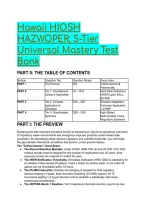
Hawaii HIOSH
HAZWOPER: S-Tier
Universal Mastery Test
Bank
PART 0: THE TABLE OF CONTENTS
Section Cognitive Tier Question Range Focus Area
PART I The Preview N/A Critical Axioms &
Frameworks
PART II Tier 1: Foundational Q1 – Q18 Hard Deck Definitions,
Syntax & Application HIOSH Laws, EALs,
DU-MIS
PART II Tier 2: Complex Q19 – Q37 Scenario Adaptation,
Application & Formulaic Application,
Simulation C-EHMP
PART II Tier 3: Grandmaster Q38 – Q55 High-Stakes
Synthesis Multi-Variable Crises,
Regulatory Synthesis
PART I: THE PREVIEW
Mastering this elite test bank translates directly to autonomous, high-level operational command
of hazardous waste environments and emergency response protocols under Hawaii state
jurisdiction. By internalizing these rigorous regulatory and scientific thresholds, you will bridge
the gap between theoretical compliance and tactical, on-the-ground mastery.
The "Critical Axioms" Cheat Sheet:
● The Record Retention Mandate: Under HIOSH (HAR Title 12) and 29 CFR 1910.1020,
medical records must be retained for the duration of employment plus 30 years, while
exposure records are retained for a strict 30 years.
● The HEER Notification Thresholds: Immediate notification (HRS 128D) is mandatory for
oil releases if they exceed 25 gallons, cause a sheen on surface water, or are under 25
gallons but not remediated within 72 hours.
● The DU-MIS Imperative: Discrete soil sampling is obsolete for final regulatory
decision-making in Hawaii. Multi-Increment Sampling (DU-MIS) requires 30-75
increments yielding 1-2 kg per Decision Unit to establish a statistically valid mean
contaminant concentration.
● The HEPCRA March 1 Deadline: Tier II hazardous chemical inventory reports are due
, annually by March 1. The Extremely Hazardous Substance (EHS) reporting threshold is
500 lbs or the Threshold Planning Quantity (TPQ), whichever is lower, while standard
hazardous chemicals trigger at 10,000 lbs.
● The Hierarchy of Remedial Actions: The Hawaii State Contingency Plan (HAR 11-451)
prioritizes remedies in strict descending order: 1) Reuse/Recycling, 2)
Destruction/Detoxification, 3) Separation/Volume Reduction, 4) Immobilization, 5)
Disposal/Containment, 6) Institutional Controls.
Key Regulatory Thresholds
Framework Parameter Threshold / Requirement
HIOSH Penalties Willful Violation Minimum $5,500 (No Good Faith
reduction allowed)
HAZWOPER Medical Surveillance Trigger Exposure above PEL for ≥ 30
days per year
1910.1000 Air Contaminant Mixtures E_m = (C_1/L_1) + (C_2/L_2) +
... \le 1.0
Tier 1 EALs Baseline Assumption Unrestricted/residential use
over a drinking water source
PART II: THE ELITE TEST BANK
Tier 1: Foundational Syntax & Application
Q1: Under HIOSH standard 29 CFR 1910.120, a written Health and Safety Plan (HASP) must
be developed for hazardous waste operations. Which organizational element is the FIRST
mandatory component required to establish operational command? A) The decontamination
corridor schematic B) The Site-Specific Safety and Health Plan (SSHP) C) The organizational
structure detailing the chain of command and responsibilities D) The medical surveillance
baseline testing protocol
Answer: C (The organizational structure detailing the chain of command and responsibilities)
Distractor Analysis: A is incorrect: Decontamination procedures are a required element of the
site-specific plan, but they are not the foundational organizational component. B is incorrect:
The SSHP is a critical sub-component of the overall HASP, but the organizational structure must
dictate who implements it first. D is incorrect: Medical surveillance is required, but it is an
operational program element, not the establishing framework of authority.
The Mentor's Analysis: Command and control precede tactical execution. When facing
hazardous waste operations, the immediate priority is establishing an unambiguous chain of
command. By utilizing a formalized organizational structure, you bypass the common trap of
overlapping authority during a crisis. Professional Intuition: Safety protocols are
meaningless without a designated Site Safety and Health Supervisor holding explicit
authority to enforce them.
Q2: Pursuant to the Hawaii Environmental Response Law (HRS 128D), an operator observes a
lubricating oil leak of approximately 15 gallons on dry concrete. The spill is fully contained and
cleaned up within 48 hours. Based on HEER Office guidelines, what is the MOST
APPROPRIATE notification action? A) Immediately notify the HEER Office and the National
Response Center (NRC). B) Notify the Local Emergency Planning Committee (LEPC) within 24
hours. C) Log the incident internally; no formal agency notification is required. D) Submit a
, written follow-up report within 30 days without verbal notification.
Answer: C (Log the incident internally; no formal agency notification is required)
Distractor Analysis: A is incorrect: Immediate notification is only required if the oil spill exceeds
25 gallons, hits groundwater/surface water (sheen), or is not cleaned up within 72 hours. B is
incorrect: LEPC notification mirrors HEER threshold requirements, which were not met here. D
is incorrect: Written follow-ups are only required if the initial release met the verbal notification
threshold.
The Mentor's Analysis: Regulatory triggers are absolute mathematical thresholds. When facing
a minor petroleum release, the immediate priority is containment and volume assessment. By
utilizing the 25-gallon/72-hour rule, you bypass the common trap of over-reporting minor,
remediated surface spills. Professional Intuition: If an oil spill is under 25 gallons, touches
no water, and vanishes within 72 hours, it remains an internal housekeeping matter.
Q3: A retired employee who worked in a chemical formulation plant for 10 years requests a
copy of their occupational medical records. Under HIOSH HAR Title 12 (aligning with 29 CFR
1910.1020), what is the MANDATED retention period for these specific records? A) 5 years
following the end of the calendar year covered. B) 30 years from the date the record was
created. C) The duration of the employee's employment plus 30 years. D) 10 years
post-employment if the facility ceases operations.
Answer: C (The duration of the employee's employment plus 30 years)
Distractor Analysis: A is incorrect: The 5-year retention rule applies to OSHA 300-series injury
and illness logs, not medical or exposure records. B is incorrect: A flat 30-year retention applies
strictly to exposure records, not individual medical records. D is incorrect: This is a fabricated
legacy rule; records must be maintained legally even if a business closes.
The Mentor's Analysis: Occupational illnesses often possess decades-long latency periods.
When facing record retention policies, the immediate priority is distinguishing between medical
and exposure documents. By utilizing the "Employment + 30" rule, you bypass the common trap
of prematurely destroying critical epidemiological data. Professional Intuition: Medical
records survive the employee's tenure by three decades; exposure records survive the
event by three decades.
Q4: A facility stores 600 pounds of sulfuric acid, which is classified as an Extremely Hazardous
Substance (EHS). Under the Hawaii Emergency Planning and Community Right-to-Know Act
(HEPCRA), what is the DEADLINE to submit the annual Tier II report? A) January 1st B) March
1st C) April 15th D) July 1st
Answer: B (March 1st)
Distractor Analysis: A is incorrect: January 1st marks the beginning of the reporting year cycle,
not the submission deadline. C is incorrect: This is a common tax deadline erroneously applied
to environmental reporting by novices. D is incorrect: July 1st is the deadline for the Toxics
Release Inventory (TRI) under EPCRA Section 313, not Tier II (Section 312).
The Mentor's Analysis: Statutory deadlines are inflexible and carry severe financial penalties.
When facing hazardous chemical inventories, the immediate priority is filing the Tier II report
with the SERC, LEPC, and local fire department. By utilizing the March 1st deadline, you
bypass the common trap of confusing Tier II with TRI reporting. Professional Intuition: March
1st is the universal operational hard-deck for Tier II chemical transparency.
Q5: The HEER Office Technical Guidance Manual strictly governs soil investigation
methodologies. When characterizing a contaminated site for final decision-making, which action
represents a PROHIBITED methodology? A) Combining 50 soil increments into a single 1.5 kg
sample per Decision Unit (DU). B) Utilizing discrete soil sampling to determine final risk-based
cleanup compliance. C) Drying and sieving the entire field sample at the laboratory prior to
HAZWOPER: S-Tier
Universal Mastery Test
Bank
PART 0: THE TABLE OF CONTENTS
Section Cognitive Tier Question Range Focus Area
PART I The Preview N/A Critical Axioms &
Frameworks
PART II Tier 1: Foundational Q1 – Q18 Hard Deck Definitions,
Syntax & Application HIOSH Laws, EALs,
DU-MIS
PART II Tier 2: Complex Q19 – Q37 Scenario Adaptation,
Application & Formulaic Application,
Simulation C-EHMP
PART II Tier 3: Grandmaster Q38 – Q55 High-Stakes
Synthesis Multi-Variable Crises,
Regulatory Synthesis
PART I: THE PREVIEW
Mastering this elite test bank translates directly to autonomous, high-level operational command
of hazardous waste environments and emergency response protocols under Hawaii state
jurisdiction. By internalizing these rigorous regulatory and scientific thresholds, you will bridge
the gap between theoretical compliance and tactical, on-the-ground mastery.
The "Critical Axioms" Cheat Sheet:
● The Record Retention Mandate: Under HIOSH (HAR Title 12) and 29 CFR 1910.1020,
medical records must be retained for the duration of employment plus 30 years, while
exposure records are retained for a strict 30 years.
● The HEER Notification Thresholds: Immediate notification (HRS 128D) is mandatory for
oil releases if they exceed 25 gallons, cause a sheen on surface water, or are under 25
gallons but not remediated within 72 hours.
● The DU-MIS Imperative: Discrete soil sampling is obsolete for final regulatory
decision-making in Hawaii. Multi-Increment Sampling (DU-MIS) requires 30-75
increments yielding 1-2 kg per Decision Unit to establish a statistically valid mean
contaminant concentration.
● The HEPCRA March 1 Deadline: Tier II hazardous chemical inventory reports are due
, annually by March 1. The Extremely Hazardous Substance (EHS) reporting threshold is
500 lbs or the Threshold Planning Quantity (TPQ), whichever is lower, while standard
hazardous chemicals trigger at 10,000 lbs.
● The Hierarchy of Remedial Actions: The Hawaii State Contingency Plan (HAR 11-451)
prioritizes remedies in strict descending order: 1) Reuse/Recycling, 2)
Destruction/Detoxification, 3) Separation/Volume Reduction, 4) Immobilization, 5)
Disposal/Containment, 6) Institutional Controls.
Key Regulatory Thresholds
Framework Parameter Threshold / Requirement
HIOSH Penalties Willful Violation Minimum $5,500 (No Good Faith
reduction allowed)
HAZWOPER Medical Surveillance Trigger Exposure above PEL for ≥ 30
days per year
1910.1000 Air Contaminant Mixtures E_m = (C_1/L_1) + (C_2/L_2) +
... \le 1.0
Tier 1 EALs Baseline Assumption Unrestricted/residential use
over a drinking water source
PART II: THE ELITE TEST BANK
Tier 1: Foundational Syntax & Application
Q1: Under HIOSH standard 29 CFR 1910.120, a written Health and Safety Plan (HASP) must
be developed for hazardous waste operations. Which organizational element is the FIRST
mandatory component required to establish operational command? A) The decontamination
corridor schematic B) The Site-Specific Safety and Health Plan (SSHP) C) The organizational
structure detailing the chain of command and responsibilities D) The medical surveillance
baseline testing protocol
Answer: C (The organizational structure detailing the chain of command and responsibilities)
Distractor Analysis: A is incorrect: Decontamination procedures are a required element of the
site-specific plan, but they are not the foundational organizational component. B is incorrect:
The SSHP is a critical sub-component of the overall HASP, but the organizational structure must
dictate who implements it first. D is incorrect: Medical surveillance is required, but it is an
operational program element, not the establishing framework of authority.
The Mentor's Analysis: Command and control precede tactical execution. When facing
hazardous waste operations, the immediate priority is establishing an unambiguous chain of
command. By utilizing a formalized organizational structure, you bypass the common trap of
overlapping authority during a crisis. Professional Intuition: Safety protocols are
meaningless without a designated Site Safety and Health Supervisor holding explicit
authority to enforce them.
Q2: Pursuant to the Hawaii Environmental Response Law (HRS 128D), an operator observes a
lubricating oil leak of approximately 15 gallons on dry concrete. The spill is fully contained and
cleaned up within 48 hours. Based on HEER Office guidelines, what is the MOST
APPROPRIATE notification action? A) Immediately notify the HEER Office and the National
Response Center (NRC). B) Notify the Local Emergency Planning Committee (LEPC) within 24
hours. C) Log the incident internally; no formal agency notification is required. D) Submit a
, written follow-up report within 30 days without verbal notification.
Answer: C (Log the incident internally; no formal agency notification is required)
Distractor Analysis: A is incorrect: Immediate notification is only required if the oil spill exceeds
25 gallons, hits groundwater/surface water (sheen), or is not cleaned up within 72 hours. B is
incorrect: LEPC notification mirrors HEER threshold requirements, which were not met here. D
is incorrect: Written follow-ups are only required if the initial release met the verbal notification
threshold.
The Mentor's Analysis: Regulatory triggers are absolute mathematical thresholds. When facing
a minor petroleum release, the immediate priority is containment and volume assessment. By
utilizing the 25-gallon/72-hour rule, you bypass the common trap of over-reporting minor,
remediated surface spills. Professional Intuition: If an oil spill is under 25 gallons, touches
no water, and vanishes within 72 hours, it remains an internal housekeeping matter.
Q3: A retired employee who worked in a chemical formulation plant for 10 years requests a
copy of their occupational medical records. Under HIOSH HAR Title 12 (aligning with 29 CFR
1910.1020), what is the MANDATED retention period for these specific records? A) 5 years
following the end of the calendar year covered. B) 30 years from the date the record was
created. C) The duration of the employee's employment plus 30 years. D) 10 years
post-employment if the facility ceases operations.
Answer: C (The duration of the employee's employment plus 30 years)
Distractor Analysis: A is incorrect: The 5-year retention rule applies to OSHA 300-series injury
and illness logs, not medical or exposure records. B is incorrect: A flat 30-year retention applies
strictly to exposure records, not individual medical records. D is incorrect: This is a fabricated
legacy rule; records must be maintained legally even if a business closes.
The Mentor's Analysis: Occupational illnesses often possess decades-long latency periods.
When facing record retention policies, the immediate priority is distinguishing between medical
and exposure documents. By utilizing the "Employment + 30" rule, you bypass the common trap
of prematurely destroying critical epidemiological data. Professional Intuition: Medical
records survive the employee's tenure by three decades; exposure records survive the
event by three decades.
Q4: A facility stores 600 pounds of sulfuric acid, which is classified as an Extremely Hazardous
Substance (EHS). Under the Hawaii Emergency Planning and Community Right-to-Know Act
(HEPCRA), what is the DEADLINE to submit the annual Tier II report? A) January 1st B) March
1st C) April 15th D) July 1st
Answer: B (March 1st)
Distractor Analysis: A is incorrect: January 1st marks the beginning of the reporting year cycle,
not the submission deadline. C is incorrect: This is a common tax deadline erroneously applied
to environmental reporting by novices. D is incorrect: July 1st is the deadline for the Toxics
Release Inventory (TRI) under EPCRA Section 313, not Tier II (Section 312).
The Mentor's Analysis: Statutory deadlines are inflexible and carry severe financial penalties.
When facing hazardous chemical inventories, the immediate priority is filing the Tier II report
with the SERC, LEPC, and local fire department. By utilizing the March 1st deadline, you
bypass the common trap of confusing Tier II with TRI reporting. Professional Intuition: March
1st is the universal operational hard-deck for Tier II chemical transparency.
Q5: The HEER Office Technical Guidance Manual strictly governs soil investigation
methodologies. When characterizing a contaminated site for final decision-making, which action
represents a PROHIBITED methodology? A) Combining 50 soil increments into a single 1.5 kg
sample per Decision Unit (DU). B) Utilizing discrete soil sampling to determine final risk-based
cleanup compliance. C) Drying and sieving the entire field sample at the laboratory prior to