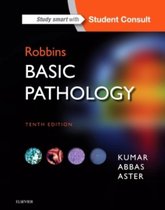
Robbins Basic Pathology
10th Edition
Author(s)Vinay Kumar; MBBS; MD;
FRCPath; Abul K. Abbas; MBBS and
Jon C. Aster; MD; PhD
Print ISBN: 9780323353175
,Question 1
A researcher examines a normal secretory cell and finds abundant
rough endoplasmic reticulum and a prominent Golgi apparatus. Which
cellular function best explains this organization?
A. Synthesis and secretion of proteins
B. Oxidation of fatty acids
C. Digestion of extracellular bacteria
D. Storage of calcium for muscle contraction
Correct Answer: A. Synthesis and secretion of proteins
,Rationale: Rough endoplasmic reticulum is specialized for synthesis of
proteins destined for secretion or insertion into membranes, while the
Golgi apparatus modifies and sorts these proteins. Mitochondria are
responsible for oxidative metabolism, lysosomes digest intracellular
material, and the sarcoplasmic reticulum is particularly important for
calcium storage in muscle cells.
Question 2
A patient has a mutation affecting the DNA sequence of a structural
protein gene. Which cellular component normally carries the
information required to produce this protein?
A. Lysosomal membrane
B. Nuclear DNA
C. Golgi apparatus
D. Plasma membrane
Correct Answer: B. Nuclear DNA
Rationale: Nuclear DNA contains the genetic information that specifies
protein sequences. The Golgi apparatus modifies and sorts proteins, the
plasma membrane regulates exchange and signaling, and lysosomes
contain digestive enzymes rather than genetic information.
Question 3
Which organelle is primarily responsible for degrading worn-out
intracellular organelles and macromolecules that have entered the cell?
A. Lysosome
B. Ribosome
, C. Peroxisome
D. Nucleolus
Correct Answer: A. Lysosome
Rationale: Lysosomes contain acid hydrolases that degrade intracellular
components delivered to them through pathways such as autophagy
and endocytosis. Ribosomes synthesize proteins, peroxisomes perform
oxidative reactions including fatty-acid metabolism, and the nucleolus is
involved in ribosomal RNA production and ribosome assembly.
Question 4
A cell requires large amounts of ATP to maintain ion gradients across its
plasma membrane. Which organelle is most directly responsible for
generating most of this ATP under aerobic conditions?
A. Golgi apparatus
B. Lysosome
C. Mitochondrion
D. Nucleolus
Correct Answer: C. Mitochondrion
Rationale: Mitochondria generate most cellular ATP through oxidative
phosphorylation, using an electron transport chain and an inner
mitochondrial membrane proton gradient. The Golgi and lysosomes
perform trafficking and degradation functions, while the nucleolus is
involved in ribosome production.
Question 5
A mutation prevents a receptor from binding its growth factor. What is
the most likely immediate consequence?
10th Edition
Author(s)Vinay Kumar; MBBS; MD;
FRCPath; Abul K. Abbas; MBBS and
Jon C. Aster; MD; PhD
Print ISBN: 9780323353175
,Question 1
A researcher examines a normal secretory cell and finds abundant
rough endoplasmic reticulum and a prominent Golgi apparatus. Which
cellular function best explains this organization?
A. Synthesis and secretion of proteins
B. Oxidation of fatty acids
C. Digestion of extracellular bacteria
D. Storage of calcium for muscle contraction
Correct Answer: A. Synthesis and secretion of proteins
,Rationale: Rough endoplasmic reticulum is specialized for synthesis of
proteins destined for secretion or insertion into membranes, while the
Golgi apparatus modifies and sorts these proteins. Mitochondria are
responsible for oxidative metabolism, lysosomes digest intracellular
material, and the sarcoplasmic reticulum is particularly important for
calcium storage in muscle cells.
Question 2
A patient has a mutation affecting the DNA sequence of a structural
protein gene. Which cellular component normally carries the
information required to produce this protein?
A. Lysosomal membrane
B. Nuclear DNA
C. Golgi apparatus
D. Plasma membrane
Correct Answer: B. Nuclear DNA
Rationale: Nuclear DNA contains the genetic information that specifies
protein sequences. The Golgi apparatus modifies and sorts proteins, the
plasma membrane regulates exchange and signaling, and lysosomes
contain digestive enzymes rather than genetic information.
Question 3
Which organelle is primarily responsible for degrading worn-out
intracellular organelles and macromolecules that have entered the cell?
A. Lysosome
B. Ribosome
, C. Peroxisome
D. Nucleolus
Correct Answer: A. Lysosome
Rationale: Lysosomes contain acid hydrolases that degrade intracellular
components delivered to them through pathways such as autophagy
and endocytosis. Ribosomes synthesize proteins, peroxisomes perform
oxidative reactions including fatty-acid metabolism, and the nucleolus is
involved in ribosomal RNA production and ribosome assembly.
Question 4
A cell requires large amounts of ATP to maintain ion gradients across its
plasma membrane. Which organelle is most directly responsible for
generating most of this ATP under aerobic conditions?
A. Golgi apparatus
B. Lysosome
C. Mitochondrion
D. Nucleolus
Correct Answer: C. Mitochondrion
Rationale: Mitochondria generate most cellular ATP through oxidative
phosphorylation, using an electron transport chain and an inner
mitochondrial membrane proton gradient. The Golgi and lysosomes
perform trafficking and degradation functions, while the nucleolus is
involved in ribosome production.
Question 5
A mutation prevents a receptor from binding its growth factor. What is
the most likely immediate consequence?