
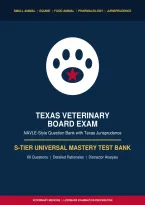
SMALL ANIMAL | EQUINE | FOOD ANIMAL | PHARMACOLOGY | JURISPRUDENCE
TEXAS VETERINARY
BOARD EXAM
NAVLE-Style Question Bank with Texas Jurisprudence
S-TIER UNIVERSAL MASTERY TEST BANK
60 Questions | Detailed Rationales | Distractor Analysis
VETERINARY MEDICINE | LICENSURE EXAMINATION PREPARATION
,Table of Contents
1. Part I: The Preview
• The Intro
• The Critical Axioms Cheat Sheet
2. Part II: The Elite Test Bank
• Tier 1: Foundational Syntax and Application (Questions 1–20)
• Tier 2: Complex Application and Simulation (Questions 21–40)
• Tier 3: Grandmaster Synthesis (Questions 41–60)
Texas Veterinary Board Exam Elite Test Bank | Page 2
,Part I: The Preview
Mastering this test bank builds the clinical reasoning and legal awareness that a veterinary licensing
examination demands: recognizing what is life-threatening, choosing the safest effective treatment, and
practicing within Texas law. Each question links a species-specific principle to a decision, so you can
defend your answer rather than recall a fact.
The Critical Axioms Cheat Sheet
• Emergency first: Treat shock, airway, and life-threatening metabolic problems before diagnostics.
Examples: aliquot crystalloid boluses for shock; calcium for hyperkalemic cardiotoxicity in a blocked
cat; stabilize, then decompress and operate for GDV.
• Calculations: Dose = mg/kg x weight; volume = dose / concentration. Fluid deficit (L) = kg x fraction
dehydrated; dog maintenance is about 40-60 mL/kg/day; drops/min = volume x drop factor / minutes.
PPV falls as prevalence falls.
• Species essentials: Core dog vaccines: distemper, adenovirus, parvovirus, rabies. Core cat: FVRCP
and rabies. Core horse: tetanus, rabies, EEE/WEE, West Nile. Cats are sensitive to acetaminophen;
xylitol causes hypoglycemia; antifreeze needs fomepizole.
• Food animals and disease control: Never use chloramphenicol in food animals; observe withdrawal
times; medically important antimicrobials in feed need a veterinary feed directive. Suspect a foreign
animal disease? Isolate and notify TAHC or USDA. Do not open a suspected anthrax carcass.
• Texas practice law: A valid veterinarian-client-patient relationship is required before prescribing. Keep
records confidential unless the owner consents or the law compels disclosure. Dogs and cats must be
rabies-vaccinated by 4 months; a biting dog is observed for 10 days. Diagnosis, prescription, and
surgery are not delegable to technicians.
Pathway to Texas veterinary licensure
Texas Texas Board Continuing
Accredited NAVLE
jurisprudence (TBVME) education and
DVM degree (national exam)
exam licensure renewal
Check current TBVME rules for exact requirements, fees, and renewal cycles.
Figure 1. Pathway to Texas licensure
Texas Veterinary Board Exam Elite Test Bank | Page 3
, Part II: The Elite Test Bank
Tier 1: Foundational Syntax and Application (Questions 1–20)
Approximate normal adult vital signs
Species Heart rate Resp. rate Temperature (F)
Dog 60-140 / min 10-30 / min 100.5-102.5
Cat 140-220 / min 20-30 / min 100.5-102.5
Horse 28-44 / min 10-14 / min 99.5-101.5
Cattle 48-84 / min 10-30 / min 100.4-102.8
Ranges vary with age, size, excitement, and environment; use them as screening values.
Figure 2. Approximate normal vital signs
Q1: A veterinary student is reviewing canine cardiac anatomy. Which valve lies between the left atrium and
the left ventricle?
A) The tricuspid valve
B) The mitral (left atrioventricular) valve
C) The aortic valve
D) The pulmonic valve
• Answer: B (The mitral (left atrioventricular) valve)
• Distractor Analysis:
• A is incorrect: This valve lies between the right atrium and right ventricle.
• C is incorrect: This semilunar valve lies between the left ventricle and the aorta.
• D is incorrect: This semilunar valve lies between the right ventricle and the pulmonary artery.
The Mentor's Analysis:
Blood flows right atrium, tricuspid valve, right ventricle, pulmonic valve, lungs, left atrium, mitral valve,
left ventricle, aortic valve. Mitral valve disease is the most common acquired cardiac disease in small
dogs.
Professional Intuition: Left AV valve is the mitral valve.
Q2: Which of the following is a CORE vaccine for dogs according to current vaccination guidelines?
A) Bordetella bronchiseptica
B) Borrelia burgdorferi (Lyme)
Texas Veterinary Board Exam Elite Test Bank | Page 4
TEXAS VETERINARY
BOARD EXAM
NAVLE-Style Question Bank with Texas Jurisprudence
S-TIER UNIVERSAL MASTERY TEST BANK
60 Questions | Detailed Rationales | Distractor Analysis
VETERINARY MEDICINE | LICENSURE EXAMINATION PREPARATION
,Table of Contents
1. Part I: The Preview
• The Intro
• The Critical Axioms Cheat Sheet
2. Part II: The Elite Test Bank
• Tier 1: Foundational Syntax and Application (Questions 1–20)
• Tier 2: Complex Application and Simulation (Questions 21–40)
• Tier 3: Grandmaster Synthesis (Questions 41–60)
Texas Veterinary Board Exam Elite Test Bank | Page 2
,Part I: The Preview
Mastering this test bank builds the clinical reasoning and legal awareness that a veterinary licensing
examination demands: recognizing what is life-threatening, choosing the safest effective treatment, and
practicing within Texas law. Each question links a species-specific principle to a decision, so you can
defend your answer rather than recall a fact.
The Critical Axioms Cheat Sheet
• Emergency first: Treat shock, airway, and life-threatening metabolic problems before diagnostics.
Examples: aliquot crystalloid boluses for shock; calcium for hyperkalemic cardiotoxicity in a blocked
cat; stabilize, then decompress and operate for GDV.
• Calculations: Dose = mg/kg x weight; volume = dose / concentration. Fluid deficit (L) = kg x fraction
dehydrated; dog maintenance is about 40-60 mL/kg/day; drops/min = volume x drop factor / minutes.
PPV falls as prevalence falls.
• Species essentials: Core dog vaccines: distemper, adenovirus, parvovirus, rabies. Core cat: FVRCP
and rabies. Core horse: tetanus, rabies, EEE/WEE, West Nile. Cats are sensitive to acetaminophen;
xylitol causes hypoglycemia; antifreeze needs fomepizole.
• Food animals and disease control: Never use chloramphenicol in food animals; observe withdrawal
times; medically important antimicrobials in feed need a veterinary feed directive. Suspect a foreign
animal disease? Isolate and notify TAHC or USDA. Do not open a suspected anthrax carcass.
• Texas practice law: A valid veterinarian-client-patient relationship is required before prescribing. Keep
records confidential unless the owner consents or the law compels disclosure. Dogs and cats must be
rabies-vaccinated by 4 months; a biting dog is observed for 10 days. Diagnosis, prescription, and
surgery are not delegable to technicians.
Pathway to Texas veterinary licensure
Texas Texas Board Continuing
Accredited NAVLE
jurisprudence (TBVME) education and
DVM degree (national exam)
exam licensure renewal
Check current TBVME rules for exact requirements, fees, and renewal cycles.
Figure 1. Pathway to Texas licensure
Texas Veterinary Board Exam Elite Test Bank | Page 3
, Part II: The Elite Test Bank
Tier 1: Foundational Syntax and Application (Questions 1–20)
Approximate normal adult vital signs
Species Heart rate Resp. rate Temperature (F)
Dog 60-140 / min 10-30 / min 100.5-102.5
Cat 140-220 / min 20-30 / min 100.5-102.5
Horse 28-44 / min 10-14 / min 99.5-101.5
Cattle 48-84 / min 10-30 / min 100.4-102.8
Ranges vary with age, size, excitement, and environment; use them as screening values.
Figure 2. Approximate normal vital signs
Q1: A veterinary student is reviewing canine cardiac anatomy. Which valve lies between the left atrium and
the left ventricle?
A) The tricuspid valve
B) The mitral (left atrioventricular) valve
C) The aortic valve
D) The pulmonic valve
• Answer: B (The mitral (left atrioventricular) valve)
• Distractor Analysis:
• A is incorrect: This valve lies between the right atrium and right ventricle.
• C is incorrect: This semilunar valve lies between the left ventricle and the aorta.
• D is incorrect: This semilunar valve lies between the right ventricle and the pulmonary artery.
The Mentor's Analysis:
Blood flows right atrium, tricuspid valve, right ventricle, pulmonic valve, lungs, left atrium, mitral valve,
left ventricle, aortic valve. Mitral valve disease is the most common acquired cardiac disease in small
dogs.
Professional Intuition: Left AV valve is the mitral valve.
Q2: Which of the following is a CORE vaccine for dogs according to current vaccination guidelines?
A) Bordetella bronchiseptica
B) Borrelia burgdorferi (Lyme)
Texas Veterinary Board Exam Elite Test Bank | Page 4


