
lOMoARcPSD|64109549
HY
6_removed.pdf)(#UUNDS*(HN
101 Key
10/6/2026,
Concepts4:05:22
and Chapters
AMMidterm
(*OIUJE(**&EHUH(*&OIUEH*&E*&YE(E*E*(*EII&UMidterm
1-6_removed.pdf)(#UUNDS*(HN
Study Guide for APHY 101 Key
(*OIUJE(**&EHUH(*&OIUEH*&E*&YE(E*E*(*EII&UMidterm
Concepts and Chapters
Study 1-6_removed.pdf)(#UUNDS*(HN
Guide for APHY 101 Key Concepts
Study
(*OIUJE(**&EHUH(*&OIUEH*&E*&YE(E*E
andGuide
Chapters
for APHY
1-6_removed.pdf
101 Key Concepts an
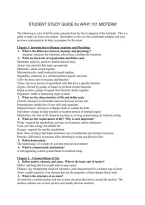
STUDENT STUDY GUIDE for APHY 101 MIDTERM
The following is a list of all the main concepts from the first 6 chapters of the textbook. This is a
guide to help you focus your studies. Remember to also use the LearnSmart modules and your
previous exams/quizzes to help you prepare for the exam.
Chapter 1- Introduction to Human Anatomy and Physiology
1. What is the difference between anatomy and physiology?
Anatomy examines the structures, physiology considers the functions
2. What are the levels of organization and define each.
Subatomic particles- particles smaller than an atom
Atoms- tiny particles that make up materials
Molecules- atoms joined together
Macromolecules- small molecules joined together
Organelles- structures in a cell that perform specific activities
Cells- the basic unit of structure and function
Tissue- layers or masses of specialized cells that have a specific function
Organs- formed by groups of tissues to perform certain functions
Organ systems- groups of organs that function closely together
Organisms- made of interacting organ systems
3. What are the characteristics of life and define each.
Growth- increase in cell number and size/increase in body size
Reproduction- production of new cells and organisms
Responsiveness- reaction to a change inside or outside the body
Movement- change in body position or location/motion of internal organs
Metabolism- the sum of all chemical reactions in a living system/energy & nutrient cycling
4. What are the requirements of life? Why is each important?
Water- required for metabolism, provides environment, carries substances
Food- provides energy for cellular life
Oxygen- required for aerobic metabolism
Heat- form of energy that helps determine rate of metabolism and chemical reactions
Pressure- differences in pressure allow breathing to occur and blood to flow
5. Define homeostasis.
The maintenance of a relatively constant internal environment
6. What is a homeostatic mechanism?
A self-regulating control system based on feedback loops
Chapter 2 – Chemical Basis of Life
1. Define matter, element, and atom. What is the basic unit of matter?
Matter- anything that has weight and occupies space
Element- any fundamental chemical substance, each characterized by a distinct type of atom
Atom- smallest particle of an element that has the properties of that element (basic unit)
2. What is the structure of an atom?
An atom has a central nucleus and one or more electrons that moves around the nucleus. The
nucleus contains one or more protons and usually also has neutrons.
HY
6_removed.pdf)(#UUNDS*(HN
101 Key
Midterm
Concepts
Study
andGuide
Chapters 101 Key ConceptsDownloaded
1-6_removed.pdf)(#UUNDS*(HN by1-6_removed.pdf)(#UUNDS*(HN
and Chapters Aplus Grade ()
(*OIUJE(**&EHUH(*&OIUEH*&E*&YE(E*E*(*EII&UMidterm
for APHY (*OIUJE(**&EHUH(*&OIUEH*&E*&YE(E*E*(*EII&UMidterm
Study Guide for APHY
(*OIUJE(**&EHUH(*&OIUEH*&E*&YE(E*E*(*EII&UMidterm
101 Key Concepts
Study
andGuide
Chapters
for APHY
1-6_removed.pdf
101 Key Concepts
Study
an
, lOMoARcPSD|64109549
HY
6_removed.pdf)(#UUNDS*(HN
101 Key
10/6/2026,
Concepts4:05:22
and Chapters
AMMidterm
(*OIUJE(**&EHUH(*&OIUEH*&E*&YE(E*E*(*EII&UMidterm
1-6_removed.pdf)(#UUNDS*(HN
Study Guide for APHY 101 Key
(*OIUJE(**&EHUH(*&OIUEH*&E*&YE(E*E*(*EII&UMidterm
Concepts and Chapters
Study 1-6_removed.pdf)(#UUNDS*(HN
Guide for APHY 101 Key Concepts
Study
(*OIUJE(**&EHUH(*&OIUEH*&E*&YE(E*E
andGuide
Chapters
for APHY
1-6_removed.pdf
101 Key Concepts an
3. Define nucleus, proton, neutron, and electron. What charges do each of these particles
have?
Nucleus- dense core of an atom composed of protons and neutrons
Proton- positively charged particle in an atomic nucleus
Neutron- electrically neutral subatomic particle
Electron- small negatively charged particle that encircles the nucleus of an atom
4. What are covalent, ionic and hydrogen bonds? What are the differences among the
three?
Covalent- chemical bond formed by electron sharing between atoms
Ionic- chemical bond between two ions formed by transfer of electrons (+ attracted to -)
Hydrogen- weak bond between a hydrogen atom and an atom of oxygen or nitrogen
The differences between covalent and ionic are that covalent bonds are with atoms, and ionic
bonds are with ions of those atoms. Both differ from hydrogen bonds in the bonding mechanism
5. Define synthesis, decomposition, and exchange reactions.
Synthesis reaction- bonding small molecules to build larger ones
Decomposition reaction- breakdown of molecules
Exchange reaction- chemical reaction in which parts of two types of molecules trade positions
6. What is a reactant? a product?
Reactant- a chemical that takes part in a chemical reaction (starting material)
Product- the result of a chemical reaction
7. Define catalyst.
Chemical that increases the rate of a chemical reaction but is not permanently altered by the
reaction
8. What happens and what is produced when salts dissolve in water?
The atoms in the molecule dissociate due to the reaction between an acid and a base, and ionize
into ions called electrolytes
9. What is an acid? a base?
Acid- substance releases hydrogen ions (H+)
Base- substance that releases ions that can combine with hydrogen ions (H+)
10. What is the pH scale? What ions are involved in the pH scale?
The pH scale tracks the concentrations of acids and bases in a substance by representing the
number of H+ molecules in a solution by how many grams/liter there are (0.1, 0.01, etc.)
11. What is the difference between an organic molecule and an inorganic molecule?
Organic molecule- molecule containing both carbon and hydrogen
Inorganic molecule- molecule that does not contain both carbon and hydrogen atoms
12. What is dehydration synthesis and hydrolysis?
Dehydration synthesis- anabolic process joining small molecules by releasing the equivalent of a
water molecule
Hydrolysis- enzymatically adding parts of a water molecule to split a bond
13. What are carbohydrates, lipids, proteins, and nucleic acids?
Carbohydrates- organic compound consisting of carbon, hydrogen, and oxygen in a 1:2:1
Lipids- group of organic compounds that include triglycerides, phospholipids, and steroids
Proteins- nitrogen containing organic compounds composed of many bonded amino acids
Nucleic acids- a molecule composed of bonded nucleotides (RNA or DNA)
HY
6_removed.pdf)(#UUNDS*(HN
101 Key
Midterm
Concepts
Study
andGuide
Chapters 101 Key ConceptsDownloaded
1-6_removed.pdf)(#UUNDS*(HN by1-6_removed.pdf)(#UUNDS*(HN
and Chapters Aplus Grade ()
(*OIUJE(**&EHUH(*&OIUEH*&E*&YE(E*E*(*EII&UMidterm
for APHY (*OIUJE(**&EHUH(*&OIUEH*&E*&YE(E*E*(*EII&UMidterm
Study Guide for APHY
(*OIUJE(**&EHUH(*&OIUEH*&E*&YE(E*E*(*EII&UMidterm
101 Key Concepts
Study
andGuide
Chapters
for APHY
1-6_removed.pdf
101 Key Concepts
Study
an
HY
6_removed.pdf)(#UUNDS*(HN
101 Key
10/6/2026,
Concepts4:05:22
and Chapters
AMMidterm
(*OIUJE(**&EHUH(*&OIUEH*&E*&YE(E*E*(*EII&UMidterm
1-6_removed.pdf)(#UUNDS*(HN
Study Guide for APHY 101 Key
(*OIUJE(**&EHUH(*&OIUEH*&E*&YE(E*E*(*EII&UMidterm
Concepts and Chapters
Study 1-6_removed.pdf)(#UUNDS*(HN
Guide for APHY 101 Key Concepts
Study
(*OIUJE(**&EHUH(*&OIUEH*&E*&YE(E*E
andGuide
Chapters
for APHY
1-6_removed.pdf
101 Key Concepts an
STUDENT STUDY GUIDE for APHY 101 MIDTERM
The following is a list of all the main concepts from the first 6 chapters of the textbook. This is a
guide to help you focus your studies. Remember to also use the LearnSmart modules and your
previous exams/quizzes to help you prepare for the exam.
Chapter 1- Introduction to Human Anatomy and Physiology
1. What is the difference between anatomy and physiology?
Anatomy examines the structures, physiology considers the functions
2. What are the levels of organization and define each.
Subatomic particles- particles smaller than an atom
Atoms- tiny particles that make up materials
Molecules- atoms joined together
Macromolecules- small molecules joined together
Organelles- structures in a cell that perform specific activities
Cells- the basic unit of structure and function
Tissue- layers or masses of specialized cells that have a specific function
Organs- formed by groups of tissues to perform certain functions
Organ systems- groups of organs that function closely together
Organisms- made of interacting organ systems
3. What are the characteristics of life and define each.
Growth- increase in cell number and size/increase in body size
Reproduction- production of new cells and organisms
Responsiveness- reaction to a change inside or outside the body
Movement- change in body position or location/motion of internal organs
Metabolism- the sum of all chemical reactions in a living system/energy & nutrient cycling
4. What are the requirements of life? Why is each important?
Water- required for metabolism, provides environment, carries substances
Food- provides energy for cellular life
Oxygen- required for aerobic metabolism
Heat- form of energy that helps determine rate of metabolism and chemical reactions
Pressure- differences in pressure allow breathing to occur and blood to flow
5. Define homeostasis.
The maintenance of a relatively constant internal environment
6. What is a homeostatic mechanism?
A self-regulating control system based on feedback loops
Chapter 2 – Chemical Basis of Life
1. Define matter, element, and atom. What is the basic unit of matter?
Matter- anything that has weight and occupies space
Element- any fundamental chemical substance, each characterized by a distinct type of atom
Atom- smallest particle of an element that has the properties of that element (basic unit)
2. What is the structure of an atom?
An atom has a central nucleus and one or more electrons that moves around the nucleus. The
nucleus contains one or more protons and usually also has neutrons.
HY
6_removed.pdf)(#UUNDS*(HN
101 Key
Midterm
Concepts
Study
andGuide
Chapters 101 Key ConceptsDownloaded
1-6_removed.pdf)(#UUNDS*(HN by1-6_removed.pdf)(#UUNDS*(HN
and Chapters Aplus Grade ()
(*OIUJE(**&EHUH(*&OIUEH*&E*&YE(E*E*(*EII&UMidterm
for APHY (*OIUJE(**&EHUH(*&OIUEH*&E*&YE(E*E*(*EII&UMidterm
Study Guide for APHY
(*OIUJE(**&EHUH(*&OIUEH*&E*&YE(E*E*(*EII&UMidterm
101 Key Concepts
Study
andGuide
Chapters
for APHY
1-6_removed.pdf
101 Key Concepts
Study
an
, lOMoARcPSD|64109549
HY
6_removed.pdf)(#UUNDS*(HN
101 Key
10/6/2026,
Concepts4:05:22
and Chapters
AMMidterm
(*OIUJE(**&EHUH(*&OIUEH*&E*&YE(E*E*(*EII&UMidterm
1-6_removed.pdf)(#UUNDS*(HN
Study Guide for APHY 101 Key
(*OIUJE(**&EHUH(*&OIUEH*&E*&YE(E*E*(*EII&UMidterm
Concepts and Chapters
Study 1-6_removed.pdf)(#UUNDS*(HN
Guide for APHY 101 Key Concepts
Study
(*OIUJE(**&EHUH(*&OIUEH*&E*&YE(E*E
andGuide
Chapters
for APHY
1-6_removed.pdf
101 Key Concepts an
3. Define nucleus, proton, neutron, and electron. What charges do each of these particles
have?
Nucleus- dense core of an atom composed of protons and neutrons
Proton- positively charged particle in an atomic nucleus
Neutron- electrically neutral subatomic particle
Electron- small negatively charged particle that encircles the nucleus of an atom
4. What are covalent, ionic and hydrogen bonds? What are the differences among the
three?
Covalent- chemical bond formed by electron sharing between atoms
Ionic- chemical bond between two ions formed by transfer of electrons (+ attracted to -)
Hydrogen- weak bond between a hydrogen atom and an atom of oxygen or nitrogen
The differences between covalent and ionic are that covalent bonds are with atoms, and ionic
bonds are with ions of those atoms. Both differ from hydrogen bonds in the bonding mechanism
5. Define synthesis, decomposition, and exchange reactions.
Synthesis reaction- bonding small molecules to build larger ones
Decomposition reaction- breakdown of molecules
Exchange reaction- chemical reaction in which parts of two types of molecules trade positions
6. What is a reactant? a product?
Reactant- a chemical that takes part in a chemical reaction (starting material)
Product- the result of a chemical reaction
7. Define catalyst.
Chemical that increases the rate of a chemical reaction but is not permanently altered by the
reaction
8. What happens and what is produced when salts dissolve in water?
The atoms in the molecule dissociate due to the reaction between an acid and a base, and ionize
into ions called electrolytes
9. What is an acid? a base?
Acid- substance releases hydrogen ions (H+)
Base- substance that releases ions that can combine with hydrogen ions (H+)
10. What is the pH scale? What ions are involved in the pH scale?
The pH scale tracks the concentrations of acids and bases in a substance by representing the
number of H+ molecules in a solution by how many grams/liter there are (0.1, 0.01, etc.)
11. What is the difference between an organic molecule and an inorganic molecule?
Organic molecule- molecule containing both carbon and hydrogen
Inorganic molecule- molecule that does not contain both carbon and hydrogen atoms
12. What is dehydration synthesis and hydrolysis?
Dehydration synthesis- anabolic process joining small molecules by releasing the equivalent of a
water molecule
Hydrolysis- enzymatically adding parts of a water molecule to split a bond
13. What are carbohydrates, lipids, proteins, and nucleic acids?
Carbohydrates- organic compound consisting of carbon, hydrogen, and oxygen in a 1:2:1
Lipids- group of organic compounds that include triglycerides, phospholipids, and steroids
Proteins- nitrogen containing organic compounds composed of many bonded amino acids
Nucleic acids- a molecule composed of bonded nucleotides (RNA or DNA)
HY
6_removed.pdf)(#UUNDS*(HN
101 Key
Midterm
Concepts
Study
andGuide
Chapters 101 Key ConceptsDownloaded
1-6_removed.pdf)(#UUNDS*(HN by1-6_removed.pdf)(#UUNDS*(HN
and Chapters Aplus Grade ()
(*OIUJE(**&EHUH(*&OIUEH*&E*&YE(E*E*(*EII&UMidterm
for APHY (*OIUJE(**&EHUH(*&OIUEH*&E*&YE(E*E*(*EII&UMidterm
Study Guide for APHY
(*OIUJE(**&EHUH(*&OIUEH*&E*&YE(E*E*(*EII&UMidterm
101 Key Concepts
Study
andGuide
Chapters
for APHY
1-6_removed.pdf
101 Key Concepts
Study
an


