
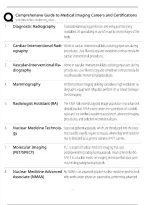
Comprehensive Guide to Medical Imaging Careers and Certifications
This comprehensive guide explores the diverse career pathways and professional credentials available within the medical imaging and radiation sciences field. Medical imaging encompasses a wide range of diagnostic and therapeutic specialties that utilize advanced technology to visualize internal anatomy, assess organ function, and guide clinical decision-making. The guide begins with Career Pathways, detailing the major roles within medical imaging. Radiographers use X-ray, CT, MRI, angiography, and mammography equipment to produce diagnostic images . Nuclear medicine technologists prepare and administer radiopharmaceuticals, acquiring images with PET and SPECT cameras that show organ function at a molecular level . Sonographers employ ultrasound for obstetric, vascular, musculoskeletal, and abdominal examinations . The guide also covers supporting and advanced roles including medical physicists, radiochemists, nurses, and radiologists . The Educational Foundations section outlines the degree requirements for each profession. Radiologic technologists typically complete an associate's or bachelor's degree in an accredited program . Sonographers often pursue post-graduate diplomas or specialized sonography programs . Nuclear medicine technologists complete accredited programs resulting in certificates or degrees . The Certification Bodies and Credentials section provides detailed coverage of the major certifying organizations. The American Registry of Radiologic Technologists (ARRT) is the most widely recognized certifying agency, offering primary certifications in Radiography, Nuclear Medicine Technology, Radiation Therapy, Magnetic Resonance Imaging, and Sonography . Requirements include completion of an approved educational program, an ethics review, and passing an examination . The American Registry for Diagnostic Medical Sonography (ARDMS) administers the Registered Diagnostic Medical Sonographer (RDMS) credential, which requires passing the Sonography Principles and Instrumentation (SPI) exam plus one or more specialty exams in Abdomen, Breast, Obstetrics and Gynecology, Fetal Echocardiography, or Pediatric Sonography . The Nuclear Medicine Technology Certification Board (NMTCB) offers the Certified Nuclear Medicine Technologist (CNMT) credential, with eligibility requiring completion of an NMTCB-recognized program and a passing score on a 90-question examination . The Specialty Certifications section addresses advanced credentials including PET and Nuclear Cardiology specialty exams from NMTCB, and the various RDMS specialty examinations, each with specific eligibility pathways and clinical experience requirements . The guide also covers continuing education and recertification requirements, including ARRT's 24 hours of continuing education every two years and NMTCB's annual registration and continuing competence policies
Document information
- Uploaded on
- October 6, 2026
- Number of pages
- 9
- Written in
- 2026/2027
- Type
- Exam (elaborations)
- Contains
- Questions & answers


