
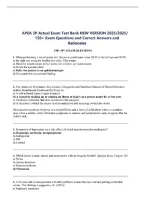
APEA 3P Exam Study & Review Resource — Pathophysiology, Physical Assessment & Pharmacology
APEA 3P Exam Study & Review Resource — Pathophysiology, Physical Assessment & Pharmacology Prepare for advanced practice nursing coursework with this comprehensive APEA 3P exam study and review resource. Designed for nurse practitioner students preparing to strengthen their knowledge of pathophysiology, physical assessment, and pharmacology, this resource provides structured practice designed to support clinical reasoning, knowledge retention, and examination preparation. The APEA 3P assessment evaluates knowledge across the three foundational areas commonly referred to as the “3Ps”: pathophysiology, physical assessment, and pharmacology. APEA identifies these areas as important indicators of clinical readiness for nurse practitioner students. Comprehensive 3P Review This study resource brings together practice-oriented material covering essential concepts from the three core disciplines. Students can use it alongside their coursework, lecture notes, textbooks, clinical resources, and instructor guidance to reinforce knowledge and identify areas requiring additional study. Rather than relying solely on memorization, students can use practice questions to work through clinical scenarios and connect foundational science with patient assessment and treatment decisions. Pathophysiology Review A strong understanding of pathophysiology is essential for advanced practice nursing. Students need to understand how disease processes develop, how physiological systems respond to illness, and how pathological changes relate to clinical manifestations. Practice-based review can help reinforce concepts involving major body systems and common disease processes. Students can work through questions involving disease mechanisms, risk factors, clinical manifestations, complications, and relationships between pathophysiological changes and patient symptoms. Regular review can help students identify subjects where they need additional clarification and return to their primary educational resources for deeper study. Physical Assessment Preparation Physical assessment is another central component of advanced practice nursing education. Students need to develop systematic approaches to obtaining health histories, performing physical examinations, interpreting findings, and recognizing abnormalities. This resource can support review of assessment principles, clinical findings, examination techniques, and interpretation of patient information. Practice scenarios can encourage students to consider which findings are expected, which may indicate disease, and which require additional assessment or follow-up. Pharmacology Review Pharmacology is a critical component of nurse practitioner education. Students must understand medication mechanisms, indications, contraindications, adverse effects, interactions, monitoring requirements, and patient education. Practice questions can help reinforce connections between pharmacological concepts and clinical decision-making. Students can review medication classes and consider how specific therapies relate to diagnoses, patient characteristics, laboratory findings, and safety considerations. Because medication recommendations can change, students should always verify drug information using current, authoritative pharmacology references and institutional guidelines. Clinical Reasoning The 3P subjects are closely connected in clinical practice. Understanding a disease process helps explain assessment findings, while pharmacology provides the foundation for understanding treatment options. This study resource encourages students to integrate these areas rather than studying them in isolation. A clinical scenario might require the learner to identify a pathophysiological process, interpret an assessment finding, and understand the pharmacological principles associated with management. This integrated approach can strengthen critical thinking and clinical judgment. Practice for Advanced Nursing Students The resource is suitable for students preparing for advanced practice nursing assessments and related coursework. It can be incorporated into study schedules throughout the semester or used for focused review before a major examination. Students can use the material to: Review pathophysiology concepts Reinforce physical assessment knowledge Study pharmacology principles Practice clinical reasoning Identify knowledge gaps Prepare for advanced nursing examinations Review difficult subject areas Connect classroom concepts with clinical situations Strengthen test-taking strategies Support independent study Organized Study Strategy Students can approach the material in several ways. One strategy is to divide study time among the three major areas: pathophysiology, physical assessment, and pharmacology. Another approach is to focus on weak areas identified through practice. For example, a student who performs well in assessment but struggles with pharmacology can dedicate additional study time to medication mechanisms, adverse effects, contraindications, and therapeutic decision-making. Repeated practice can help students determine whether their understanding improves after reviewing the corresponding textbook material. Knowledge Areas and Clinical Application Advanced practice nursing encompasses a wide range of clinical conditions. A well-rounded study strategy should include multiple body systems and patient populations. Review may involve concepts related to: Cardiovascular disorders Respiratory conditions Endocrine disorders Gastrointestinal conditions Neurological disorders Dermatological conditions Hematological disorders Musculoskeletal problems Genitourinary conditions Women's health Men's health Pediatrics Psychiatry Infectious conditions Preventive healthcare Pharmacological management Physical assessment APEA's published sample 3P results illustrate knowledge areas such as cardiovascular, respiratory, endocrine, gastrointestinal, neurological, dermatological, pediatric, psychiatric, women's health, and men's health topics. Develop Better Test-Taking Skills Practice questions can help students become more comfortable analyzing clinical information under time constraints. Instead of immediately looking for a familiar phrase, learners can practice identifying the key clinical information, eliminating inappropriate alternatives, and determining which principle the question is testing. When an answer is missed, students should review the rationale or relevant learning material and determine why the selected response was incorrect. This approach promotes understanding and can make future questions easier to analyze. Complement Your Existing APEA Preparation This resource is best used as a supplement to official and instructor-approved preparation materials. APEA itself offers dedicated study questions with detailed rationales, as well as practice and predictor assessments. Its MyQBank resources include separate areas for pathophysiology, assessment, and prescribing, with detailed rationales designed to build critical thinking. Students can combine practice questions with their course textbooks, review courses, clinical guidelines, lecture materials, and faculty recommendations. Why Use a 3P Study Resource? A structured review resource can make preparation more efficient by giving students an organized way to test their knowledge. Instead of passively rereading material, students can actively retrieve information, analyze scenarios, and identify topics requiring further study. Benefits include: Structured 3P review Active learning opportunities Clinical reasoning practice Pathophysiology reinforcement Physical assessment review Pharmacology practice Knowledge-gap identification Flexible independent study Examination preparation Improved confidence through practice Ideal for Nurse Practitioner Students This resource is particularly useful for students progressing through nurse practitioner programs who want additional opportunities to review foundational concepts before clinical and comprehensive assessments. The 3P foundation is important because advanced practice nurses must integrate knowledge of disease processes, patient assessment, and pharmacological treatment when making clinical decisions. Educational Note This product should be used as a supplemental educational study and review resource. It is not represented as an official APEA examination, as containing secure/actual examination questions, or as guaranteeing examination results. Students should rely on their institution's approved resources, current clinical guidelines, instructor materials, and official APEA resources for authoritative preparation. Use this resource to reinforce your understanding, identify areas for further study, and develop the clinical reasoning skills needed for advanced practice nursing. Key Features APEA 3P-focused study material Pathophysiology review Physical assessment review Pharmacology review Clinical reasoning practice Advanced nursing examination preparation Knowledge-gap identification Patient-centered clinical application Flexible independent study Suitable for nurse practitioner students Build a stronger foundation in pathophysiology, physical assessment, and pharmacology with a structured study resource designed to complement your advanced practice nursing education.
Document information
- Uploaded on
- October 6, 2026
- Number of pages
- 34
- Written in
- 2026/2027
- Type
- Exam (elaborations)
- Contains
- Questions & answers


