
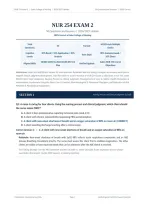
NUR 254 Exam 2 | Galen College of Nursing | 2026/2027 Update 50 Questions and Answers | 100% Correct
NUR 254 EXAM 2
50 Questions and Answers | 2026/2027 Update
100% Correct • Galen College of Nursing
Total NCLEX-style Multiple
50 Format:
Questions: Choice
Cognitive 30% Recall / 50% Application / 20% 80% Scenario-based /
Item Style:
Levels: Analysis 20% Direct
NCSBN CJMM & 2026 NCLEX-RN Test Galen NUR 254 Course
Aligned With: Verified Against:
Plan Objectives
Instructions: Select the SINGLE best answer for each question. Rationales and test-taking strategies accompany each item to
support clinical judgment development. Use this exam to assess mastery of NUR 254 Exam 2 objectives across the seven
NCLEX Client Need categories: Nursing Process & Clinical Judgment; Management of Care & Safety; Health Promotion &
Maintenance; Psychosocial Integrity; Basic Care & Comfort; Pharmacological & Parenteral Therapies; and Reduction of Risk
Potential & Physiological Adaptation.
SECTION 1 Nursing Process and Clinical Judgment (Q1-Q8)
Q1: A nurse is caring for four clients. Using the nursing process and clinical judgment, which client should
the nurse assess FIRST?
A. A client 2 days postoperative reporting incisional pain rated 6/10
B. A client with chronic osteoarthritis requesting PRN acetaminophen
C. A client with new-onset shortness of breath and an oxygen saturation of 88% on room air [CORRECT]
D. A client awaiting discharge teaching after a colonoscopy
Correct Answer: C — C. A client with new-onset shortness of breath and an oxygen saturation of 88% on
room air
Rationale: New-onset shortness of breath with SpO2 88% reflects acute respiratory compromise and an ABC
(Airway-Breathing-Circulation) priority. The nurse must assess this client first to stabilize oxygenation. The other
clients are stable or have expected needs that can be addressed after the ABC threat is resolved.
Test-Taking Strategy: Use the ABC framework and the 'unstable vs. stable' principle. Acute respiratory distress always
supersedes chronic pain, routine PRN requests, or pending teaching.
Confidential - Educational Use Only Page 1 Verified against NUR 254 Course Materials
,NUR 254 Exam 2 | Galen College of Nursing | 2026/2027 Update 50 Questions and Answers | 100% Correct
Q2: A client is admitted with heart failure exacerbation. The nurse formulates the nursing diagnosis 'Excess
Fluid Volume related to compromised regulatory mechanisms.' Which assessment finding BEST supports
this diagnosis during the evaluation phase?
A. Serum sodium of 138 mEq/L
B. 2+ pitting edema of the lower extremities and a 4-pound weight gain in 48 hours [CORRECT]
C. Blood pressure of 118/76 mmHg
D. Urine output of 60 mL/hour
Correct Answer: B — B. 2+ pitting edema of the lower extremities and a 4-pound weight gain in 48 hours
Rationale: Pitting edema and a rapid weight gain of >2 lb in 24 hours (or 4 lb/week) are classic indicators of fluid
volume excess. The evaluation phase compares current data to expected outcomes; these findings confirm the
diagnosis persists. Normal sodium, normal blood pressure, and adequate urine output do not reflect the problem
identified.
Test-Taking Strategy: When evaluating, look for the assessment cue that matches the diagnosed problem. Weight gain and
edema are hallmark signs of Excess Fluid Volume.
Q3: During the planning phase of the nursing process, the nurse writes the goal: 'Client will ambulate
independently within 48 hours.' Which revision makes this goal MEASURABLE and client-centered?
A. 'Client will ambulate with assistance.'
B. 'Client will ambulate 50 feet in the hallway with a walker, without assistance, within 48 hours.'
[CORRECT]
C. 'Client will be able to walk soon.'
D. 'Nurse will assist client with ambulation twice daily.'
Correct Answer: B — B. 'Client will ambulate 50 feet in the hallway with a walker, without assistance, within
48 hours.'
Rationale: An effective goal must be Specific, Measurable, Achievable, Relevant, and Time-bound (SMART).
Option B specifies distance, device, level of assistance, and timeframe. Option A is vague, C is not measurable,
and D is a nursing intervention, not a client goal.
Test-Taking Strategy: Eliminate goals that lack measurable criteria (distance, frequency, independence level) or are written
from the nurse's perspective rather than the client's outcome.
Confidential - Educational Use Only Page 2 Verified against NUR 254 Course Materials
, NUR 254 Exam 2 | Galen College of Nursing | 2026/2027 Update 50 Questions and Answers | 100% Correct
Q4: A nurse is implementing the nursing care plan for a client receiving IV heparin for a deep vein
thrombosis. Which action demonstrates the EVALUATION step of the nursing process?
A. Administering the prescribed heparin dose
B. Reassessing the aPTT result and adjusting the heparin per protocol [CORRECT]
C. Documenting the IV site as intact and without erythema
D. Educating the client about bleeding precautions
Correct Answer: B — B. Reassessing the aPTT result and adjusting the heparin per protocol
Rationale: Evaluation involves comparing current assessment data (aPTT) against expected outcomes and
modifying the plan accordingly. Reassessing the lab value and adjusting therapy is classic evaluation.
Administering medication is implementation; documentation and education are also implementation activities,
not evaluation.
Test-Taking Strategy: Look for the action that includes both reassessment AND modification of the plan based on findings.
Q5: A nurse receives shift report on four clients. Using Maslow's hierarchy, which client need should the
nurse address FIRST?
A. A client expressing feelings of isolation
B. A client requesting information about discharge medications
C. A client with a respiratory rate of 8 breaths/min after opioid administration [CORRECT]
D. A client who desires spiritual counseling
Correct Answer: C — C. A client with a respiratory rate of 8 breaths/min after opioid administration
Rationale: Respiratory depression of 8 breaths/min is a physiological threat to life that must be addressed first, as
it sits at the base of Maslow's hierarchy (physiological needs). Psychosocial, educational, and self-actualization
needs are addressed only after life-sustaining physiological needs are met.
Test-Taking Strategy: Apply Maslow by prioritizing physiological integrity (ABCs) over safety, love/belonging, esteem, and
self-actualization.
Q6: A nurse identifies that a postoperative client's wound has increased serosanguineous drainage. Which
step of the nursing process is the nurse demonstrating?
A. Diagnosis
B. Assessment [CORRECT]
C. Implementation
D. Evaluation
Correct Answer: B — B. Assessment
Rationale: Collecting objective data (wound drainage) during ongoing care is the assessment step. The nurse is
gathering cues. Diagnosis would follow once data are clustered and patterns identified; implementation requires
action, and evaluation compares outcomes to goals.
Test-Taking Strategy: Recall the ADPIE sequence. New data collection = assessment.
Confidential - Educational Use Only Page 3 Verified against NUR 254 Course Materials
NUR 254 EXAM 2
50 Questions and Answers | 2026/2027 Update
100% Correct • Galen College of Nursing
Total NCLEX-style Multiple
50 Format:
Questions: Choice
Cognitive 30% Recall / 50% Application / 20% 80% Scenario-based /
Item Style:
Levels: Analysis 20% Direct
NCSBN CJMM & 2026 NCLEX-RN Test Galen NUR 254 Course
Aligned With: Verified Against:
Plan Objectives
Instructions: Select the SINGLE best answer for each question. Rationales and test-taking strategies accompany each item to
support clinical judgment development. Use this exam to assess mastery of NUR 254 Exam 2 objectives across the seven
NCLEX Client Need categories: Nursing Process & Clinical Judgment; Management of Care & Safety; Health Promotion &
Maintenance; Psychosocial Integrity; Basic Care & Comfort; Pharmacological & Parenteral Therapies; and Reduction of Risk
Potential & Physiological Adaptation.
SECTION 1 Nursing Process and Clinical Judgment (Q1-Q8)
Q1: A nurse is caring for four clients. Using the nursing process and clinical judgment, which client should
the nurse assess FIRST?
A. A client 2 days postoperative reporting incisional pain rated 6/10
B. A client with chronic osteoarthritis requesting PRN acetaminophen
C. A client with new-onset shortness of breath and an oxygen saturation of 88% on room air [CORRECT]
D. A client awaiting discharge teaching after a colonoscopy
Correct Answer: C — C. A client with new-onset shortness of breath and an oxygen saturation of 88% on
room air
Rationale: New-onset shortness of breath with SpO2 88% reflects acute respiratory compromise and an ABC
(Airway-Breathing-Circulation) priority. The nurse must assess this client first to stabilize oxygenation. The other
clients are stable or have expected needs that can be addressed after the ABC threat is resolved.
Test-Taking Strategy: Use the ABC framework and the 'unstable vs. stable' principle. Acute respiratory distress always
supersedes chronic pain, routine PRN requests, or pending teaching.
Confidential - Educational Use Only Page 1 Verified against NUR 254 Course Materials
,NUR 254 Exam 2 | Galen College of Nursing | 2026/2027 Update 50 Questions and Answers | 100% Correct
Q2: A client is admitted with heart failure exacerbation. The nurse formulates the nursing diagnosis 'Excess
Fluid Volume related to compromised regulatory mechanisms.' Which assessment finding BEST supports
this diagnosis during the evaluation phase?
A. Serum sodium of 138 mEq/L
B. 2+ pitting edema of the lower extremities and a 4-pound weight gain in 48 hours [CORRECT]
C. Blood pressure of 118/76 mmHg
D. Urine output of 60 mL/hour
Correct Answer: B — B. 2+ pitting edema of the lower extremities and a 4-pound weight gain in 48 hours
Rationale: Pitting edema and a rapid weight gain of >2 lb in 24 hours (or 4 lb/week) are classic indicators of fluid
volume excess. The evaluation phase compares current data to expected outcomes; these findings confirm the
diagnosis persists. Normal sodium, normal blood pressure, and adequate urine output do not reflect the problem
identified.
Test-Taking Strategy: When evaluating, look for the assessment cue that matches the diagnosed problem. Weight gain and
edema are hallmark signs of Excess Fluid Volume.
Q3: During the planning phase of the nursing process, the nurse writes the goal: 'Client will ambulate
independently within 48 hours.' Which revision makes this goal MEASURABLE and client-centered?
A. 'Client will ambulate with assistance.'
B. 'Client will ambulate 50 feet in the hallway with a walker, without assistance, within 48 hours.'
[CORRECT]
C. 'Client will be able to walk soon.'
D. 'Nurse will assist client with ambulation twice daily.'
Correct Answer: B — B. 'Client will ambulate 50 feet in the hallway with a walker, without assistance, within
48 hours.'
Rationale: An effective goal must be Specific, Measurable, Achievable, Relevant, and Time-bound (SMART).
Option B specifies distance, device, level of assistance, and timeframe. Option A is vague, C is not measurable,
and D is a nursing intervention, not a client goal.
Test-Taking Strategy: Eliminate goals that lack measurable criteria (distance, frequency, independence level) or are written
from the nurse's perspective rather than the client's outcome.
Confidential - Educational Use Only Page 2 Verified against NUR 254 Course Materials
, NUR 254 Exam 2 | Galen College of Nursing | 2026/2027 Update 50 Questions and Answers | 100% Correct
Q4: A nurse is implementing the nursing care plan for a client receiving IV heparin for a deep vein
thrombosis. Which action demonstrates the EVALUATION step of the nursing process?
A. Administering the prescribed heparin dose
B. Reassessing the aPTT result and adjusting the heparin per protocol [CORRECT]
C. Documenting the IV site as intact and without erythema
D. Educating the client about bleeding precautions
Correct Answer: B — B. Reassessing the aPTT result and adjusting the heparin per protocol
Rationale: Evaluation involves comparing current assessment data (aPTT) against expected outcomes and
modifying the plan accordingly. Reassessing the lab value and adjusting therapy is classic evaluation.
Administering medication is implementation; documentation and education are also implementation activities,
not evaluation.
Test-Taking Strategy: Look for the action that includes both reassessment AND modification of the plan based on findings.
Q5: A nurse receives shift report on four clients. Using Maslow's hierarchy, which client need should the
nurse address FIRST?
A. A client expressing feelings of isolation
B. A client requesting information about discharge medications
C. A client with a respiratory rate of 8 breaths/min after opioid administration [CORRECT]
D. A client who desires spiritual counseling
Correct Answer: C — C. A client with a respiratory rate of 8 breaths/min after opioid administration
Rationale: Respiratory depression of 8 breaths/min is a physiological threat to life that must be addressed first, as
it sits at the base of Maslow's hierarchy (physiological needs). Psychosocial, educational, and self-actualization
needs are addressed only after life-sustaining physiological needs are met.
Test-Taking Strategy: Apply Maslow by prioritizing physiological integrity (ABCs) over safety, love/belonging, esteem, and
self-actualization.
Q6: A nurse identifies that a postoperative client's wound has increased serosanguineous drainage. Which
step of the nursing process is the nurse demonstrating?
A. Diagnosis
B. Assessment [CORRECT]
C. Implementation
D. Evaluation
Correct Answer: B — B. Assessment
Rationale: Collecting objective data (wound drainage) during ongoing care is the assessment step. The nurse is
gathering cues. Diagnosis would follow once data are clustered and patterns identified; implementation requires
action, and evaluation compares outcomes to goals.
Test-Taking Strategy: Recall the ADPIE sequence. New data collection = assessment.
Confidential - Educational Use Only Page 3 Verified against NUR 254 Course Materials


