
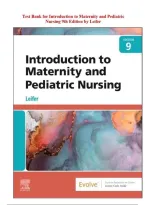
Introduction to Maternity and Pediatric Nursing 9th Edition by Leifer — Study & Review Resource
Introduction to Maternity and Pediatric Nursing 9th Edition by Leifer — Study & Review Resource Strengthen your understanding of maternal, newborn, and pediatric nursing with this comprehensive study and review resource based on Introduction to Maternity and Pediatric Nursing, 9th Edition by Leifer. Designed to complement classroom instruction and textbook study, this resource provides an organized way for nursing students to review essential concepts, practice clinical reasoning, and prepare for assessments throughout their maternity and pediatric nursing course. Maternity and pediatric nursing require students to understand the unique physiological, developmental, emotional, and family-related needs of patients. This resource supports learning across these areas by providing opportunities to revisit major concepts and apply nursing knowledge to practical situations. Comprehensive Maternity Nursing Review The maternity section provides a useful framework for reviewing concepts associated with women's health, pregnancy, labor, birth, postpartum care, and newborn nursing. Students can use practice material to reinforce knowledge about prenatal assessment, maternal adaptation to pregnancy, fetal development, nutrition, patient education, and preparation for childbirth. Reviewing these subjects regularly can help students recognize expected findings and identify situations that may require additional assessment or intervention. The resource can also support preparation for classroom examinations and clinical experiences by encouraging students to connect theoretical knowledge with patient-care situations. Pregnancy and Prenatal Care Pregnancy involves significant physiological and psychosocial changes. Students need to understand normal pregnancy progression while also recognizing potential complications. This study resource can help reinforce concepts related to prenatal visits, maternal assessment, fetal assessment, nutritional needs, health promotion, patient teaching, and common concerns during pregnancy. Students can use practice questions to evaluate their understanding and then refer to their textbook or course materials for additional clarification. Labor and Birth Understanding labor and delivery is a central component of maternity nursing education. Students can review the stages of labor, maternal and fetal assessment, pain-management approaches, nursing interventions, birth procedures, and safety considerations. Clinical-style questions can encourage learners to think about assessment findings and determine appropriate nursing priorities. This type of practice is especially useful when preparing for examinations that require students to apply knowledge rather than simply recall definitions. Postpartum and Newborn Nursing Postpartum nursing involves careful assessment of the mother and identification of normal versus unexpected findings. Students can review postpartum assessment, recovery, patient education, breastfeeding concepts, emotional adaptation, and discharge teaching. Newborn care is also an essential area of study. Review topics may include newborn assessment, thermoregulation, feeding, safety, elimination, normal physiological adaptation, and parent education. A structured review resource allows students to repeatedly practice these concepts and identify topics that require further study. Pediatric Nursing Review Pediatric nursing requires an age-appropriate approach to assessment, communication, education, and intervention. Children are not simply smaller versions of adults; their needs vary considerably according to developmental stage. This resource can help students review pediatric nursing principles across infancy, childhood, and adolescence. Areas of study may include growth and development, developmental milestones, nutrition, health promotion, immunization concepts, safety, common childhood health problems, and family-centered care. Growth and Development Understanding normal growth and development is essential for pediatric nursing. Students need to recognize expected developmental characteristics and understand how nursing care should be adapted to the child's age and developmental level. Practice-based review can help reinforce physical, cognitive, emotional, and social development. Students can use these exercises to become more comfortable identifying age-appropriate communication techniques, health teaching approaches, and nursing interventions. Family-Centered Nursing Care Families play a central role in maternity and pediatric healthcare. Effective nursing care involves communication with parents, caregivers, children, and other members of the healthcare team. The resource encourages students to consider the family as an important component of the care process. Topics can include parent education, therapeutic communication, emotional support, patient advocacy, and collaboration with caregivers. Clinical Reasoning and Application Successful nursing students need more than memorized information. They must be able to interpret assessment findings, recognize priorities, select appropriate interventions, and evaluate patient responses. Practice questions provide an opportunity to develop these skills. Students can work through each question independently, identify the rationale behind their choice, and return to the relevant textbook section when additional clarification is necessary. This approach promotes active learning and helps students develop stronger clinical judgment. Useful for Nursing Students This study resource can be incorporated into many different study strategies. Students may use it during weekly coursework, before examinations, while preparing for clinical assignments, or as part of a comprehensive review. Potential uses include: Reviewing maternity nursing concepts Reinforcing pediatric nursing principles Preparing for course examinations Practicing clinical reasoning Reviewing maternal-newborn nursing Studying newborn assessment Reviewing pediatric growth and development Identifying knowledge gaps Preparing for clinical experiences Supporting independent study Organized and Convenient Study Support Maternity and pediatric nursing courses cover a substantial amount of material. Having structured review material can make independent study more manageable. Students can organize their preparation by subject area, focusing first on topics they find challenging. Practice can then be repeated after additional textbook review to determine whether understanding has improved. For students who prefer active learning, answering practice questions can be more engaging than simply rereading notes. Combining practice questions with lecture notes, textbook chapters, care plans, and instructor resources can provide a well-rounded study approach. Complement Your Nursing Textbook This resource should be used as a supplement to Introduction to Maternity and Pediatric Nursing, 9th Edition by Leifer, rather than as a replacement for the textbook or formal classroom instruction. For the strongest results, students should review the corresponding textbook material, follow instructor guidance, participate in clinical learning, and use their school's approved resources. Key Study Areas The resource can support review of a broad range of subjects, including: Maternal and reproductive health Pregnancy and prenatal care Fetal development Nutrition during pregnancy Labor and delivery Postpartum nursing Newborn assessment Newborn care Breastfeeding concepts Pediatric assessment Growth and development Pediatric health promotion Child safety Common pediatric conditions Family-centered care Patient and family education Therapeutic communication Nursing assessment Nursing interventions Clinical reasoning Build Confidence Through Consistent Practice Consistent practice can help nursing students become more confident with complex maternity and pediatric concepts. Instead of waiting until an examination approaches, students can incorporate review questions into their regular study schedule. When an answer is incorrect, the goal should be to understand the underlying concept rather than simply memorize the correct response. Returning to the textbook, reviewing class notes, and identifying the clinical principle behind the question can turn an incorrect answer into a valuable learning opportunity. Important Educational Note This product is presented as a supplemental study and review resource. Students should rely on their assigned textbook, instructor-provided materials, institutional resources, and official course requirements for authoritative academic guidance and examination preparation. It should be used to support learning, review, and practice rather than to obtain or reproduce unauthorized examination content. Whether you are beginning your maternity and pediatric nursing course, preparing for a unit examination, reviewing before clinical practice, or completing a comprehensive course review, this resource can provide structured support for mastering important concepts from Introduction to Maternity and Pediatric Nursing, 9th Edition by Leifer.
Document information
- Uploaded on
- October 6, 2026
- Number of pages
- 334
- Written in
- 2026/2027
- Type
- Exam (elaborations)
- Contains
- Questions & answers


