
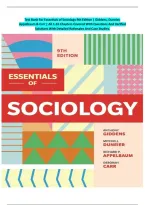
Test Bank For Essentials of Sociology 9th Edition | Giddens, Duneier,
Appelbaum & Carr | All 1-16 Chapters Covered With Questions And Verified
Solutions With Detailed Rationales And Case Studies.
, TABLE OF CONTENT
Chapter 1. Sociology: Theory and Method
Chapter 2. Culture and Society
Chapter 3. Socialization, the Life Course, and Aging
Chapter 4. Social Interaction and Everyday Life
Chapter 5. Networks, Groups, and Organizations
Chapter 6. Deviance, Crime, and Punishment
Chapter 7. Stratification, Class, and Inequality
Chapter 8. Global Inequality
Chapter 9. Inequality on the Basis of Gender and Sexuality
Chapter 10. Race, Ethnicity, and Racism
Chapter 11. Families and Intimate Relationships
Chapter 12. Education and Religion
Chapter 13. Politics and Economic Life
Chapter 14. Sociology of the Body: Health, Illness, and
Medicine
Chapter 15. Urbanization, Populations, and the
Environment
Chapter 16. Globalization in a Changing World
,Chapter 1: The Study of Society
Multiple-Choice Questions
1. The sociological imagination is best defined as:
A) The ability to memorize sociological theories
B) A vivid awareness of the relationship between personal experience and the wider society
C) A method for conducting statistical analysis
D) The study of small-scale group interactions
Answer: B
Rationale: C. Wright Mills introduced the sociological imagination to describe the capacity to see the
connection between "personal troubles" and "public issues." This perspective allows sociologists to
understand how individual experiences are shaped by broader social structures and historical forces.
Why the other options are incorrect:
• A: The sociological imagination is not about memorization but about a way of thinking that
connects biography to history.
• C: Statistical analysis is a research tool, not the defining quality of the sociological
imagination.
• D: Small-scale interactions are the focus of microsociology, not the sociological imagination
itself.
2. Auguste Comte is credited with:
A) Developing conflict theory
B) Coining the term "sociology" and advocating positivism
C) Introducing the concept of verstehen
D) Writing The Protestant Ethic and the Spirit of Capitalism
Answer: B
Rationale: Comte, often called the "father of sociology," coined the term in 1838 and championed
positivism — the idea that society should be studied using the same scientific methods applied to
the natural world.
Why the other options are incorrect:
• A: Conflict theory is primarily associated with Karl Marx.
• C: Verstehen (understanding social action from the actor's perspective) was introduced by
Max Weber.
• D: This work was written by Max Weber, not Comte.
3. Harriet Martineau's contributions to sociology include:
A) Translating Comte's work into English and advocating for women's rights and the abolition of
slavery
B) Developing the theory of structural functionalism
, C) Coining the phrase "survival of the fittest"
D) Founding the Chicago School of sociology
Answer: A
Rationale: Martineau was a pioneering English sociologist who made Comte's work accessible to
English-speaking audiences. She was also an outspoken advocate for social reform, including
women's rights and the emancipation of slaves.
Why the other options are incorrect:
• B: Structural functionalism was developed later by thinkers like Talcott Parsons and Robert
Merton.
• C: "Survival of the fittest" was coined by Herbert Spencer.
• D: The Chicago School emerged in the early 20th century, after Martineau's time.
4. The scientific method in sociology involves:
A) Relying on common sense and personal intuition
B) Applying logical, systematic methods to produce verifiable evidence
C) Conducting research without hypotheses
D) Using only qualitative data
Answer: B
Rationale: The scientific method is an investigative process that uses systematic observation,
hypothesis testing, and verifiable evidence. In sociology, it helps researchers move beyond personal
biases and anecdotal knowledge.
Why the other options are incorrect:
• A: Common sense and intuition are not systematic or verifiable, making them unreliable for
sociological research.
• C: Hypotheses are a key component of the scientific method, providing testable predictions.
• D: Both qualitative and quantitative data can be used in scientific sociological research.
5. Which thinker introduced the concept of the sociological imagination?
A) Émile Durkheim
B) Max Weber
C) C. Wright Mills
D) Auguste Comte
Answer: C
Rationale: C. Wright Mills introduced the sociological imagination in his 1959 book of the same
name. He argued that it enables us to grasp the relationship between history and biography.
Why the other options are incorrect:
Appelbaum & Carr | All 1-16 Chapters Covered With Questions And Verified
Solutions With Detailed Rationales And Case Studies.
, TABLE OF CONTENT
Chapter 1. Sociology: Theory and Method
Chapter 2. Culture and Society
Chapter 3. Socialization, the Life Course, and Aging
Chapter 4. Social Interaction and Everyday Life
Chapter 5. Networks, Groups, and Organizations
Chapter 6. Deviance, Crime, and Punishment
Chapter 7. Stratification, Class, and Inequality
Chapter 8. Global Inequality
Chapter 9. Inequality on the Basis of Gender and Sexuality
Chapter 10. Race, Ethnicity, and Racism
Chapter 11. Families and Intimate Relationships
Chapter 12. Education and Religion
Chapter 13. Politics and Economic Life
Chapter 14. Sociology of the Body: Health, Illness, and
Medicine
Chapter 15. Urbanization, Populations, and the
Environment
Chapter 16. Globalization in a Changing World
,Chapter 1: The Study of Society
Multiple-Choice Questions
1. The sociological imagination is best defined as:
A) The ability to memorize sociological theories
B) A vivid awareness of the relationship between personal experience and the wider society
C) A method for conducting statistical analysis
D) The study of small-scale group interactions
Answer: B
Rationale: C. Wright Mills introduced the sociological imagination to describe the capacity to see the
connection between "personal troubles" and "public issues." This perspective allows sociologists to
understand how individual experiences are shaped by broader social structures and historical forces.
Why the other options are incorrect:
• A: The sociological imagination is not about memorization but about a way of thinking that
connects biography to history.
• C: Statistical analysis is a research tool, not the defining quality of the sociological
imagination.
• D: Small-scale interactions are the focus of microsociology, not the sociological imagination
itself.
2. Auguste Comte is credited with:
A) Developing conflict theory
B) Coining the term "sociology" and advocating positivism
C) Introducing the concept of verstehen
D) Writing The Protestant Ethic and the Spirit of Capitalism
Answer: B
Rationale: Comte, often called the "father of sociology," coined the term in 1838 and championed
positivism — the idea that society should be studied using the same scientific methods applied to
the natural world.
Why the other options are incorrect:
• A: Conflict theory is primarily associated with Karl Marx.
• C: Verstehen (understanding social action from the actor's perspective) was introduced by
Max Weber.
• D: This work was written by Max Weber, not Comte.
3. Harriet Martineau's contributions to sociology include:
A) Translating Comte's work into English and advocating for women's rights and the abolition of
slavery
B) Developing the theory of structural functionalism
, C) Coining the phrase "survival of the fittest"
D) Founding the Chicago School of sociology
Answer: A
Rationale: Martineau was a pioneering English sociologist who made Comte's work accessible to
English-speaking audiences. She was also an outspoken advocate for social reform, including
women's rights and the emancipation of slaves.
Why the other options are incorrect:
• B: Structural functionalism was developed later by thinkers like Talcott Parsons and Robert
Merton.
• C: "Survival of the fittest" was coined by Herbert Spencer.
• D: The Chicago School emerged in the early 20th century, after Martineau's time.
4. The scientific method in sociology involves:
A) Relying on common sense and personal intuition
B) Applying logical, systematic methods to produce verifiable evidence
C) Conducting research without hypotheses
D) Using only qualitative data
Answer: B
Rationale: The scientific method is an investigative process that uses systematic observation,
hypothesis testing, and verifiable evidence. In sociology, it helps researchers move beyond personal
biases and anecdotal knowledge.
Why the other options are incorrect:
• A: Common sense and intuition are not systematic or verifiable, making them unreliable for
sociological research.
• C: Hypotheses are a key component of the scientific method, providing testable predictions.
• D: Both qualitative and quantitative data can be used in scientific sociological research.
5. Which thinker introduced the concept of the sociological imagination?
A) Émile Durkheim
B) Max Weber
C) C. Wright Mills
D) Auguste Comte
Answer: C
Rationale: C. Wright Mills introduced the sociological imagination in his 1959 book of the same
name. He argued that it enables us to grasp the relationship between history and biography.
Why the other options are incorrect:


