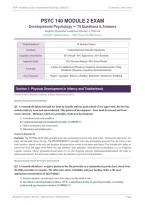
PSYC 140 Module 2 Exam | Developmental Psychology | 2026/2027 75 Questions | 100% Correct
PSYC 140 MODULE 2 EXAM
Developmental Psychology — 75 Questions & Answers
Requires Respondus LockDown Browser + Webcam
2026/2027 Updated Edition — 100% Correct Verified Answers
Total Questions 75 Multiple Choice
Sections 5 Developmental Domain Categories
Cognitive Distribution 35% Recall / 45% Application / 20% Analysis
Question Style 70% Scenario-Based • 30% Direct Recall
Infancy & Toddlerhood (Physical, Cognitive, Social-Emotional) | Early
Coverage
Childhood (Physical, Cognitive, Social-Emotional)
Key Theorists Piaget | Vygotsky | Erikson | Bowlby | Ainsworth | Baumrind | Kohlberg
Section 1: Physical Development in Infancy and Toddlerhood
Growth Patterns, Brain Development, & Motor Milestones (Q1-Q15)
[Domain: Physical Growth Patterns]
Q1: A 4-month-old infant can hold her head up steadily and has good control of her upper body, but her legs
remain relatively weak and uncoordinated. This pattern of development—from head downward and from
center outward—illustrates which two principles of physical development?
A. Assimilation and accommodation
B. Cephalocaudal and proximodistal principles [CORRECT]
C. Object permanence and conservation
D. Habituation and dishabituation
Correct Answer: B
Rationale: The CEPHALOCAUDAL principle states that development proceeds from head to tail—the head develops before the
trunk, and the trunk before the legs. The PROXIMODISTAL principle states that development proceeds from the center of the
body outward—control of the torso and shoulders develops before control of the hands and fingers. This 4-month-old's ability to
control her head and upper body before her legs illustrates both principles. Assimilation/accommodation (A) are Piagetian
cognitive concepts. Object permanence/conservation (C) are also Piagetian concepts. Habituation/dishabituation (D) relate to
attention and memory. Pre-assessment readiness: know the direction of growth for both principles.
[Domain: Growth Charts & Pediatric Assessment]
Q2: A 6-month-old infant's weight is plotted at the 5th percentile on a standardized growth chart, down from
the 50th percentile at 2 months. The infant also shows irritability and poor feeding. What is the most
appropriate interpretation of this finding?
A. Normal variation—growth charts have wide ranges and the infant is fine
B. The infant is showing failure to thrive (FTT), a significant decline in growth percentiles warranting
medical and psychosocial evaluation [CORRECT]
Respondus LockDown Browser + Webcam Format | Verified Answers Page 1
,PSYC 140 Module 2 Exam | Developmental Psychology | 2026/2027 75 Questions | 100% Correct
C. The infant is genetically short—no concern
D. The infant is overweight—reduce feedings
Correct Answer: B
Rationale: Failure to thrive (FTT) is indicated by a significant decline across two major growth percentiles, especially when
accompanied by symptoms like irritability and poor feeding. FTT can result from organic causes (medical conditions, GI
disorders) or non-organic causes (neglect, inadequate nutrition, poverty). It requires comprehensive evaluation. A 5th percentile
alone is not necessarily concerning if the infant has always been small, but crossing two percentile lines downward (50th → 5th)
signals a problem. Option A dismisses concerning growth decline. Option C ignores the dramatic percentile drop. Option D
misinterprets the data—the infant is underweight, not overweight.
[Domain: Brain Development - Synaptic Pruning]
Q3: A 3-year-old child has more synaptic connections in her visual cortex than she will have as an adult. The
process by which excess synapses are eliminated to improve neural efficiency is called:
A. Myelination
B. Synaptic pruning [CORRECT]
C. Neurogenesis
D. Lateralization
Correct Answer: B
Rationale: SYNAPTIC PRUNING is the process by which unused or weak neural connections are eliminated, allowing frequently
used connections to become stronger and more efficient. The brain overproduces synapses in early development; pruning then
refines neural circuits based on experience. Pruning occurs most intensely in early childhood but continues into adolescence.
Myelination (A) is the formation of fatty sheaths around axons, which speeds neural transmission. Neurogenesis (C) is the birth of
new neurons (mostly prenatal). Lateralization (D) is the specialization of brain hemispheres for particular functions.
Pre-assessment readiness: pruning "use it or lose it" maximizes efficiency.
[Domain: Brain Development - Myelination]
Q4: A developmental researcher studies how the speed of neural impulses increases dramatically during the
first two years of life. This increase is primarily due to which process?
A. Synaptic pruning
B. Myelination (formation of myelin sheaths around axons) [CORRECT]
C. Neurogenesis
D. Cell body growth
Correct Answer: B
Rationale: MYELINATION is the process by which glial cells produce a fatty myelin sheath around the axons of neurons, which
dramatically increases the SPEED of neural impulse transmission. Myelination begins prenatally and continues through
adolescence, with sensory and motor pathways myelinating first, followed by higher cognitive areas. The rapid motor development
of infancy is supported by myelination of motor pathways. Synaptic pruning (A) refines connections but does not speed
transmission. Neurogenesis (C) is mostly prenatal. Cell body growth (D) does not increase speed. Pre-assessment readiness:
myelination supports faster, more coordinated responses.
[Domain: Brain Development - Plasticity]
Q5: A 2-year-old child suffers damage to the left hemisphere of the brain. Surprisingly, the child eventually
recovers most language abilities. This recovery demonstrates which property of the developing brain?
A. Lateralization
B. Plasticity (the brain's ability to reorganize and recover function, especially in early development)
[CORRECT]
Respondus LockDown Browser + Webcam Format | Verified Answers Page 2
, PSYC 140 Module 2 Exam | Developmental Psychology | 2026/2027 75 Questions | 100% Correct
C. Synaptic pruning
D. Critical period closure
Correct Answer: B
Rationale: PLASTICITY refers to the brain's ability to reorganize and adapt in response to experience or injury. The young brain
is highly plastic—undamaged areas can take over functions of damaged areas, especially in early childhood. This is why a
2-year-old who suffers brain damage may recover language abilities that would be lost permanently in an adult. Plasticity decreases
with age (the brain becomes less adaptable as it matures). Lateralization (A) is the specialization of the two hemispheres (left for
language, right for spatial tasks). Synaptic pruning (C) is connection elimination. Critical period (D) refers to windows of optimal
development for certain skills. Pre-assessment readiness: plasticity is highest in early development.
[Domain: Motor Milestones - Gross Motor]
Q6: Which of the following represents the correct chronological sequence of GROSS motor milestones in
infancy (from earliest to latest)?
A. Walking independently → Sitting without support → Crawling → Rolling over
B. Rolling over → Sitting without support → Crawling → Walking independently [CORRECT]
C. Sitting without support → Rolling over → Walking → Crawling
D. Crawling → Rolling over → Sitting → Walking
Correct Answer: B
Rationale: The typical sequence of gross motor milestones: (1) Rolls over (around 2-4 months); (2) Sits without support (around 6
months); (3) Crawls (around 8-10 months); (4) Pulls to stand and cruises (around 9-12 months); (5) Walks independently (around
12-15 months). The sequence is generally universal, though exact timing varies. The sequence reflects cephalocaudal development
(head control → trunk control → leg control) and proximodistal development (trunk → limbs). Pre-assessment readiness: memorize
this sequence—questions often require ordering milestones.
[Domain: Motor Milestones - Fine Motor]
Q7: A 10-month-old infant uses her thumb and forefinger to pick up a small piece of cereal. This fine motor
milestone is called the:
A. Palmar grasp
B. Pincer grasp [CORRECT]
C. Ulnar grasp
D. Power grip
Correct Answer: B
Rationale: The PINCER GRASP develops around 8-12 months and involves using the thumb and forefinger to pick up small
objects—a milestone reflecting fine motor maturation. Before this, infants use the palmar grasp (A, using whole hand) and ulnar
grasp (C, using pinky-side of hand). The pincer grasp is important for self-feeding, exploration, and independence. It develops
later than the palmar grasp, illustrating the proximodistal principle (control of the trunk and arms develops before fine finger
control). Power grip (D) involves whole-hand gripping of larger objects. Pre-assessment readiness: pincer grasp ~8-12 months;
palmar grasp appears earlier (~3-4 months).
[Domain: Experience and Motor Development]
Q8: Research by Esther Thelen on the stepping reflex demonstrated that the disappearance of the stepping
reflex in early infancy is NOT due to cortical maturation alone. What did Thelen's research suggest?
A. The reflex is purely genetically programmed and cannot be modified
B. Infants lose the stepping reflex because their legs become too heavy for their underdeveloped muscles to
lift in air, but they can "step" when held in water [CORRECT]
Respondus LockDown Browser + Webcam Format | Verified Answers Page 3