
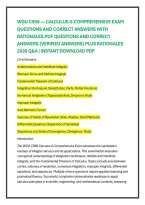
WGU C958 — CALCULUS II-COMPREHENSIVE EXAM
QUESTIONS AND CORRECT ANSWERS WITH
RATIONALES.PDF QUESTIONS AND CORRECT
ANSWERS (VERIFIED ANSWERS) PLUS RATIONALES
2026 Q&A | INSTANT DOWNLOAD PDF
Core Domains
Antiderivatives and Indefinite Integrals
Riemann Sums and Definite Integrals
Fundamental Theorem of Calculus
Integration Techniques (Substitution, Parts, Partial Fractions)
Numerical Integration (Trapezoidal Rule, Simpson's Rule)
Improper Integrals
Area Between Curves
Volumes of Solids of Revolution (Disk, Washer, Shell Methods)
Differential Equations (Separation of Variables)
Sequences and Series (Convergence, Divergence, Tests)
Introduction
The WGU C958 Calculus II Comprehensive Exam assesses the candidate's
mastery of integral calculus and its applications. This examination evaluates
conceptual understanding of integration techniques, definite and indefinite
integrals, and the Fundamental Theorem of Calculus. Topics include area between
curves, volumes of revolution, numerical integration, improper integrals, differential
equations, and sequences. Multiple-choice questions require applied reasoning and
procedural fluency. Successful completion demonstrates readiness to apply
calculus principles in scientific, engineering, and mathematical contexts, preparing
,candidates for advanced coursework and professional practice involving
quantitative analysis and modeling.
SECTION ONE: QUESTIONS 1–100
1. Which of the following is the general antiderivative of f(x) = 3x²?
A. x³ + C
B. 6x + C
C. 3x³ + C
D. x³/3 + C
A. x³ + C
RATIONALE: The antiderivative of xⁿ is xⁿ⁺¹/(n+1) + C. For 3x², this gives 3 · x³/3
+ C = x³ + C.
2. Evaluate ∫ 4x³ dx.
A. x⁴ + C
B. 12x² + C
C. 4x⁴ + C
D. x⁴/4 + C
A. x⁴ + C
RATIONALE: Using the power rule for integration, ∫ 4x³ dx = 4 · x⁴/4 + C = x⁴ + C.
3. What is the antiderivative of sin(x)?
A. cos(x) + C
B. -cos(x) + C
C. -sin(x) + C
D. tan(x) + C
, B. -cos(x) + C
RATIONALE: The derivative of -cos(x) is sin(x), so the antiderivative of sin(x) is -
cos(x) + C.
4. Evaluate ∫ sec²(x) dx.
A. sec(x) + C
B. tan(x) + C
C. ln|sec(x)| + C
D. -cot(x) + C
B. tan(x) + C
RATIONALE: The derivative of tan(x) is sec²(x), so the antiderivative of sec²(x) is
tan(x) + C.
5. What does the constant of integration C represent in an indefinite integral?
A. A fixed numerical value
B. A family of antiderivatives differing by a constant
C. The area under the curve
D. The slope of the tangent line
B. A family of antiderivatives differing by a constant
RATIONALE: The constant C accounts for the fact that infinitely many
antiderivatives exist, each differing by a constant value.
6. Evaluate ∫ (2x + 5) dx.
A. x² + 5x + C
B. 2x² + 5x + C
C. x² + 5 + C
D. 2x + C
, A. x² + 5x + C
RATIONALE: ∫ 2x dx = x² and ∫ 5 dx = 5x, so the result is x² + 5x + C.
7. Which of the following is the antiderivative of eˣ?
A. eˣ + C
B. xeˣ + C
C. eˣ/x + C
D. ln|x| + C
A. eˣ + C
RATIONALE: The derivative of eˣ is eˣ, so the antiderivative of eˣ is eˣ + C.
8. Evaluate ∫ 1/x dx for x > 0.
A. -1/x² + C
B. ln|x| + C
C. x⁰ + C
D. 1/x + C
B. ln|x| + C
RATIONALE: The antiderivative of 1/x is ln|x| + C, valid for x ≠ 0.
9. A particle has velocity v(t) = 3t² + 2t. What is its position function s(t) if s(0) =
5?
A. t³ + t² + 5
B. 6t + 2 + 5
C. t³ + t² + C
D. 3t³ + t² + 5
A. t³ + t² + 5
QUESTIONS AND CORRECT ANSWERS WITH
RATIONALES.PDF QUESTIONS AND CORRECT
ANSWERS (VERIFIED ANSWERS) PLUS RATIONALES
2026 Q&A | INSTANT DOWNLOAD PDF
Core Domains
Antiderivatives and Indefinite Integrals
Riemann Sums and Definite Integrals
Fundamental Theorem of Calculus
Integration Techniques (Substitution, Parts, Partial Fractions)
Numerical Integration (Trapezoidal Rule, Simpson's Rule)
Improper Integrals
Area Between Curves
Volumes of Solids of Revolution (Disk, Washer, Shell Methods)
Differential Equations (Separation of Variables)
Sequences and Series (Convergence, Divergence, Tests)
Introduction
The WGU C958 Calculus II Comprehensive Exam assesses the candidate's
mastery of integral calculus and its applications. This examination evaluates
conceptual understanding of integration techniques, definite and indefinite
integrals, and the Fundamental Theorem of Calculus. Topics include area between
curves, volumes of revolution, numerical integration, improper integrals, differential
equations, and sequences. Multiple-choice questions require applied reasoning and
procedural fluency. Successful completion demonstrates readiness to apply
calculus principles in scientific, engineering, and mathematical contexts, preparing
,candidates for advanced coursework and professional practice involving
quantitative analysis and modeling.
SECTION ONE: QUESTIONS 1–100
1. Which of the following is the general antiderivative of f(x) = 3x²?
A. x³ + C
B. 6x + C
C. 3x³ + C
D. x³/3 + C
A. x³ + C
RATIONALE: The antiderivative of xⁿ is xⁿ⁺¹/(n+1) + C. For 3x², this gives 3 · x³/3
+ C = x³ + C.
2. Evaluate ∫ 4x³ dx.
A. x⁴ + C
B. 12x² + C
C. 4x⁴ + C
D. x⁴/4 + C
A. x⁴ + C
RATIONALE: Using the power rule for integration, ∫ 4x³ dx = 4 · x⁴/4 + C = x⁴ + C.
3. What is the antiderivative of sin(x)?
A. cos(x) + C
B. -cos(x) + C
C. -sin(x) + C
D. tan(x) + C
, B. -cos(x) + C
RATIONALE: The derivative of -cos(x) is sin(x), so the antiderivative of sin(x) is -
cos(x) + C.
4. Evaluate ∫ sec²(x) dx.
A. sec(x) + C
B. tan(x) + C
C. ln|sec(x)| + C
D. -cot(x) + C
B. tan(x) + C
RATIONALE: The derivative of tan(x) is sec²(x), so the antiderivative of sec²(x) is
tan(x) + C.
5. What does the constant of integration C represent in an indefinite integral?
A. A fixed numerical value
B. A family of antiderivatives differing by a constant
C. The area under the curve
D. The slope of the tangent line
B. A family of antiderivatives differing by a constant
RATIONALE: The constant C accounts for the fact that infinitely many
antiderivatives exist, each differing by a constant value.
6. Evaluate ∫ (2x + 5) dx.
A. x² + 5x + C
B. 2x² + 5x + C
C. x² + 5 + C
D. 2x + C
, A. x² + 5x + C
RATIONALE: ∫ 2x dx = x² and ∫ 5 dx = 5x, so the result is x² + 5x + C.
7. Which of the following is the antiderivative of eˣ?
A. eˣ + C
B. xeˣ + C
C. eˣ/x + C
D. ln|x| + C
A. eˣ + C
RATIONALE: The derivative of eˣ is eˣ, so the antiderivative of eˣ is eˣ + C.
8. Evaluate ∫ 1/x dx for x > 0.
A. -1/x² + C
B. ln|x| + C
C. x⁰ + C
D. 1/x + C
B. ln|x| + C
RATIONALE: The antiderivative of 1/x is ln|x| + C, valid for x ≠ 0.
9. A particle has velocity v(t) = 3t² + 2t. What is its position function s(t) if s(0) =
5?
A. t³ + t² + 5
B. 6t + 2 + 5
C. t³ + t² + C
D. 3t³ + t² + 5
A. t³ + t² + 5


