
AQA Chem · 3.1.2 p.1
amount of substance
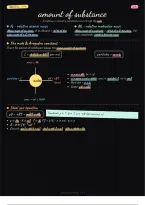
Everything in chemistry calculations runs through the mole .
Aᵣ · relative atomic mass Mᵣ · relative molecular mass
Mean mass of an atom of an element ÷ 1/12 of the Mean mass of a molecule ÷ 1/12 of a C-12 atom . For
mean mass of a C-12 atom ionic compounds: relative formula mass
The mole & Avogadro constant
A unit for amount of substance: always the same number of particles .
L = 6.022 × 10²³ per mol particles = n × L
mass ÷ Mᵣ
n = m ÷ Mᵣ (m in g)
particles ÷ L pV = nRT n = conc × vol ÷ 1000 : conc in mol dm⁻³ , vol in cm³
moles (gases) Particles = n × L
Gases: pV = nRT
conc × vol ÷ 1000
Ideal gas equation
pV = nRT = mRT ÷ Mᵣ Combines: p ∝ T, V ∝ T, p ∝ 1/V (at constant n)
p in Pa · V in m³ · T in K (°C + 273) · n in mol · m in g
R = 8.31 J K⁻¹ mol⁻¹
Convert: cm³ × 10⁻⁶ = m³ · dm³ × 10⁻³ = m³ · kPa × 1000 = Pa
amount of substance ·


