
AQA Chem · 3.2.1 p.1
periodicity
Elements are ordered by proton number . Periodicity = the repeating trends that follow from electron configuration.
Periods & groups Blocks
Along a period : same number of electron shells s : groups 1 & 2 · p : groups 3–0 (13–18)
Down a group : same number of outer electrons (= d : transition metals · f : lanthanides & actinides
group number)
Atomic radius
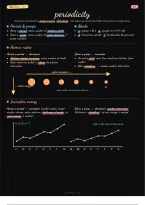
Across a period → decreases Down a group → increases
Nuclear charge increases , same number of shells An extra shell each time: electrons further from
Outer electrons pulled in closer by greater nucleus
attraction More shielding → weaker nuclear attraction
radius decreases →
↓ radius increases
Li Ne
same shells, more protons pulling in
Ionisation energy
Across a period → increases: smaller radius, bigger Down a group → decreases: weaker attraction
nuclear charge, outer electrons held more strongly , so (distance + shielding ), so less energy is needed.
more energy is needed.
1st IE (kJ mol⁻¹) drops at the start of each period
Li Be B C N O F Ne Na Mg Al Si P S Cl Ar
periodicity ·


