
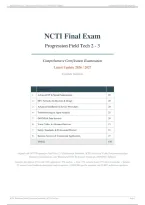
NCTI Final Exam — Progression Field Tech 2-3 | 2026/2027 Edition Complete Solutions | 150 Questions
NCTI Final Exam
Progression Field Tech 2 - 3
Comprehensive Certification Examination
Latest Update
Complete Solutions
# Section Title Qs
1 Advanced RF & Signal Fundamentals 20
2 HFC Network Architecture & Design 20
3 Advanced Installation & Service Procedures 20
4 Troubleshooting & Signal Analysis 25
5 DOCSIS & Data Services 20
6 Voice, Video, & Advanced Services 15
7 Safety, Standards, & Professional Practice 15
8 Business Services & Commercial Applications 15
TOTAL 150
Aligned with NCTI Progression Field Tech 2-3 Certification Standards, SCTE (Society of Cable Telecommunications
Engineers) Competencies, and Broadband Field Technician Standards (2026/2027 Edition).
Cognitive distribution: 25% recall | 50% application | 25% analysis • Style: 75% scenario-based | 25% direct knowledge • Includes
25 scenario-based troubleshooting/signal-analysis questions, 15 DOCSIS-specific questions, and 15 HFC architecture questions.
SCTE Broadband Field Technician Standards | NCTI Certified Page 1
,NCTI Final Exam — Progression Field Tech 2-3 | 2026/2027 Edition Complete Solutions | 150 Questions
Section 1: Advanced RF & Signal Fundamentals
Scope: Electromagnetic spectrum, dB/dBmV/dBm, SNR/CNR, modulation (QAM/QPSK/OFDM/OFDMA), bandwidth, tilt,
attenuation, coax types, connectors, impedance, reflections, group delay, micro-reflections, ingress, egress, CPD, shielding,
grounding & bonding.
Q1: A field technician measures a cable modem downstream receive level of -8 dBmV at the tap. The drop
cable loss to the home is 4.5 dB, and a 2-way splitter (3.5 dB insertion loss) is used inside. What is the
approximate signal level at the modem input?
A. +1.0 dBmV
B. -16.0 dBmV *[CORRECT]*
C. -8.0 dBmV
D. -3.5 dBmV
Correct Answer: B
Rationale: Subtracting all losses from the tap level: -8 dBmV - 4.5 dB (drop) - 3.5 dB (splitter) = -16.0 dBmV at the
modem input. Option A incorrectly adds losses; option C ignores the splitter; option D ignores the drop loss. Per SCTE
measurement practices, downstream modem receive should typically fall between -10 dBmV and +10 dBmV, so this
result indicates the drop needs an amplifier or redesign.
Q2: Which statement correctly distinguishes Carrier-to-Noise Ratio (CNR) from Signal-to-Noise Ratio
(SNR) in an HFC plant?
A. CNR is measured at the customer premises; SNR is measured at the headend.
B. CNR is the ratio of carrier power to total noise power in the channel bandwidth at the RF level;
SNR is the ratio after demodulation and includes all impairments. *[CORRECT]*
C. CNR and SNR are interchangeable terms used by different test equipment manufacturers.
D. CNR applies only to the upstream; SNR applies only to the downstream.
Correct Answer: B
Rationale: CNR is an RF-domain measurement (carrier vs. noise floor in the channel bandwidth), while SNR is a
post-demodulation metric that captures all impairments including noise, distortion, and ingress. Per SCTE HFMM and
DOCSIS definitions, a healthy CNR is typically ≥35 dB downstream and ≥25 dB upstream; SNR reported by a modem
is generally 2-6 dB lower than CNR due to added impairments. The other options misrepresent the measurement
locations or imply a false equivalence.
SCTE Broadband Field Technician Standards | NCTI Certified Page 2
,NCTI Final Exam — Progression Field Tech 2-3 | 2026/2027 Edition Complete Solutions | 150 Questions
Q3: Why is 75-ohm impedance the standard for CATV/broadband coaxial plant while 50-ohm is used for
RF two-way communications?
A. 75 ohm minimizes attenuation for coaxial lines carrying broadband video signals; 50 ohm is a
compromise for power handling. *[CORRECT]*
B. 75 ohm is cheaper to manufacture; 50 ohm is required for FCC compliance.
C. 75 ohm allows higher frequencies than 50 ohm by physics.
D. 75 ohm is required for DOCSIS; 50 ohm is required for legacy analog video only.
Correct Answer: A
Rationale: Coax impedance selection follows a physics tradeoff: 75 ohm minimizes insertion loss per unit length for
shielded lines carrying wideband video, while 50 ohm approximates the optimum for power transfer (VSWR tolerance).
For CATV plants, 75 ohm is mandated by SCTE and IEEE standards so all coax, passives, connectors, and CPE present
a matched impedance. Mismatched impedance causes reflections (return loss), micro-reflections, and group delay —
options B, C, D misstate the underlying physics or imply a regulatory mandate that does not exist.
Q4: A technician at an amplifier output reads +44 dBmV at 55 MHz and +36 dBmV at 750 MHz. The
specified output is +44/+40 dBmV (low/high). What corrective action is correct?
A. Add a 4 dB attenuator on the low side only.
B. Increase the high-frequency output by adjusting the equalizer from a 6 dB to an 8 dB value.
*[CORRECT]*
C. Decrease the high-frequency output by replacing the 8 dB equalizer with a 6 dB equalizer.
D. Replace the amplifier; the readings are inconsistent with any equalizer.
Correct Answer: B
Rationale: The measured tilt is 8 dB (44 - 36) but the target is 4 dB (44 - 40), meaning the high-frequency band is 4 dB
low. The correct action is to install a smaller equalizer (e.g., from 8 dB to 6 dB) to raise the high end by approximately 2
dB, or to select an 8 dB equalizer to provide the needed compensation per SCTE amplifier setup procedures. Option A
would attenuate the wrong band; option C would worsen the deficit; option D is unnecessary because the readings are
within a typical equalizer adjustment range.
Q5: In a DOCSIS upstream using 64-QAM at 5.12 Msym/s, what is the approximate raw data rate, and why
is QPSK still supported on the same return path?
A. ~30.72 Mbps; QPSK is retained for legacy modems and to provide a robust fallback in high-noise
conditions. *[CORRECT]*
B. ~5.12 Mbps; QPSK is retained only because of FCC mandate.
C. ~30.72 Mbps; QPSK is retained only for analog set-top boxes.
D. ~10.24 Mbps; QPSK is retained because it consumes less spectrum than 64-QAM.
Correct Answer: A
Rationale: 64-QAM carries 6 bits per symbol; at 5.12 Msym/s the raw rate is ~30.72 Mbps (5.12 × 6). QPSK (2
bits/symbol) is retained per DOCSIS for low-CNR upstream conditions where higher-order modulation cannot maintain
MER/BER targets, and for legacy DOCSIS 1.0/1.1 modems. Options B and D miscompute the rate; option C confuses
the use case — QPSK is a modem modulation, not an STB requirement.
SCTE Broadband Field Technician Standards | NCTI Certified Page 3
, NCTI Final Exam — Progression Field Tech 2-3 | 2026/2027 Edition Complete Solutions | 150 Questions
Q6: A customer complains of intermittent cable modem loss only during evening hours. The plant has
historical ingress problems at 27 MHz. What is the MOST LIKELY root cause given a return path that
operates between 5-42 MHz?
A. CB radio ingress near 27 MHz overwhelming the upstream receiver. *[CORRECT]*
B. Forward-path compression causing downstream MER degradation.
C. Loose F-connector on the drop causing micro-reflections only on warm days.
D. Excessive group delay from a damaged trunk amplifier.
Correct Answer: A
Rationale: The 11-meter Citizen Band (CB) operates at ~27 MHz, directly inside the upstream 5-42 MHz return path.
Evening ingress spikes align with peak CB usage and are a classic upstream impairment per SCTE ingress
troubleshooting guidance. The modem loses ranging when the upstream CNR drops below threshold. Options B and D
describe forward-path or distortion issues that would not be time-correlated to CB activity; option C would not exhibit
the time-of-day pattern.
Q7: Which coaxial cable type is MOST appropriate for a 350-foot aerial drop from a tap to a single-family
residence, and why?
A. RG-59 — lowest loss, most flexible, easiest to install.
B. RG-6 quad-shield — adequate loss performance, good shielding, standard residential drop cable.
*[CORRECT]*
C. RG-11 — required for any drop over 100 feet.
D. .500 hardline — required for any drop over 200 feet.
Correct Answer: B
Rationale: RG-6 quad-shield is the SCTE-standard residential drop cable; at 350 feet, its 750 MHz loss (~5.6 dB/100
ft) is acceptable and the quad shield provides >90 dB shielding effectiveness. RG-59 has higher loss and poorer
shielding; RG-11 is rarely used for residential drops (only for very long drops >200 ft where loss is critical); .500
hardline is feeder plant, never used for customer drops. The other options either misrepresent the loss performance or
inappropriately specify hardline for a drop.
Q8: A technician needs to feed three outlets from a single drop. Using only splitters, what is the MINIMUM
insertion loss configuration at the highest frequency, and what equipment should be specified?
A. Three 2-way splitters cascaded (3.5 + 3.5 + 3.5 = 10.5 dB loss per leg).
B. One 3-way splitter (5.5 dB loss per leg). *[CORRECT]*
C. One 4-way splitter with one port terminated (7.0 dB loss per active port).
D. Two 2-way splitters, one feeding the third 2-way (7.0 dB loss on two legs, 3.5 dB on one leg).
Correct Answer: B
Rationale: A balanced 3-way splitter has 5.5 dB insertion loss per leg and is the cleanest single-device solution per
SCTE passive practices. Cascading 2-ways (option A) wastes 5 dB and adds two connector pairs; option C wastes 1.5
dB and an unused port; option D creates unbalanced outlet levels that complicate service. The standard 3-way balanced
splitter is the optimal solution for three outlets.
SCTE Broadband Field Technician Standards | NCTI Certified Page 4


