
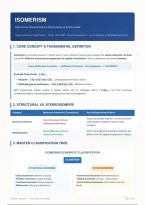
ISOMERISM
High-Value Comprehensive Study Notes & Exam Guide
Organic Chemistry Master Series | Target: JEE / NEET / Board Examinations | Core Framework & Identification Shortcuts
1. CORE CONCEPT & FUNDAMENTAL DEFINITION
Isomerism is the phenomenon in which two or more chemical compounds possess the same molecular formula
but exhibit different structural arrangements or spatial orientations. Such compounds are termed isomers.
Same Molecular Formula + Different Structure / Arrangement ⇒ ISOMERS
Example Case Study: C₄H₁₀
• n-Butane: CH₃–CH₂–CH₂–CH₃ (Unbranched continuous chain)
• 2-Methylpropane (Isobutane): CH₃–CH(CH₃)–CH₃ (Branched chain)
Both compounds contain exactly 4 Carbon atoms and 10 Hydrogen atoms ( C₄H₁₀ ), but their structural
connectivity differs, imparting distinct physical and chemical properties.
2. STRUCTURAL VS. STEREOISOMERS
Category Molecular Formula & Connectivity Key Distinguishing Feature
Atoms are bonded together in entirely different
Same Molecular Formula
Structural Isomers orders/patterns (different atom-to-atom
Different Connectivity
linkages).
Same Molecular Formula Atoms have identical bonding connectivity but
Stereoisomers
Same Connectivity differ in their 3D spatial arrangement in space.
3. MASTER CLASSIFICATION TREE
ISOMERISM SCHEMATIC CLASSIFICATION
ISOMERISM
STRUCTURAL ISOMERISM STEREOISOMERISM
• Chain Isomerism (Skeleton changes) • Geometrical Isomerism (Restricted rotation)
• Position Isomerism (Locant changes) • Optical Isomerism (Chirality / Light rotation)
• Functional Isomerism (Group changes) • Conformational Isomerism (Free rotation around σ-
• Metamerism (Alky group distribution) bonds)
Organic Chemistry — High-Value Study Notes Page 1 of 5
, • Tautomerism (Dynamic H / π-shift)
• Ring-Chain Isomerism (Cyclic vs Open)
4. MASTER IDENTIFICATION PROTOCOL
Step-by-Step Question Solving Framework
1. Step 1 — Verify Molecular Formula: Count every single atom. If the molecular formulas are not identical, they
are not isomers (they are completely different compounds).
2. Step 2 — Compare Atom Connectivity (IUPAC Naming):
◦ If IUPAC connectivity / bonding pattern is different ⇒ STRUCTURAL ISOMERS
◦ If IUPAC connectivity is identical but 3D orientations differ ⇒ STEREOISOMERS
5. DEGREE OF UNSATURATION (DU) / DOUBLE BOND EQUIVALENT (DBE)
Core Axiom: Isomers must always have the exact same Degree of Unsaturation (DU) because DU is calculated
directly from the molecular formula.
Formula: For C_c H_h N_n X_x :
DU = C + 1 - rac{H + X - N}{2}
Structural Significance: 1 DU = 1 Ring OR 1 π-bond. (2 DU = 2 π-bonds, 1 triple bond, 2 rings, or 1 ring + 1 π-
bond).
Exam Elimination Shortcut: Calculate DU instantly. If Compound A has DU = 1 and Compound B has DU = 0,
eliminate them immediately as potential isomers!
6. STRUCTURAL ISOMERISM DEEP-DIVE: CHAIN ISOMERISM
Chain isomers possess the same molecular formula and same functional groups, but differ in the length or skeleton of
the parent carbon chain or side branches.
Compound Name Molecular Formula Parent Chain Length Structural Representation
n-Butane C₄H₁₀ 4 Carbons CH₃–CH₂–CH₂–CH₃
2-Methylpropane C₄H₁₀ 3 Carbons CH₃–CH(CH₃)–CH₃
Pentan-1-ol C₅H₁₂O 5 Carbons CH₃–CH₂–CH₂–CH₂–CH₂–OH
3-Methylbutan-1-ol C₅H₁₂O 4 Carbons CH₃–CH(CH₃)–CH₂–CH₂–OH
Execution Protocol for Chain Isomer Identification: Count total carbons → Verify DU → Determine IUPAC
Parent Chain → If parent chain lengths differ, classify as Chain Isomers.
Organic Chemistry — High-Value Study Notes Page 2 of 5
High-Value Comprehensive Study Notes & Exam Guide
Organic Chemistry Master Series | Target: JEE / NEET / Board Examinations | Core Framework & Identification Shortcuts
1. CORE CONCEPT & FUNDAMENTAL DEFINITION
Isomerism is the phenomenon in which two or more chemical compounds possess the same molecular formula
but exhibit different structural arrangements or spatial orientations. Such compounds are termed isomers.
Same Molecular Formula + Different Structure / Arrangement ⇒ ISOMERS
Example Case Study: C₄H₁₀
• n-Butane: CH₃–CH₂–CH₂–CH₃ (Unbranched continuous chain)
• 2-Methylpropane (Isobutane): CH₃–CH(CH₃)–CH₃ (Branched chain)
Both compounds contain exactly 4 Carbon atoms and 10 Hydrogen atoms ( C₄H₁₀ ), but their structural
connectivity differs, imparting distinct physical and chemical properties.
2. STRUCTURAL VS. STEREOISOMERS
Category Molecular Formula & Connectivity Key Distinguishing Feature
Atoms are bonded together in entirely different
Same Molecular Formula
Structural Isomers orders/patterns (different atom-to-atom
Different Connectivity
linkages).
Same Molecular Formula Atoms have identical bonding connectivity but
Stereoisomers
Same Connectivity differ in their 3D spatial arrangement in space.
3. MASTER CLASSIFICATION TREE
ISOMERISM SCHEMATIC CLASSIFICATION
ISOMERISM
STRUCTURAL ISOMERISM STEREOISOMERISM
• Chain Isomerism (Skeleton changes) • Geometrical Isomerism (Restricted rotation)
• Position Isomerism (Locant changes) • Optical Isomerism (Chirality / Light rotation)
• Functional Isomerism (Group changes) • Conformational Isomerism (Free rotation around σ-
• Metamerism (Alky group distribution) bonds)
Organic Chemistry — High-Value Study Notes Page 1 of 5
, • Tautomerism (Dynamic H / π-shift)
• Ring-Chain Isomerism (Cyclic vs Open)
4. MASTER IDENTIFICATION PROTOCOL
Step-by-Step Question Solving Framework
1. Step 1 — Verify Molecular Formula: Count every single atom. If the molecular formulas are not identical, they
are not isomers (they are completely different compounds).
2. Step 2 — Compare Atom Connectivity (IUPAC Naming):
◦ If IUPAC connectivity / bonding pattern is different ⇒ STRUCTURAL ISOMERS
◦ If IUPAC connectivity is identical but 3D orientations differ ⇒ STEREOISOMERS
5. DEGREE OF UNSATURATION (DU) / DOUBLE BOND EQUIVALENT (DBE)
Core Axiom: Isomers must always have the exact same Degree of Unsaturation (DU) because DU is calculated
directly from the molecular formula.
Formula: For C_c H_h N_n X_x :
DU = C + 1 - rac{H + X - N}{2}
Structural Significance: 1 DU = 1 Ring OR 1 π-bond. (2 DU = 2 π-bonds, 1 triple bond, 2 rings, or 1 ring + 1 π-
bond).
Exam Elimination Shortcut: Calculate DU instantly. If Compound A has DU = 1 and Compound B has DU = 0,
eliminate them immediately as potential isomers!
6. STRUCTURAL ISOMERISM DEEP-DIVE: CHAIN ISOMERISM
Chain isomers possess the same molecular formula and same functional groups, but differ in the length or skeleton of
the parent carbon chain or side branches.
Compound Name Molecular Formula Parent Chain Length Structural Representation
n-Butane C₄H₁₀ 4 Carbons CH₃–CH₂–CH₂–CH₃
2-Methylpropane C₄H₁₀ 3 Carbons CH₃–CH(CH₃)–CH₃
Pentan-1-ol C₅H₁₂O 5 Carbons CH₃–CH₂–CH₂–CH₂–CH₂–OH
3-Methylbutan-1-ol C₅H₁₂O 4 Carbons CH₃–CH(CH₃)–CH₂–CH₂–OH
Execution Protocol for Chain Isomer Identification: Count total carbons → Verify DU → Determine IUPAC
Parent Chain → If parent chain lengths differ, classify as Chain Isomers.
Organic Chemistry — High-Value Study Notes Page 2 of 5


