
NEXPHYRA / EXAM STUDY PACK
General Chemistry Foundations
NEXPHYRA / EXAM STUDY PACK
Atoms, bonding, moles, and solutions
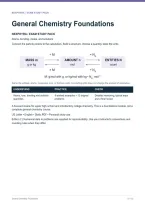
Connect the particle picture to the calculation. Build a structure, choose a quantity, keep the units.
÷M × NA
MASS m AMOUNT n ENTITIES N
g or kg mol count
×M ÷ NA
M: g/mol with g, or kg/mol with kg • NA: mol-1
Name the entities: atoms, molecules, ions, or formula units. Converting units does not change the amount of substance.
UNDERSTAND PRACTICE CHECK
Atoms, ions, bonding and solution 4 worked examples + 12 original Detailed reasoning, typical traps
quantities problems and a final review
A focused review for upper high school and introductory college chemistry. This is a foundations module, not a
complete general chemistry course.
US Letter • English • Static PDF • Personal study use
Edition 2 | Numerical data in problems are supplied for reproducibility. Use your instructor's conventions and
rounding rules when they differ.
General Chemistry Foundations
,NEXPHYRA / EXAM STUDY PACK
Quick Start and Study Map
First identify the kind of question: particle counting, structure, amount of substance, or solution concentration.
Different-looking problems often share the same underlying conversion.
Choose a route
• 20 minutes: review the formula sheet, solve one problem from each level, then check the final review.
• 60 minutes: read concepts and formula cards, cover each worked solution, attempt it, then solve all 12
problems.
• If stuck: write the unit of the requested answer before choosing an equation.
Pages Topic
3–6 Atomic structure, bonding, and molecular shape visuals
7–10 Symbols, units, formula sheet and formula cards
11 Method and common mistakes
12–13 Worked examples 1–4
14–16 Practice problems 1–12
17–20 Detailed solutions
21 Exam checklist and references
22 Final one-page review
An answer is complete when it states the quantity, the units or count, the assumptions and a reason the result
is sensible. Try the practice before reading the solutions.
General Chemistry Foundations
, NEXPHYRA / EXAM STUDY PACK
From Matter to Atoms
An element is identified by its proton count. A compound contains elements in a fixed chemical ratio. A mixture
contains substances together without a single fixed chemical formula. Changing an electron count makes an
ion; changing a neutron count makes an isotope of the same element.
Quantity Meaning What it changes
Atomic number Z Number of protons Element identity
Mass number A Protons + neutrons in one nucleus Isotope label; not an averaged
atomic mass
Charge number z Protons minus electrons Positive for a cation, negative for
an anion
Atomic mass Mass of an atom, often expressed in u Not exactly the integer mass
number
Relative sample Fractions of different isotopes The weighted average atomic mass
composition
Electrons and the periodic table
For the first 20 neutral atoms in their ground states, fill 1s, 2s, 2p, 3s, 3p, then 4s. An s subshell holds at most
2 electrons and a p subshell 6. Equal-energy p orbitals fill singly before pairing. The configurations here do not
cover transition-metal exceptions.
Main-group valence electrons help predict bonding. Across much of a period, atomic radius tends to decrease
and first ionization energy tends to increase, but these are trends with exceptions, not exact rules.
Particle picture: a nucleus holds protons and neutrons; electrons occupy quantum states around it. A ring
drawing is a bookkeeping model, not a literal electron trajectory.
General Chemistry Foundations
General Chemistry Foundations
NEXPHYRA / EXAM STUDY PACK
Atoms, bonding, moles, and solutions
Connect the particle picture to the calculation. Build a structure, choose a quantity, keep the units.
÷M × NA
MASS m AMOUNT n ENTITIES N
g or kg mol count
×M ÷ NA
M: g/mol with g, or kg/mol with kg • NA: mol-1
Name the entities: atoms, molecules, ions, or formula units. Converting units does not change the amount of substance.
UNDERSTAND PRACTICE CHECK
Atoms, ions, bonding and solution 4 worked examples + 12 original Detailed reasoning, typical traps
quantities problems and a final review
A focused review for upper high school and introductory college chemistry. This is a foundations module, not a
complete general chemistry course.
US Letter • English • Static PDF • Personal study use
Edition 2 | Numerical data in problems are supplied for reproducibility. Use your instructor's conventions and
rounding rules when they differ.
General Chemistry Foundations
,NEXPHYRA / EXAM STUDY PACK
Quick Start and Study Map
First identify the kind of question: particle counting, structure, amount of substance, or solution concentration.
Different-looking problems often share the same underlying conversion.
Choose a route
• 20 minutes: review the formula sheet, solve one problem from each level, then check the final review.
• 60 minutes: read concepts and formula cards, cover each worked solution, attempt it, then solve all 12
problems.
• If stuck: write the unit of the requested answer before choosing an equation.
Pages Topic
3–6 Atomic structure, bonding, and molecular shape visuals
7–10 Symbols, units, formula sheet and formula cards
11 Method and common mistakes
12–13 Worked examples 1–4
14–16 Practice problems 1–12
17–20 Detailed solutions
21 Exam checklist and references
22 Final one-page review
An answer is complete when it states the quantity, the units or count, the assumptions and a reason the result
is sensible. Try the practice before reading the solutions.
General Chemistry Foundations
, NEXPHYRA / EXAM STUDY PACK
From Matter to Atoms
An element is identified by its proton count. A compound contains elements in a fixed chemical ratio. A mixture
contains substances together without a single fixed chemical formula. Changing an electron count makes an
ion; changing a neutron count makes an isotope of the same element.
Quantity Meaning What it changes
Atomic number Z Number of protons Element identity
Mass number A Protons + neutrons in one nucleus Isotope label; not an averaged
atomic mass
Charge number z Protons minus electrons Positive for a cation, negative for
an anion
Atomic mass Mass of an atom, often expressed in u Not exactly the integer mass
number
Relative sample Fractions of different isotopes The weighted average atomic mass
composition
Electrons and the periodic table
For the first 20 neutral atoms in their ground states, fill 1s, 2s, 2p, 3s, 3p, then 4s. An s subshell holds at most
2 electrons and a p subshell 6. Equal-energy p orbitals fill singly before pairing. The configurations here do not
cover transition-metal exceptions.
Main-group valence electrons help predict bonding. Across much of a period, atomic radius tends to decrease
and first ionization energy tends to increase, but these are trends with exceptions, not exact rules.
Particle picture: a nucleus holds protons and neutrons; electrons occupy quantum states around it. A ring
drawing is a bookkeeping model, not a literal electron trajectory.
General Chemistry Foundations


