
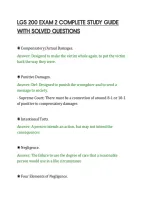
LGS 200 EXAM 2 COMPLETE STUDY GUIDE
WITH SOLVED QUESTIONS
◉ Compensatory/Actual Damages.
Answer: Designed to make the victim whole again, to put the victim
back the way they were.
◉ Punitive Damages.
Answer: Def- Designed to punish the wrongdoer and to send a
message to society.
- Supreme Court: There must be a connection of around 8-1 or 10-1
of punitive to compensatory damages
◉ Intentional Torts.
Answer: A person intends an action, but may not intend the
consequences
◉ Negligence.
Answer: The failure to use the degree of care that a reasonable
person would use in a like circumstance
◉ Four Elements of Negligence.
,Answer: Must be proven to win a negligence tort:
1) A duty of care
2) A breach of the duty of care
3) Causation
-- Cause in fact
-- Proximate/Legal cause
4) Damages
◉ Strict Liability.
Answer: Liability without fault
◉ Rylands v. Fletcher (CASE).
Answer: Established the idea of strict liability within the common
law
- Blasting cases (with dynamite) are most common
- Categories:
-- Ultrahazardous Activity: If you engage in harmful activity, you are
liable for that harm
--- Wild Animals
--- Products Liability
◉ Ultrahazardous Activity.
, Answer: If you engage in harmful activity, you are liable for that
harm
Ex- Wild Animals
-Products Liability
◉ Assault.
Answer: Any word or deed intended to make someone fearful of
immediate harm or reasonable threat
◉ Battery.
Answer: Any unprivileged intentional touching of another
◉ False Imprisonment.
Answer: Intentional keeping of someone against their wills (Pg. 135)
- Shoplifting scenarios are most common
◉ Intentional Infliction of Emotional Distress.
Answer: Results in extreme emotional distress.
- Death of a loved one scenarios
◉ Defamation.
WITH SOLVED QUESTIONS
◉ Compensatory/Actual Damages.
Answer: Designed to make the victim whole again, to put the victim
back the way they were.
◉ Punitive Damages.
Answer: Def- Designed to punish the wrongdoer and to send a
message to society.
- Supreme Court: There must be a connection of around 8-1 or 10-1
of punitive to compensatory damages
◉ Intentional Torts.
Answer: A person intends an action, but may not intend the
consequences
◉ Negligence.
Answer: The failure to use the degree of care that a reasonable
person would use in a like circumstance
◉ Four Elements of Negligence.
,Answer: Must be proven to win a negligence tort:
1) A duty of care
2) A breach of the duty of care
3) Causation
-- Cause in fact
-- Proximate/Legal cause
4) Damages
◉ Strict Liability.
Answer: Liability without fault
◉ Rylands v. Fletcher (CASE).
Answer: Established the idea of strict liability within the common
law
- Blasting cases (with dynamite) are most common
- Categories:
-- Ultrahazardous Activity: If you engage in harmful activity, you are
liable for that harm
--- Wild Animals
--- Products Liability
◉ Ultrahazardous Activity.
, Answer: If you engage in harmful activity, you are liable for that
harm
Ex- Wild Animals
-Products Liability
◉ Assault.
Answer: Any word or deed intended to make someone fearful of
immediate harm or reasonable threat
◉ Battery.
Answer: Any unprivileged intentional touching of another
◉ False Imprisonment.
Answer: Intentional keeping of someone against their wills (Pg. 135)
- Shoplifting scenarios are most common
◉ Intentional Infliction of Emotional Distress.
Answer: Results in extreme emotional distress.
- Death of a loved one scenarios
◉ Defamation.


