
LGS 200 EXAM 1 PRACTICE QUESTIONS AND
DETAILED SOLUTIONS
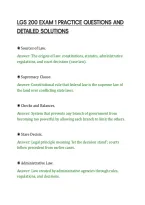
◉ Sources of Law.
Answer: The origins of law: constitutions, statutes, administrative
regulations, and court decisions (case law).
◉ Supremacy Clause.
Answer: Constitutional rule that federal law is the supreme law of
the land over conflicting state laws.
◉ Checks and Balances.
Answer: System that prevents any branch of government from
becoming too powerful by allowing each branch to limit the others.
◉ Stare Decisis.
Answer: Legal principle meaning 'let the decision stand'; courts
follow precedent from earlier cases.
◉ Administrative Law.
Answer: Law created by administrative agencies through rules,
regulations, and decisions.
, ◉ Citizens United v. Federal Election Commission.
Answer: Supreme Court case holding that corporations and unions
have First Amendment free speech rights to spend money on
political campaigns.
◉ Grimshaw v. Ford Motor Co..
Answer: Product liability case where Ford was held liable for
knowingly selling a dangerous vehicle design (Pinto gas tank).
◉ Utilitarianism.
Answer: Ethical theory that actions are right if they produce the
greatest good for the greatest number.
◉ Role of Legislatures.
Answer: Lawmaking bodies that create statutes, represent citizens,
and establish public policy.
◉ Legal vs. Ethical.
Answer: Legal actions follow the law; ethical actions follow moral
principles—something can be legal but unethical.
◉ Jurisdiction (Federal vs. State).
DETAILED SOLUTIONS
◉ Sources of Law.
Answer: The origins of law: constitutions, statutes, administrative
regulations, and court decisions (case law).
◉ Supremacy Clause.
Answer: Constitutional rule that federal law is the supreme law of
the land over conflicting state laws.
◉ Checks and Balances.
Answer: System that prevents any branch of government from
becoming too powerful by allowing each branch to limit the others.
◉ Stare Decisis.
Answer: Legal principle meaning 'let the decision stand'; courts
follow precedent from earlier cases.
◉ Administrative Law.
Answer: Law created by administrative agencies through rules,
regulations, and decisions.
, ◉ Citizens United v. Federal Election Commission.
Answer: Supreme Court case holding that corporations and unions
have First Amendment free speech rights to spend money on
political campaigns.
◉ Grimshaw v. Ford Motor Co..
Answer: Product liability case where Ford was held liable for
knowingly selling a dangerous vehicle design (Pinto gas tank).
◉ Utilitarianism.
Answer: Ethical theory that actions are right if they produce the
greatest good for the greatest number.
◉ Role of Legislatures.
Answer: Lawmaking bodies that create statutes, represent citizens,
and establish public policy.
◉ Legal vs. Ethical.
Answer: Legal actions follow the law; ethical actions follow moral
principles—something can be legal but unethical.
◉ Jurisdiction (Federal vs. State).


