
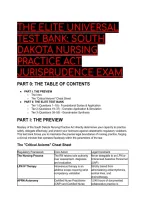
THE ELITE UNIVERSAL
TEST BANK: SOUTH
DAKOTA NURSING
PRACTICE ACT
JURISPRUDENCE EXAM
PART 0: THE TABLE OF CONTENTS
● PART I: THE PREVIEW
○ The Intro
○ The "Critical Axioms" Cheat Sheet
● PART II: THE ELITE TEST BANK
○ Tier 1 (Questions 1–18) - Foundational Syntax & Application
○ Tier 2 (Questions 19–37) - Complex Application & Simulation
○ Tier 3 (Questions 38–55) - Grandmaster Synthesis
PART I: THE PREVIEW
Mastery of the South Dakota Nursing Practice Act directly determines your capacity to practice
safely, delegate effectively, and protect your licensure against catastrophic regulatory violations.
This test bank forces you to internalize the precise legal boundaries of nursing practice, forging
a clinical mindset that operates flawlessly within the parameters of the law.
The "Critical Axioms" Cheat Sheet
Regulatory Framework Core Axiom Legal Constraint
The Nursing Process The RN retains sole authority Never delegable to an LPN or
over assessment, diagnosis, Unlicensed Assistive Personnel
and evaluation. (UAP).
LPN IV Therapy Intravenous therapy is an Strictly barred from
additive scope requiring strict administering antiarrhythmics,
competency validation. central lines, and
chemotherapy.
APRN Autonomy Certified Nurse Practitioner 1,040 hours of documented
(CNP) and Certified Nurse collaborative practice is
,Regulatory Framework Core Axiom Legal Constraint
Midwife (CNM) independence statutorily required.
requires a structural transition.
Delegation Proximity, patient stability, and The delegating RN retains
competency verification govern absolute professional
delegation. accountability.
Disciplinary Action Refusal of a board-ordered Immediate license suspension
fitness examination triggers is authorized for
summary action. non-compliance.
PART II: THE ELITE TEST BANK
Tier 1 - Foundational Syntax & Application
Q1: An RN is admitted to a new clinical unit and is assigning tasks for the shift. Based on the
principles of the South Dakota Nurse Practice Act, which action is the MOST APPROPRIATE
task to delegate to a nursing assistant? A) Conducting the admission health history and physical
assessment. B) Evaluating the client's response to an initial dose of oral antihypertensive
medication. C) Administering a routine, pre-measured oral medication following specific RN
delegation and board-approved training. D) Updating the individualized nursing care plan based
on overnight vital signs.
● Answer: C (Administering a routine, pre-measured oral medication following specific RN
delegation and board-approved training.)
● Distractor Analysis:
○ A is incorrect: Comprehensive assessments are non-delegable and remain the
exclusive domain of the RN.
○ B is incorrect: Evaluating a patient's response to interventions requires independent
professional nursing judgment, which cannot be delegated.
○ D is incorrect: Formulation and modification of the nursing plan of care are strictly
restricted to the RN.
The Mentor's Analysis: The non-negotiable anchor of delegation is that professional nursing
judgment cannot be transferred. When facing task assignment, the immediate priority is
verifying that the task is routine and requires no clinical decision-making. By utilizing delegation
protocols, you bypass the common trap of unlawfully transferring the nursing process.
Professional Intuition: Never delegate assessment, teaching, or evaluation.
Q2: An applicant for an RN license has failed the NCLEX examination on their first attempt.
They currently hold a temporary permit to practice as an "R.N. App." Based on the regulations of
the South Dakota Board of Nursing, what is the IMMEDIATE consequence regarding their
practice status? A) The applicant may continue to practice under direct RN supervision until the
next testing date. B) The applicant must complete a board-approved refresher course before
practicing again. C) The temporary permit becomes invalid upon notification of the examination
failure. D) The applicant is demoted to a UAP role indefinitely.
● Answer: C (The temporary permit becomes invalid upon notification of the examination
failure.)
● Distractor Analysis:
○ A is incorrect: The permit does not extend past the first exam failure, regardless of
supervision.
○ B is incorrect: A refresher course is typically required for lapsed licenses over six
, years, not immediately after a first exam failure.
○ D is incorrect: The individual simply loses the temporary permit to practice as an
RN applicant; they do not automatically receive a lesser title.
The Mentor's Analysis: Temporary permits are strictly contingent on the pending results of the
initial licensure examination. When facing a first-time exam failure, the immediate priority is
ceasing practice as an RN applicant. By utilizing immediate cessation of practice, you bypass
the common trap of practicing without a valid permit, which constitutes a regulatory violation.
Professional Intuition: A temporary permit evaporates the exact moment a failure notice is
received.
Q3: A newly licensed Certified Nurse Practitioner (CNP) in South Dakota wishes to open an
independent telehealth practice. Based on the principles of advanced practice licensure, which
requirement must be met FIRST? A) The CNP must secure a permanent collaborating physician
for the duration of the practice. B) The CNP must complete a minimum of 1,040 practice hours
under a collaborative agreement. C) The CNP must complete 500 hours of independent practice
before utilizing telehealth. D) The CNP must register as a Medical Corporation with the Board of
Medical and Osteopathic Examiners.
● Answer: B (The CNP must complete a minimum of 1,040 practice hours under a
collaborative agreement.)
● Distractor Analysis:
○ A is incorrect: South Dakota allows full practice authority; a permanent collaborator
is not required once the transition period is met.
○ C is incorrect: The statutory requirement is specifically 1,040 hours of collaborative
practice, not independent hours.
○ D is incorrect: CNPs are regulated by the Board of Nursing, and this specific
registration is not the primary barrier to independent practice.
The Mentor's Analysis: Full practice authority in South Dakota is earned through a structured
mentorship phase, not granted instantly at licensure. When facing the establishment of an
independent clinic, the immediate priority is fulfilling the statutory transition hours. By utilizing
documented collaborative hours, you bypass the common trap of premature, unlawful
independent practice. Professional Intuition: Independence as a CNP requires 1,040 hours of
documented collaboration.
Q4: The Board of Nursing receives a credible report that an RN is experiencing severe,
unmanaged substance use disorder that threatens patient safety. The Board orders the RN to
submit to a physical and mental examination. The RN refuses. Based on the principles of
disciplinary action, which action is the Board MOST LIKELY to take? A) Issue a non-disciplinary
Letter of Concern. B) Mandate participation in the Health Professionals Assistance Program
(HPAP) within 30 days. C) Immediately suspend the nurse's license. D) Place the nurse on
inactive status pending a formal court hearing.
● Answer: C (Immediately suspend the nurse's license.)
● Distractor Analysis:
○ A is incorrect: A Letter of Concern is for minor issues, not critical safety threats
paired with refusal of a board order.
○ B is incorrect: While HPAP is an option for substance use, refusing a mandated
evaluation escalates the situation beyond a simple mandate to enroll.
○ D is incorrect: Inactive status is a voluntary designation for nurses not currently
practicing, not a punitive measure.
The Mentor's Analysis: Public safety supersedes a licensee's preference to avoid clinical
evaluation. When facing a refusal to comply with a mandated fitness-to-practice exam, the
TEST BANK: SOUTH
DAKOTA NURSING
PRACTICE ACT
JURISPRUDENCE EXAM
PART 0: THE TABLE OF CONTENTS
● PART I: THE PREVIEW
○ The Intro
○ The "Critical Axioms" Cheat Sheet
● PART II: THE ELITE TEST BANK
○ Tier 1 (Questions 1–18) - Foundational Syntax & Application
○ Tier 2 (Questions 19–37) - Complex Application & Simulation
○ Tier 3 (Questions 38–55) - Grandmaster Synthesis
PART I: THE PREVIEW
Mastery of the South Dakota Nursing Practice Act directly determines your capacity to practice
safely, delegate effectively, and protect your licensure against catastrophic regulatory violations.
This test bank forces you to internalize the precise legal boundaries of nursing practice, forging
a clinical mindset that operates flawlessly within the parameters of the law.
The "Critical Axioms" Cheat Sheet
Regulatory Framework Core Axiom Legal Constraint
The Nursing Process The RN retains sole authority Never delegable to an LPN or
over assessment, diagnosis, Unlicensed Assistive Personnel
and evaluation. (UAP).
LPN IV Therapy Intravenous therapy is an Strictly barred from
additive scope requiring strict administering antiarrhythmics,
competency validation. central lines, and
chemotherapy.
APRN Autonomy Certified Nurse Practitioner 1,040 hours of documented
(CNP) and Certified Nurse collaborative practice is
,Regulatory Framework Core Axiom Legal Constraint
Midwife (CNM) independence statutorily required.
requires a structural transition.
Delegation Proximity, patient stability, and The delegating RN retains
competency verification govern absolute professional
delegation. accountability.
Disciplinary Action Refusal of a board-ordered Immediate license suspension
fitness examination triggers is authorized for
summary action. non-compliance.
PART II: THE ELITE TEST BANK
Tier 1 - Foundational Syntax & Application
Q1: An RN is admitted to a new clinical unit and is assigning tasks for the shift. Based on the
principles of the South Dakota Nurse Practice Act, which action is the MOST APPROPRIATE
task to delegate to a nursing assistant? A) Conducting the admission health history and physical
assessment. B) Evaluating the client's response to an initial dose of oral antihypertensive
medication. C) Administering a routine, pre-measured oral medication following specific RN
delegation and board-approved training. D) Updating the individualized nursing care plan based
on overnight vital signs.
● Answer: C (Administering a routine, pre-measured oral medication following specific RN
delegation and board-approved training.)
● Distractor Analysis:
○ A is incorrect: Comprehensive assessments are non-delegable and remain the
exclusive domain of the RN.
○ B is incorrect: Evaluating a patient's response to interventions requires independent
professional nursing judgment, which cannot be delegated.
○ D is incorrect: Formulation and modification of the nursing plan of care are strictly
restricted to the RN.
The Mentor's Analysis: The non-negotiable anchor of delegation is that professional nursing
judgment cannot be transferred. When facing task assignment, the immediate priority is
verifying that the task is routine and requires no clinical decision-making. By utilizing delegation
protocols, you bypass the common trap of unlawfully transferring the nursing process.
Professional Intuition: Never delegate assessment, teaching, or evaluation.
Q2: An applicant for an RN license has failed the NCLEX examination on their first attempt.
They currently hold a temporary permit to practice as an "R.N. App." Based on the regulations of
the South Dakota Board of Nursing, what is the IMMEDIATE consequence regarding their
practice status? A) The applicant may continue to practice under direct RN supervision until the
next testing date. B) The applicant must complete a board-approved refresher course before
practicing again. C) The temporary permit becomes invalid upon notification of the examination
failure. D) The applicant is demoted to a UAP role indefinitely.
● Answer: C (The temporary permit becomes invalid upon notification of the examination
failure.)
● Distractor Analysis:
○ A is incorrect: The permit does not extend past the first exam failure, regardless of
supervision.
○ B is incorrect: A refresher course is typically required for lapsed licenses over six
, years, not immediately after a first exam failure.
○ D is incorrect: The individual simply loses the temporary permit to practice as an
RN applicant; they do not automatically receive a lesser title.
The Mentor's Analysis: Temporary permits are strictly contingent on the pending results of the
initial licensure examination. When facing a first-time exam failure, the immediate priority is
ceasing practice as an RN applicant. By utilizing immediate cessation of practice, you bypass
the common trap of practicing without a valid permit, which constitutes a regulatory violation.
Professional Intuition: A temporary permit evaporates the exact moment a failure notice is
received.
Q3: A newly licensed Certified Nurse Practitioner (CNP) in South Dakota wishes to open an
independent telehealth practice. Based on the principles of advanced practice licensure, which
requirement must be met FIRST? A) The CNP must secure a permanent collaborating physician
for the duration of the practice. B) The CNP must complete a minimum of 1,040 practice hours
under a collaborative agreement. C) The CNP must complete 500 hours of independent practice
before utilizing telehealth. D) The CNP must register as a Medical Corporation with the Board of
Medical and Osteopathic Examiners.
● Answer: B (The CNP must complete a minimum of 1,040 practice hours under a
collaborative agreement.)
● Distractor Analysis:
○ A is incorrect: South Dakota allows full practice authority; a permanent collaborator
is not required once the transition period is met.
○ C is incorrect: The statutory requirement is specifically 1,040 hours of collaborative
practice, not independent hours.
○ D is incorrect: CNPs are regulated by the Board of Nursing, and this specific
registration is not the primary barrier to independent practice.
The Mentor's Analysis: Full practice authority in South Dakota is earned through a structured
mentorship phase, not granted instantly at licensure. When facing the establishment of an
independent clinic, the immediate priority is fulfilling the statutory transition hours. By utilizing
documented collaborative hours, you bypass the common trap of premature, unlawful
independent practice. Professional Intuition: Independence as a CNP requires 1,040 hours of
documented collaboration.
Q4: The Board of Nursing receives a credible report that an RN is experiencing severe,
unmanaged substance use disorder that threatens patient safety. The Board orders the RN to
submit to a physical and mental examination. The RN refuses. Based on the principles of
disciplinary action, which action is the Board MOST LIKELY to take? A) Issue a non-disciplinary
Letter of Concern. B) Mandate participation in the Health Professionals Assistance Program
(HPAP) within 30 days. C) Immediately suspend the nurse's license. D) Place the nurse on
inactive status pending a formal court hearing.
● Answer: C (Immediately suspend the nurse's license.)
● Distractor Analysis:
○ A is incorrect: A Letter of Concern is for minor issues, not critical safety threats
paired with refusal of a board order.
○ B is incorrect: While HPAP is an option for substance use, refusing a mandated
evaluation escalates the situation beyond a simple mandate to enroll.
○ D is incorrect: Inactive status is a voluntary designation for nurses not currently
practicing, not a punitive measure.
The Mentor's Analysis: Public safety supersedes a licensee's preference to avoid clinical
evaluation. When facing a refusal to comply with a mandated fitness-to-practice exam, the


