
OCE 1001 Ch. 3 Questions with Correct Answers (Grade A+)
Question 1: Which of the following statements accurately describe(s) the depth and height of Earth's
surface as shown on the hypsographic curve? Choose all that apply.
Answer: -The percentage of Earth's surface above sea level is 29.2%. -More people have been to the top of
the tallest mountain on Earth than have been to the bottom of the deepest trench. -The average depth of the
ocean is much greater than the average height of land.
Question 2: Why is the average depth of the ocean much greater than the average height of land?
Answer: Oceanic crust is more dense than continental crust.
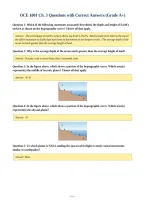
Question 3: In the figure above, which shows a portion of the hypsographic curve. Which area(s)
represent(s) the middle of tectonic plates? Choose all that apply.
Answer: -B -D
Question 4: In the figure above, which shows a portion of the hypsographic curve. Which area(s)
represent(s) the abyssal plains?
Answer: -D
Question 5: To which planet is NASA sending the spacecraft InSight to study crustal movements
similar to earthquakes?
Answer: Mars
Page 1
, Question 6: In the figure above, darker blue areas indicate deep water, and lighter blue areas indicate
shallow water. Land is shown in shades of brown and green. Which area in the figure is on a
continental margin?
Answer: D
Question 7: Refer to the figure above. Where would you expect to find a rift valley?
Answer: B
Question 8: Which of the following is an example of an active continental margin? Choose all that
apply.
Answer: -west coast of Chile -west coast of the United States
Question 9: What features are associated with a passive continental margin? Choose all that apply.
Answer: -continental rise -Flat coastal terrain
Question 10: Which of the following is a difference between passive and active continental margins?
Answer: Convergent active margins will have a steep continental slope, whereas passive margins will have
a more gradual slope.
Question 11: What common item is used in this video to demonstrate a turbidity current?
Answer: a large jar filled with water and sediment
Question 12: What is turbidity?
Answer: suspended sediment
Question 13: What effect do turbidity currents have on the continental slope? Hints
Answer: Turbidity currents are erosive to the continental slope and, as a result, carve out submarine
canyons.
Question 14: The reason the deposit on the bottom forms the way it does is a result of
Answer: settling velocity
Page 2
Question 1: Which of the following statements accurately describe(s) the depth and height of Earth's
surface as shown on the hypsographic curve? Choose all that apply.
Answer: -The percentage of Earth's surface above sea level is 29.2%. -More people have been to the top of
the tallest mountain on Earth than have been to the bottom of the deepest trench. -The average depth of the
ocean is much greater than the average height of land.
Question 2: Why is the average depth of the ocean much greater than the average height of land?
Answer: Oceanic crust is more dense than continental crust.
Question 3: In the figure above, which shows a portion of the hypsographic curve. Which area(s)
represent(s) the middle of tectonic plates? Choose all that apply.
Answer: -B -D
Question 4: In the figure above, which shows a portion of the hypsographic curve. Which area(s)
represent(s) the abyssal plains?
Answer: -D
Question 5: To which planet is NASA sending the spacecraft InSight to study crustal movements
similar to earthquakes?
Answer: Mars
Page 1
, Question 6: In the figure above, darker blue areas indicate deep water, and lighter blue areas indicate
shallow water. Land is shown in shades of brown and green. Which area in the figure is on a
continental margin?
Answer: D
Question 7: Refer to the figure above. Where would you expect to find a rift valley?
Answer: B
Question 8: Which of the following is an example of an active continental margin? Choose all that
apply.
Answer: -west coast of Chile -west coast of the United States
Question 9: What features are associated with a passive continental margin? Choose all that apply.
Answer: -continental rise -Flat coastal terrain
Question 10: Which of the following is a difference between passive and active continental margins?
Answer: Convergent active margins will have a steep continental slope, whereas passive margins will have
a more gradual slope.
Question 11: What common item is used in this video to demonstrate a turbidity current?
Answer: a large jar filled with water and sediment
Question 12: What is turbidity?
Answer: suspended sediment
Question 13: What effect do turbidity currents have on the continental slope? Hints
Answer: Turbidity currents are erosive to the continental slope and, as a result, carve out submarine
canyons.
Question 14: The reason the deposit on the bottom forms the way it does is a result of
Answer: settling velocity
Page 2


