
ANATOMY, CHAPTER 5, PIVOT POINT ESTHETICS
FREQUENTLY TESTED ACTUAL EXAM QUESTIONS
WITH CORRECT ANSWERS
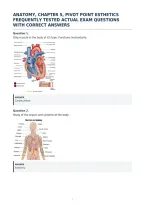
Question 1.
Only muscle in the body of it's type. Functions involuntarily.
ANSWER
Cardiac/Heart
Question 2.
Study of the organs and systems of the body.
ANSWER
Anatomy
1
,Question 3.
Study of the functions of the organs and systems of the body.
ANSWER
Physiology
Question 4.
Study of the structures that can be seen with the naked eye.
ANSWER
Gross Anatomy
Question 5.
Study of structures too small to be seen except through a microscope.
ANSWER
Histology
2
,Question 6.
Building blocks of the human body.
ANSWER
Cells, Tissues, Organs, Body Systems
Question 7.
Basic units of life.
ANSWER
Cells
Question 8.
A colorless gel-like substance that contains water, salt and nutrients obtained from food.
ANSWER
Protoplasm
3
, Question 9.
Control center of the cell.
ANSWER
Nucleus
Question 10.
Production department of the cell.
ANSWER
Cytoplasm
Question 11.
Perform most of the cells activities. Store food for growth as well as repair and restore the cell.
ANSWER
Organells
4
FREQUENTLY TESTED ACTUAL EXAM QUESTIONS
WITH CORRECT ANSWERS
Question 1.
Only muscle in the body of it's type. Functions involuntarily.
ANSWER
Cardiac/Heart
Question 2.
Study of the organs and systems of the body.
ANSWER
Anatomy
1
,Question 3.
Study of the functions of the organs and systems of the body.
ANSWER
Physiology
Question 4.
Study of the structures that can be seen with the naked eye.
ANSWER
Gross Anatomy
Question 5.
Study of structures too small to be seen except through a microscope.
ANSWER
Histology
2
,Question 6.
Building blocks of the human body.
ANSWER
Cells, Tissues, Organs, Body Systems
Question 7.
Basic units of life.
ANSWER
Cells
Question 8.
A colorless gel-like substance that contains water, salt and nutrients obtained from food.
ANSWER
Protoplasm
3
, Question 9.
Control center of the cell.
ANSWER
Nucleus
Question 10.
Production department of the cell.
ANSWER
Cytoplasm
Question 11.
Perform most of the cells activities. Store food for growth as well as repair and restore the cell.
ANSWER
Organells
4


