
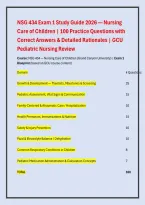
NSG 434 Exam 1 Study Guide 2026 — Nursing
Care of Children | 100 Practice Questions with
Correct Answers & Detailed Rationales | GCU
Pediatric Nursing Review
Course: NSG 434 — Nursing Care of Children (Grand Canyon University) | Exam 1
Blueprint (based on GCU course content)
Domain # Questions
Growth & Development — Theorists, Milestones & Screening 25
Pediatric Assessment, Vital Signs & Communication 15
Family-Centered & Atraumatic Care / Hospitalization 10
Health Promotion, Immunizations & Nutrition 15
Safety & Injury Prevention 10
Fluid & Electrolyte Balance / Dehydration 10
Common Respiratory Conditions in Children 8
Pediatric Medication Administration & Calculation Concepts 7
TOTAL 100
,Each question includes four options, the correct answer, and a detailed rationale
explaining why the correct answer is best and why distractors are incorrect. Format
mirrors the GCU NSG 434 Exam 1 question style. Always verify course-specific
content against your current GCU syllabus and lecture materials.
SECTION 1: GROWTH & DEVELOPMENT — THEORISTS, MILESTONES & SCREENING
(Questions 1–25)
Question 1
A nurse is assessing a 2-month-old infant at a well-child visit. Which finding indicates
normal development?
A) Social smile and head lag when pulled to sitting
B) Rolling from back to stomach
C) Transferring objects hand to hand
D) Sitting without support
Correct Answer: A
A social smile appears at approximately 2 months of age, and head lag when pulled
to sitting is expected at this age because neck muscles are still developing. Rolling
over typically occurs at 4–6 months, transferring objects hand to hand at 7–8 months,
and sitting without support at 8–9 months.
Question 2
The nurse is teaching parents of a 6-month-old infant about expected developmental
milestones. Which statement by the parent indicates correct understanding?
A) "My baby should be able to say mama and dada specifically."
B) "My baby should be able to sit alone without support."
C) "My baby should be able to roll from back to abdomen."
D) "My baby should be able to walk with assistance."
Correct Answer: C
Rolling from back to abdomen is a 6-month milestone. Specific words "mama" and
"dada" appear closer to 10–12 months. Independent sitting occurs around 8–9
months, and walking with assistance occurs around 9–12 months.
,Question 3
According to Piaget, a 4-year-old child is in which stage of cognitive development?
A) Sensorimotor
B) Preoperational
C) Concrete operational
D) Formal operational
Correct Answer: B
Piaget's preoperational stage (2–7 years) is characterized by egocentrism, magical
thinking, and symbolic play. The sensorimotor stage (birth–2 years) involves learning
through senses and motor activity. The concrete operational stage (7–11 years)
involves logical thinking about concrete objects. The formal operational stage (11
years–adulthood) involves abstract reasoning.
Question 4
According to Erikson, the primary developmental task of a toddler is:
A) Trust vs. mistrust
B) Autonomy vs. shame and doubt
C) Initiative vs. guilt
D) Industry vs. inferiority
Correct Answer: B
Erikson's autonomy vs. shame and doubt stage (1–3 years) is the toddler's central
task — developing a sense of control over self and environment. Trust vs. mistrust is
the infant stage (birth–1 year). Initiative vs. guilt is the preschool stage (3–6 years).
Industry vs. inferiority is the school-age stage (6–12 years).
Question 5
A nurse is teaching a parent of a 4-year-old about toilet training regression. Which
response indicates correct understanding?
A) "Regression is always a sign of abuse."
B) "Regression can occur during stress and typically resolves with patience."
, C) "Regression means my child will never be potty trained."
D) "Regression should be punished immediately."
Correct Answer: B
Regression is a common response to stress (new sibling, hospitalization, moving) and
typically resolves with patience, reassurance, and consistent routines. Regression
alone is not a sign of abuse. Punishment can worsen the behavior and harm the
parent-child relationship.
Question 6
Which of the following is an expected finding in a 12-month-old infant?
A) Uses a pincer grasp and says 2–3 words
B) Walks independently with a steady gait
C) Uses 50-word vocabulary
D) Draws a circle
Correct Answer: A
A 12-month-old typically uses a pincer grasp, says 2–3 words besides "mama" and
"dada," cruises, and may take first steps. Independent steady walking is more typical
at 15 months. A 50-word vocabulary and drawing a circle are milestones of 2–3 years.
Question 7
The nurse is assessing a 5-year-old child's language development. Which finding
indicates a need for further evaluation?
A) Speaks in full sentences with 1,000+ words
B) Uses past tense correctly
C) Speech is unintelligible to strangers at age 5
D) Tells simple stories
Correct Answer: C
By age 5, speech should be largely intelligible to strangers, even with minor
articulation errors. Persistent unintelligibility suggests a possible speech or language
Care of Children | 100 Practice Questions with
Correct Answers & Detailed Rationales | GCU
Pediatric Nursing Review
Course: NSG 434 — Nursing Care of Children (Grand Canyon University) | Exam 1
Blueprint (based on GCU course content)
Domain # Questions
Growth & Development — Theorists, Milestones & Screening 25
Pediatric Assessment, Vital Signs & Communication 15
Family-Centered & Atraumatic Care / Hospitalization 10
Health Promotion, Immunizations & Nutrition 15
Safety & Injury Prevention 10
Fluid & Electrolyte Balance / Dehydration 10
Common Respiratory Conditions in Children 8
Pediatric Medication Administration & Calculation Concepts 7
TOTAL 100
,Each question includes four options, the correct answer, and a detailed rationale
explaining why the correct answer is best and why distractors are incorrect. Format
mirrors the GCU NSG 434 Exam 1 question style. Always verify course-specific
content against your current GCU syllabus and lecture materials.
SECTION 1: GROWTH & DEVELOPMENT — THEORISTS, MILESTONES & SCREENING
(Questions 1–25)
Question 1
A nurse is assessing a 2-month-old infant at a well-child visit. Which finding indicates
normal development?
A) Social smile and head lag when pulled to sitting
B) Rolling from back to stomach
C) Transferring objects hand to hand
D) Sitting without support
Correct Answer: A
A social smile appears at approximately 2 months of age, and head lag when pulled
to sitting is expected at this age because neck muscles are still developing. Rolling
over typically occurs at 4–6 months, transferring objects hand to hand at 7–8 months,
and sitting without support at 8–9 months.
Question 2
The nurse is teaching parents of a 6-month-old infant about expected developmental
milestones. Which statement by the parent indicates correct understanding?
A) "My baby should be able to say mama and dada specifically."
B) "My baby should be able to sit alone without support."
C) "My baby should be able to roll from back to abdomen."
D) "My baby should be able to walk with assistance."
Correct Answer: C
Rolling from back to abdomen is a 6-month milestone. Specific words "mama" and
"dada" appear closer to 10–12 months. Independent sitting occurs around 8–9
months, and walking with assistance occurs around 9–12 months.
,Question 3
According to Piaget, a 4-year-old child is in which stage of cognitive development?
A) Sensorimotor
B) Preoperational
C) Concrete operational
D) Formal operational
Correct Answer: B
Piaget's preoperational stage (2–7 years) is characterized by egocentrism, magical
thinking, and symbolic play. The sensorimotor stage (birth–2 years) involves learning
through senses and motor activity. The concrete operational stage (7–11 years)
involves logical thinking about concrete objects. The formal operational stage (11
years–adulthood) involves abstract reasoning.
Question 4
According to Erikson, the primary developmental task of a toddler is:
A) Trust vs. mistrust
B) Autonomy vs. shame and doubt
C) Initiative vs. guilt
D) Industry vs. inferiority
Correct Answer: B
Erikson's autonomy vs. shame and doubt stage (1–3 years) is the toddler's central
task — developing a sense of control over self and environment. Trust vs. mistrust is
the infant stage (birth–1 year). Initiative vs. guilt is the preschool stage (3–6 years).
Industry vs. inferiority is the school-age stage (6–12 years).
Question 5
A nurse is teaching a parent of a 4-year-old about toilet training regression. Which
response indicates correct understanding?
A) "Regression is always a sign of abuse."
B) "Regression can occur during stress and typically resolves with patience."
, C) "Regression means my child will never be potty trained."
D) "Regression should be punished immediately."
Correct Answer: B
Regression is a common response to stress (new sibling, hospitalization, moving) and
typically resolves with patience, reassurance, and consistent routines. Regression
alone is not a sign of abuse. Punishment can worsen the behavior and harm the
parent-child relationship.
Question 6
Which of the following is an expected finding in a 12-month-old infant?
A) Uses a pincer grasp and says 2–3 words
B) Walks independently with a steady gait
C) Uses 50-word vocabulary
D) Draws a circle
Correct Answer: A
A 12-month-old typically uses a pincer grasp, says 2–3 words besides "mama" and
"dada," cruises, and may take first steps. Independent steady walking is more typical
at 15 months. A 50-word vocabulary and drawing a circle are milestones of 2–3 years.
Question 7
The nurse is assessing a 5-year-old child's language development. Which finding
indicates a need for further evaluation?
A) Speaks in full sentences with 1,000+ words
B) Uses past tense correctly
C) Speech is unintelligible to strangers at age 5
D) Tells simple stories
Correct Answer: C
By age 5, speech should be largely intelligible to strangers, even with minor
articulation errors. Persistent unintelligibility suggests a possible speech or language


