
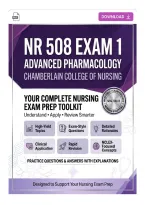
,NR 508 Advanced Pharmacology Exam Prep —
Comprehensive Review + Practice MCQs —
Chamberlain College of Nursing 2025/2026
1. Which of the following pharmacokinetic processes is primarily affected by a patient's genetic polymorphism
of the CYP2D6 enzyme?
A. Absorption
B. Distribution
C. Metabolism
D. Excretion
Correct Answer: C. Metabolism
Rationale: CYP2D6 is a cytochrome P450 enzyme responsible for Phase I metabolism of many drugs, including
codeine, SSRIs, and beta-blockers. Genetic polymorphisms can produce poor, intermediate, extensive, or ultra-
rapid metabolizer phenotypes, significantly altering drug metabolism and plasma concentrations .
2. The three most important characteristics of any drug are effectiveness, safety, and:
A. Potency
B. Selectivity
C. Cost
D. Solubility
Correct Answer: B. Selectivity
Rationale: The three most important drug characteristics are effectiveness (produces intended response),
safety (does not produce harmful effects), and selectivity (elicits only the intended response without affecting
other receptors). Potency is clinically less important than these three characteristics .
,3. Steady-state plasma concentrations of a drug are typically achieved after approximately:
A. One half-life
B. Two half-lives
C. Four to five half-lives
D. Ten half-lives
Correct Answer: C. Four to five half-lives
Rationale: Steady state occurs when the amount of drug entering the body equals the amount being
eliminated. This equilibrium is typically reached after four to five half-lives, at which point the full therapeutic
effect can be assessed .
4. A patient's laboratory results reveal hypoalbuminemia. This is clinically significant for prescribing because:
A. The solubility of the drug will not match the site of absorption
B. There will be less free drug available to generate an effect
C. Distribution of drugs to target tissue may be affected
D. Drugs bound to albumin are readily excreted by the kidneys
Correct Answer: C. Distribution of drugs to target tissue may be affected
Rationale: Albumin is the primary plasma protein that binds drugs. Hypoalbuminemia reduces binding sites,
increasing free (unbound) drug levels, which can enhance therapeutic effects but also increase toxicity risk.
Additionally, altered protein binding affects drug distribution to target tissues .
, 5. A drug with a narrow therapeutic index:
A. Has a wide margin of safety
B. Requires therapeutic drug monitoring
C. Is always administered intravenously
D. Cannot be used in elderly patients
Correct Answer: B. Requires therapeutic drug monitoring
Rationale: Drugs with a narrow therapeutic index (e.g., warfarin, digoxin, phenytoin, lithium) have a small
margin between therapeutic and toxic doses. They require therapeutic drug monitoring to maintain levels
within the therapeutic range .
6. The primary site of drug metabolism is the:
A. Kidney
B. Liver
C. Small intestine
D. Lungs
Correct Answer: B. Liver
Rationale: The liver is the primary site of drug metabolism, performing Phase I (oxidation, reduction,
hydrolysis) and Phase II (conjugation) reactions to convert lipid-soluble drugs into more water-soluble
compounds for excretion. The kidneys are the primary site of drug excretion .
7. Drugs that undergo significant first-pass metabolism:
Comprehensive Review + Practice MCQs —
Chamberlain College of Nursing 2025/2026
1. Which of the following pharmacokinetic processes is primarily affected by a patient's genetic polymorphism
of the CYP2D6 enzyme?
A. Absorption
B. Distribution
C. Metabolism
D. Excretion
Correct Answer: C. Metabolism
Rationale: CYP2D6 is a cytochrome P450 enzyme responsible for Phase I metabolism of many drugs, including
codeine, SSRIs, and beta-blockers. Genetic polymorphisms can produce poor, intermediate, extensive, or ultra-
rapid metabolizer phenotypes, significantly altering drug metabolism and plasma concentrations .
2. The three most important characteristics of any drug are effectiveness, safety, and:
A. Potency
B. Selectivity
C. Cost
D. Solubility
Correct Answer: B. Selectivity
Rationale: The three most important drug characteristics are effectiveness (produces intended response),
safety (does not produce harmful effects), and selectivity (elicits only the intended response without affecting
other receptors). Potency is clinically less important than these three characteristics .
,3. Steady-state plasma concentrations of a drug are typically achieved after approximately:
A. One half-life
B. Two half-lives
C. Four to five half-lives
D. Ten half-lives
Correct Answer: C. Four to five half-lives
Rationale: Steady state occurs when the amount of drug entering the body equals the amount being
eliminated. This equilibrium is typically reached after four to five half-lives, at which point the full therapeutic
effect can be assessed .
4. A patient's laboratory results reveal hypoalbuminemia. This is clinically significant for prescribing because:
A. The solubility of the drug will not match the site of absorption
B. There will be less free drug available to generate an effect
C. Distribution of drugs to target tissue may be affected
D. Drugs bound to albumin are readily excreted by the kidneys
Correct Answer: C. Distribution of drugs to target tissue may be affected
Rationale: Albumin is the primary plasma protein that binds drugs. Hypoalbuminemia reduces binding sites,
increasing free (unbound) drug levels, which can enhance therapeutic effects but also increase toxicity risk.
Additionally, altered protein binding affects drug distribution to target tissues .
, 5. A drug with a narrow therapeutic index:
A. Has a wide margin of safety
B. Requires therapeutic drug monitoring
C. Is always administered intravenously
D. Cannot be used in elderly patients
Correct Answer: B. Requires therapeutic drug monitoring
Rationale: Drugs with a narrow therapeutic index (e.g., warfarin, digoxin, phenytoin, lithium) have a small
margin between therapeutic and toxic doses. They require therapeutic drug monitoring to maintain levels
within the therapeutic range .
6. The primary site of drug metabolism is the:
A. Kidney
B. Liver
C. Small intestine
D. Lungs
Correct Answer: B. Liver
Rationale: The liver is the primary site of drug metabolism, performing Phase I (oxidation, reduction,
hydrolysis) and Phase II (conjugation) reactions to convert lipid-soluble drugs into more water-soluble
compounds for excretion. The kidneys are the primary site of drug excretion .
7. Drugs that undergo significant first-pass metabolism:


