
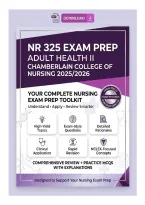
,NR 325 Adult Health II Exam Prep —
Comprehensive Review + Practice
MCQs — Chamberlain College of
Nursing 2025/2026
1. A client with acute decompensated heart failure is receiving furosemide IV. Which assessment finding
requires immediate nursing intervention?
A. Urine output of 50 mL/hr
B. Blood pressure 98/62 mm Hg
C. Serum potassium 2.9 mEq/L
D. Weight loss of 0.5 kg in 24 hours
Correct Answer: C
Rationale: Loop diuretics like furosemide cause significant potassium loss. A serum potassium of 2.9 mEq/L is
critically low and places the client at risk for life-threatening dysrhythmias (especially with concurrent digoxin
use). Immediate notification and potassium replacement are required. While hypotension is a concern, K+ <3.0
mEq/L is the most acute safety threat requiring immediate action.
2. A client with atrial fibrillation has been prescribed warfarin. Which instruction is most important for the
nurse to include in discharge teaching?
A. "Increase your intake of green leafy vegetables."
B. "Use a soft toothbrush and electric razor."
C. "Take aspirin for any headaches."
D. "Expect your INR to be 2.5 to 3.5 if you have mechanical valves."
Correct Answer: B
Rationale: Warfarin increases bleeding risk. Using a soft toothbrush and electric razor reduces injury-related
bleeding. Clients should maintain consistent (not increased) vitamin K intake, avoid aspirin (increases bleeding
,risk), and the INR goal varies by indication (2.0–3.0 for atrial fibrillation, 2.5–3.5 for mechanical valves). The
safety instruction is the priority teaching point.
3. A nurse is caring for a client receiving heparin infusion. The aPTT is 95 seconds (control 30 seconds). Which
action should the nurse take first?
A. Increase the heparin infusion rate.
B. Document the finding and continue monitoring.
C. Stop the heparin infusion and notify the provider.
D. Prepare to administer vitamin K.
Correct Answer: C
Rationale: Therapeutic aPTT for heparin is typically 1.5–2.5 times control (approximately 45–75 seconds). A
value of 95 seconds indicates supratherapeutic anticoagulation with high bleeding risk. The nurse should stop
the infusion and notify the provider. Protamine sulfate, not vitamin K, is the antidote for heparin. Vitamin K
reverses warfarin.
4. A client is admitted with infective endocarditis. Which clinical manifestation should the nurse anticipate?
A. Painless, red nodules on the fingertips
B. Splinter hemorrhages under the fingernails
C. Bilateral jugular venous distention
D. Pitting edema of the lower extremities
Correct Answer: B
Rationale: Infective endocarditis commonly presents with peripheral stigmata including splinter hemorrhages
(small, dark lines under nails), Janeway lesions (painless macules on palms/soles), Osler nodes (painful nodules
on fingertips), and Roth spots. JVD and pitting edema suggest right-sided heart failure. Painless red nodules
would more likely describe Janeway lesions, but splinter hemorrhages are a classic finding.
5. A client with a new permanent pacemaker asks why the incision site should not be lifted over the shoulder.
Which response by the nurse is accurate?
, A. "It prevents dislodgment of the pacing leads."
B. "It reduces the risk of pacemaker syndrome."
C. "It prevents the battery from depleting."
D. "It allows the incision to heal faster."
Correct Answer: A
Rationale: Arm movement on the pacemaker side is restricted for several weeks to prevent dislodgment of the
newly implanted leads. Once leads fibrose in place, activity can be gradually increased. Pacemaker syndrome is
a hemodynamic issue unrelated to arm movement, and battery life is not affected by shoulder movement.
6. A nurse is assessing a client with peripheral arterial disease (PAD). Which finding is most characteristic?
A. Dependent rubor and thin, shiny skin
B. Brown pigmentation and edema
C. Warm extremities with bounding pulses
D. Pain relieved by elevating the extremity
Correct Answer: A
Rationale: PAD causes decreased arterial perfusion, resulting in dependent rubor (redness when leg is
lowered), thin/shiny/hairless skin, cool extremities, diminished pulses, and pain relieved by dependency
(hanging leg down). Venous insufficiency presents with brown pigmentation, edema, and pain relieved by
elevation.
7. A client is scheduled for a cardiac catheterization. Which assessment finding should the nurse report to the
provider before the procedure?
A. History of shellfish allergy
B. Blood pressure 138/86 mm Hg
C. Heart rate 88 beats/min
D. Serum creatinine 2.4 mg/dL
Comprehensive Review + Practice
MCQs — Chamberlain College of
Nursing 2025/2026
1. A client with acute decompensated heart failure is receiving furosemide IV. Which assessment finding
requires immediate nursing intervention?
A. Urine output of 50 mL/hr
B. Blood pressure 98/62 mm Hg
C. Serum potassium 2.9 mEq/L
D. Weight loss of 0.5 kg in 24 hours
Correct Answer: C
Rationale: Loop diuretics like furosemide cause significant potassium loss. A serum potassium of 2.9 mEq/L is
critically low and places the client at risk for life-threatening dysrhythmias (especially with concurrent digoxin
use). Immediate notification and potassium replacement are required. While hypotension is a concern, K+ <3.0
mEq/L is the most acute safety threat requiring immediate action.
2. A client with atrial fibrillation has been prescribed warfarin. Which instruction is most important for the
nurse to include in discharge teaching?
A. "Increase your intake of green leafy vegetables."
B. "Use a soft toothbrush and electric razor."
C. "Take aspirin for any headaches."
D. "Expect your INR to be 2.5 to 3.5 if you have mechanical valves."
Correct Answer: B
Rationale: Warfarin increases bleeding risk. Using a soft toothbrush and electric razor reduces injury-related
bleeding. Clients should maintain consistent (not increased) vitamin K intake, avoid aspirin (increases bleeding
,risk), and the INR goal varies by indication (2.0–3.0 for atrial fibrillation, 2.5–3.5 for mechanical valves). The
safety instruction is the priority teaching point.
3. A nurse is caring for a client receiving heparin infusion. The aPTT is 95 seconds (control 30 seconds). Which
action should the nurse take first?
A. Increase the heparin infusion rate.
B. Document the finding and continue monitoring.
C. Stop the heparin infusion and notify the provider.
D. Prepare to administer vitamin K.
Correct Answer: C
Rationale: Therapeutic aPTT for heparin is typically 1.5–2.5 times control (approximately 45–75 seconds). A
value of 95 seconds indicates supratherapeutic anticoagulation with high bleeding risk. The nurse should stop
the infusion and notify the provider. Protamine sulfate, not vitamin K, is the antidote for heparin. Vitamin K
reverses warfarin.
4. A client is admitted with infective endocarditis. Which clinical manifestation should the nurse anticipate?
A. Painless, red nodules on the fingertips
B. Splinter hemorrhages under the fingernails
C. Bilateral jugular venous distention
D. Pitting edema of the lower extremities
Correct Answer: B
Rationale: Infective endocarditis commonly presents with peripheral stigmata including splinter hemorrhages
(small, dark lines under nails), Janeway lesions (painless macules on palms/soles), Osler nodes (painful nodules
on fingertips), and Roth spots. JVD and pitting edema suggest right-sided heart failure. Painless red nodules
would more likely describe Janeway lesions, but splinter hemorrhages are a classic finding.
5. A client with a new permanent pacemaker asks why the incision site should not be lifted over the shoulder.
Which response by the nurse is accurate?
, A. "It prevents dislodgment of the pacing leads."
B. "It reduces the risk of pacemaker syndrome."
C. "It prevents the battery from depleting."
D. "It allows the incision to heal faster."
Correct Answer: A
Rationale: Arm movement on the pacemaker side is restricted for several weeks to prevent dislodgment of the
newly implanted leads. Once leads fibrose in place, activity can be gradually increased. Pacemaker syndrome is
a hemodynamic issue unrelated to arm movement, and battery life is not affected by shoulder movement.
6. A nurse is assessing a client with peripheral arterial disease (PAD). Which finding is most characteristic?
A. Dependent rubor and thin, shiny skin
B. Brown pigmentation and edema
C. Warm extremities with bounding pulses
D. Pain relieved by elevating the extremity
Correct Answer: A
Rationale: PAD causes decreased arterial perfusion, resulting in dependent rubor (redness when leg is
lowered), thin/shiny/hairless skin, cool extremities, diminished pulses, and pain relieved by dependency
(hanging leg down). Venous insufficiency presents with brown pigmentation, edema, and pain relieved by
elevation.
7. A client is scheduled for a cardiac catheterization. Which assessment finding should the nurse report to the
provider before the procedure?
A. History of shellfish allergy
B. Blood pressure 138/86 mm Hg
C. Heart rate 88 beats/min
D. Serum creatinine 2.4 mg/dL


