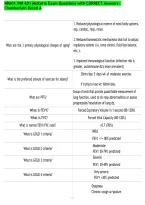
NR601 /NR 601 Midterm Exam Questions with CORRECT Answers-
Chamberlain Rated A
1. Reduced physiological reserve of most body systems,
esp. cardiac, resp, renal.
2. Reduced homeostatic mechanisms that fail to adjust
What are the 3 primary physiological changes of aging? regulatory systems (i.e. temp control, fluid/lyte balance,
etc.).
3. Impaired immunological function (infection risk is
greater, autoimmune dz's more prevalent)
30min/day 5 days/wk of moderate exercise.
What is the preferred amount of exercise for elderly?
If trying to lose wt: 60min/day.
Group of tests that provide quantifiable measurement of
What are PFTs? lung function, used to dx resp abnormalities or assess
progression/resolution of lung dz.
What is FEV1? Forced Expiratory Volume in 1 second (80-120%)
What is FVC? Forced Vital Capacity (80-120%)
What is normal FEV1/FVC ratio? <0.7 (70%)
Mild
What is GOLD 1 criteria?
FEV1 >/= 80% predicted
Moderate
What is GOLD 2 criteria?
FEV1 50-79% predicted
Severe
What is GOLD 3 criteria?
FEV1 30-49% predicted
Very severe
What is GOLD 4 criteria?
FEV1 <30% predicted
Dyspnea
Chronic cough w/sputum
, Decreased activity tolerance
What are the signal symptoms of COPD?
Wheezing
Common, preventable, treatable.
Characterized by persistent airflow limitation.
Usually progressive, associated with enhanced chronic
inflammatory response in airways and lungs to noxious
What are characteristics of COPD?
particles/gases
Airway fibrosis, luminal plugs, airway inflammation, in-
creased airway resistance, small airway dz.
Decreased elastic recoil of alveoli.
Smoking (increasing w/number of pack years)
Second hand smoke
What are risk factors for COPD?
Environmental pollution (endotoxins, coal dust, mineral
dust)
May be normal in early states
As severity progresses: lung hyperinflation, decreased
What is seen on phys exam in COPD? breath sounds, wheezes at bases, distant heart tones (b/c
of hyperinflation, so S1/S2 sounds ott in distance), acces-
sory muscle use, pursed lip breathing, increased expira-
tory phase, neck vein distention.
Spirometry is gold standard (pre and post bronchodila-
How is COPD diagnosed? tor).
Irreversible airflow limitation is hallmark.
Bronchodilators: beta agonists (long/short), anticholiner-
How is COPD treated?
gics (long/short), or combo.
What is the MOA of beta agonists?
,Stimulates beta-2-adrenergic receptors, increasing cyclic
AMP, resulting in relaxing airways.
Block the ettect of acetylcholine on muscarinic type 3 re-
What is the MOA of anticholinergics?
ceptors, resulting in bronchodilation.
They are for moderate airflow limitation.
Why are long-acting beta agonists prescribed for COPD?
They relieve symptoms, increase exercise tolerance, re-
duce number of exacerbations, improve QOL.
CHF
Hyperventilation syndrome
Panic attacks
What are some non pulmonary diagnoses that result in
Vocal cord dysfunction
COPD-type symptoms?
Obstructive sleep apnea
Aspergillosis
Chronic fatigue syndrome
Wheezing
Shortness of breath
What are signal symptoms of asthma?
Cough (esp at night)
Chest tightness
Daily chronic cough w/increased sputum for at least 3
consecutive months in at least 2 consecutive years.
What is chronic bronchitis?
Usually worse on wakening.
May or may not be associated with COPD.
Characterized by obstruction to airflow caused by abnor-
mal airspace enlargement distal to terminal bronchioles.
What is emphysema?
Chronic inflammation/remodeling, trapping air, hindering
, ettective O2/CO2 exchange (all due to inflammatory me-
diators infiltrating airways).
Chest pain
What are signal symptoms of ischemic heart dz? Chest tightness
Chest discomfort
Imbalance between supply and demand for blood flow to
What is ischemic heart dz?
myocardium
Cough
Dyspnea
What are signal symptoms of lung CA? Wt loss
Anorexia
Hemoptysis
Malignant neoplasm originating in parenchyma of
What is lung CA?
lung/airways
Prolonged CP (>20min duration)
SOB
What are signal symptoms of MI? Confusion
Weakness
Worsening HF
Necrosis of heart tissue caused by lack of blood and O2
What is an MI?
supply to the heart
Fever
Chills
Hypothermia
What are signal symptoms of pneumonia? New cough w/or w/out sputum
Chest discomfort or dyspnea
Fatigue
HA