
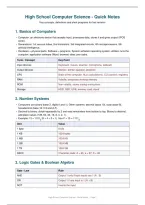
High School Computer Science - Quick Notes
Key concepts, definitions and short programs for fast revision
1. Basics of Computers
• Computer: an electronic device that accepts input, processes data, stores it and gives output (IPOS
cycle).
• Generations: 1st vacuum tubes, 2nd transistors, 3rd integrated circuits, 4th microprocessors, 5th
artificial intelligence.
• Hardware = physical parts. Software = programs. System software (operating system, utilities) runs the
computer; application software (Word, browser) does user tasks.
Term / Concept Key Point
Input devices Keyboard, mouse, scanner, microphone, webcam
Output devices Monitor, printer, speaker, projector
CPU Brain of the computer: ALU (calculations), CU (control), registers
RAM Volatile, temporary working memory
ROM Non-volatile, stores startup instructions
Storage HDD, SSD, USB, memory card, cloud
2. Number Systems
• Computers use binary (base 2, digits 0 and 1). Other systems: decimal (base 10), octal (base 8),
hexadecimal (base 16: 0-9 and A-F).
• Decimal to binary: divide repeatedly by 2 and read remainders from bottom to top. Binary to decimal:
add place values (128, 64, 32, 16, 8, 4, 2, 1).
• Example: 13 = 11012 (8 + 4 + 0 + 1). Hex F = 15 = 11112.
Unit Value
1 byte 8 bits
1 KB 1024 bytes
1 MB 1024 KB
1 GB 1024 MB
1 TB 1024 GB
ASCII Character code: A = 65, a = 97, 0 = 48
3. Logic Gates & Boolean Algebra
Gate / Law Rule
AND Output 1 only if both inputs are 1 (A . B)
OR Output 1 if any input is 1 (A + B)
NOT Inverts the input
High School Computer Science - Quick Notes | Page 1
Key concepts, definitions and short programs for fast revision
1. Basics of Computers
• Computer: an electronic device that accepts input, processes data, stores it and gives output (IPOS
cycle).
• Generations: 1st vacuum tubes, 2nd transistors, 3rd integrated circuits, 4th microprocessors, 5th
artificial intelligence.
• Hardware = physical parts. Software = programs. System software (operating system, utilities) runs the
computer; application software (Word, browser) does user tasks.
Term / Concept Key Point
Input devices Keyboard, mouse, scanner, microphone, webcam
Output devices Monitor, printer, speaker, projector
CPU Brain of the computer: ALU (calculations), CU (control), registers
RAM Volatile, temporary working memory
ROM Non-volatile, stores startup instructions
Storage HDD, SSD, USB, memory card, cloud
2. Number Systems
• Computers use binary (base 2, digits 0 and 1). Other systems: decimal (base 10), octal (base 8),
hexadecimal (base 16: 0-9 and A-F).
• Decimal to binary: divide repeatedly by 2 and read remainders from bottom to top. Binary to decimal:
add place values (128, 64, 32, 16, 8, 4, 2, 1).
• Example: 13 = 11012 (8 + 4 + 0 + 1). Hex F = 15 = 11112.
Unit Value
1 byte 8 bits
1 KB 1024 bytes
1 MB 1024 KB
1 GB 1024 MB
1 TB 1024 GB
ASCII Character code: A = 65, a = 97, 0 = 48
3. Logic Gates & Boolean Algebra
Gate / Law Rule
AND Output 1 only if both inputs are 1 (A . B)
OR Output 1 if any input is 1 (A + B)
NOT Inverts the input
High School Computer Science - Quick Notes | Page 1


