
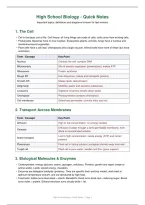
High School Biology - Quick Notes
Important topics, definitions and diagrams-to-learn for fast revision
1. The Cell
• Cell is the basic unit of life. Cell theory: all living things are made of cells; cells come from existing cells.
• Prokaryotes (bacteria) have no true nucleus. Eukaryotes (plants, animals, fungi) have a nucleus and
membrane-bound organelles.
• Plant cells have a cell wall, chloroplasts and a large vacuole. Animal cells have none of these (but have
centrioles).
Term / Concept Key Point
Nucleus Controls the cell; contains DNA
Mitochondria Site of aerobic respiration (powerhouse); makes ATP
Ribosomes Protein synthesis
Rough ER Has ribosomes; makes and transports proteins
Smooth ER Makes lipids; detoxification
Golgi body Modifies, packs and secretes substances
Lysosome Digestive enzymes; breaks down waste
Chloroplast Photosynthesis (contains chlorophyll)
Cell membrane Selectively permeable; controls entry and exit
2. Transport Across Membranes
Term / Concept Key Point
Diffusion High to low concentration; no energy needed
Diffusion of water through a semi-permeable membrane, from
Osmosis
dilute to concentrated solution
Low to high concentration; needs energy (ATP) and carrier
Active transport
proteins
Plasmolysis Plant cell in strong solution: protoplast shrinks away from wall
Turgid cell Plant cell in pure water: swollen and firm (gives support)
3. Biological Molecules & Enzymes
• Carbohydrates: energy (glucose, starch, glycogen, cellulose). Proteins: growth and repair (made of
amino acids). Lipids: stored energy, insulation.
• Enzymes are biological catalysts (proteins). They are specific (lock and key model), work best at
optimum temperature and pH, and are denatured by high heat.
• Food tests: Iodine turns blue-black = starch. Benedict's (heat) turns brick-red = reducing sugar. Biuret
turns violet = protein. Ethanol emulsion turns cloudy white = fat.
High School Biology - Quick Notes | Page 1
Important topics, definitions and diagrams-to-learn for fast revision
1. The Cell
• Cell is the basic unit of life. Cell theory: all living things are made of cells; cells come from existing cells.
• Prokaryotes (bacteria) have no true nucleus. Eukaryotes (plants, animals, fungi) have a nucleus and
membrane-bound organelles.
• Plant cells have a cell wall, chloroplasts and a large vacuole. Animal cells have none of these (but have
centrioles).
Term / Concept Key Point
Nucleus Controls the cell; contains DNA
Mitochondria Site of aerobic respiration (powerhouse); makes ATP
Ribosomes Protein synthesis
Rough ER Has ribosomes; makes and transports proteins
Smooth ER Makes lipids; detoxification
Golgi body Modifies, packs and secretes substances
Lysosome Digestive enzymes; breaks down waste
Chloroplast Photosynthesis (contains chlorophyll)
Cell membrane Selectively permeable; controls entry and exit
2. Transport Across Membranes
Term / Concept Key Point
Diffusion High to low concentration; no energy needed
Diffusion of water through a semi-permeable membrane, from
Osmosis
dilute to concentrated solution
Low to high concentration; needs energy (ATP) and carrier
Active transport
proteins
Plasmolysis Plant cell in strong solution: protoplast shrinks away from wall
Turgid cell Plant cell in pure water: swollen and firm (gives support)
3. Biological Molecules & Enzymes
• Carbohydrates: energy (glucose, starch, glycogen, cellulose). Proteins: growth and repair (made of
amino acids). Lipids: stored energy, insulation.
• Enzymes are biological catalysts (proteins). They are specific (lock and key model), work best at
optimum temperature and pH, and are denatured by high heat.
• Food tests: Iodine turns blue-black = starch. Benedict's (heat) turns brick-red = reducing sugar. Biuret
turns violet = protein. Ethanol emulsion turns cloudy white = fat.
High School Biology - Quick Notes | Page 1


