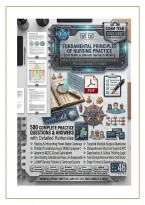
,ATI RN FUNDAMENTALS EDITION 11.0
2026 Complete Test Bank Chapters 1–58
500 Questions with Verified Answers & Rationales | Pass
Guaranteed – A+ Graded
DOMAIN 1: MANAGEMENT OF CARE (Q1–Q65)
Chapters 1–8: Health Care Delivery Systems; The Interprofessional Team; Ethical Responsibilities;
Legal Responsibilities; Information Technology; Delegation and Supervision; Nursing Process; Critical
Thinking and Clinical Judgment
Question 1
A nurse is discussing the purpose of regulatory agencies during a staff meeting. Which of the following
tasks should the nurse identify as the responsibility of state licensing boards?
A) Monitoring the quality of care provided by health care facilities
B) Ensuring that health care providers comply with regulations
C) Explaining the various types of health care coverage a client might have
D) Determining the scope of practice for health care providers
Correct Answer: B
Rationale: State licensing boards are responsible for ensuring that health care providers comply with
regulations, including licensure requirements and scope of practice standards. Monitoring quality of
care is typically the responsibility of accreditation bodies (e.g., The Joint Commission). Explaining health
care coverage is a financial/insurance function. Scope of practice is defined by state nurse practice acts
and regulatory boards.
Question 2
A nurse is explaining the various levels of health care services to a group of newly licensed nurses.
Which of the following examples of care or care settings should the nurse classify as tertiary care?
A) A community health center providing immunizations
B) An intensive care unit, oncology treatment center, and burn center
C) A provider's office performing routine physical examinations
D) A home health agency providing wound care
Correct Answer: B
,Rationale: Tertiary care involves specialized, highly technical services such as intensive care units,
oncology treatment centers, and burn centers. Primary care (A, C) focuses on health promotion,
prevention, and routine care. Secondary care involves acute care in hospitals. Home health (D) is often
considered primary or secondary care depending on the services provided.
Question 3
A nurse is preparing to administer a continuous enteral feeding through a small-bore nasogastric tube.
Which action is most critical to verify tube placement before initiating the feeding?
A) Aspirate gastric contents and test pH; a pH of 5.5 or lower confirms gastric placement
B) Injection of 30 mL of air while auscultating the epigastrium for a whooshing sound
C) Measurement of tube length from the nose to the earlobe to xiphoid process
D) Obtaining a chest radiograph and reviewing the report before feeding
Correct Answer: D
Rationale: For small-bore feeding tubes, radiographic confirmation is the only reliable method to verify
placement before initiating feedings. pH testing (A) is supportive but not definitive, especially if the
patient is on acid-suppressing medications. Auscultation (B) is no longer recommended due to
unreliability. External measurement (C) only estimates insertion length and does not confirm the tube
tip's location.
Question 4
Which ethical principle is most directly violated when a nurse fails to obtain informed consent before
performing a procedure, even though the procedure is beneficial and the patient would likely agree?
A) Autonomy
B) Beneficence
C) Justice
D) Veracity
Correct Answer: A
Rationale: Autonomy is the right of patients to make their own decisions about their care. Performing a
procedure without informed consent overrides the patient's right to self-determination, even if the
action is beneficial. Beneficence (B) is not violated because the action intends to benefit the patient.
Justice (C) relates to fairness in treatment distribution. Veracity (D) is about truthfulness.
Question 5
A nurse is using the SBAR (Situation-Background-Assessment-Recommendation) technique to report a
change in a patient's condition to a provider. Which statement is an example of the 'Recommendation'
component?
, A) The patient has become increasingly short of breath over the past hour
B) The patient has a history of heart failure and is on furosemide
C) I recommend that the patient receive a chest x-ray and arterial blood gas analysis
D) The patient's oxygen saturation is 88% on room air and crackles are audible in the bases
Correct Answer: C
Rationale: The 'Recommendation' component of SBAR states what the nurse believes is needed or what
action the provider should take. Option C clearly states a recommendation. Option A is Situation, B is
Background, and D is Assessment.
Question 6
A nurse is caring for a postoperative patient who is refusing to get out of bed despite ambulation orders.
The nurse tells the patient, "If you don't get up and walk, you'll develop pneumonia and blood clots."
This statement is an example of which ethical dilemma?
A) Beneficence
B) Nonmaleficence
C) Paternalism
D) Coercion
Correct Answer: D
Rationale: Coercion involves using threats or intimidation to force a patient to comply with treatment.
The nurse is threatening negative consequences to manipulate the patient's decision. Beneficence (A) is
doing good. Nonmaleficence (B) is avoiding harm. Paternalism (C) is making decisions for patients but
doesn't necessarily involve threats.
Question 7
A patient with stage IV colon cancer privately tells the nurse that he does not want to undergo another
round of chemotherapy, but his family is insisting he continue treatment. Which action by the nurse
BEST demonstrates patient advocacy?
A) Tell the family the patient has the right to make his own decisions
B) Facilitate a family meeting with the provider and social worker to clarify the patient's wishes and
treatment options, supporting the patient's autonomy
C) Encourage the patient to comply with his family's wishes
D) Refuse to discuss the issue because it is the provider's role
Correct Answer: B
Rationale: Advocacy means supporting the patient's right to make autonomous decisions. The nurse
facilitates communication among the patient, family, and provider to clarify values and ensure the
patient's wishes are respected. Telling the family directly (A) may bypass the patient's own voice.
Encouraging compliance (C) undermines autonomy. Refusing to discuss (D) abandons the advocacy role.